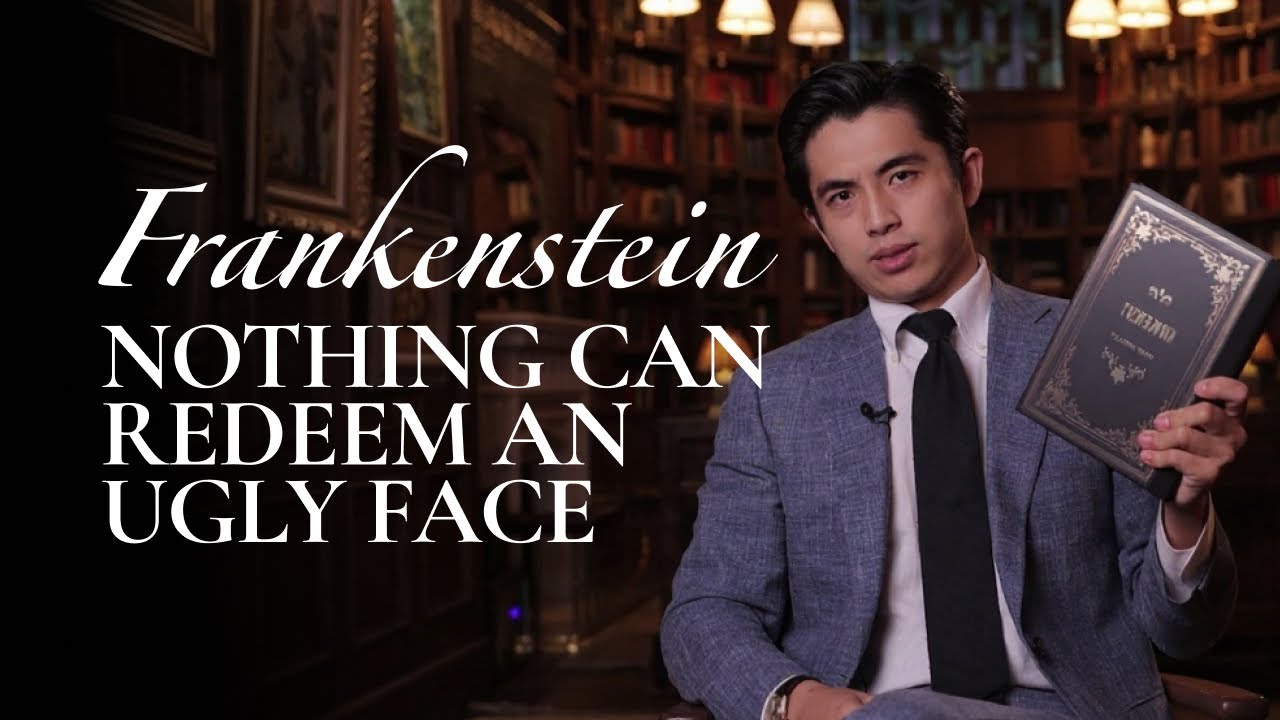
Mary Shelley’s Frankenstein challenges the comforting lie that “looks don’t matter” by showing how the creature’s defining ugliness connects to its eventual wickedness, raising the question of whether that link runs through social prejudice or an intrinsic bond between outer form and inner character
The creature’s arc: gentle soul turned murderous through rejection
The creature begins pure and ethical — rescuing a drowning girl, secretly cutting firewood and shoveling snow for a family, befriending the blind father who cannot see its hideousness
Only after repeated, appearance-based rejection — shot by the girl’s guardian, violently driven away by the family, abandoned by Victor — does it become resentful and vengeful
Even during its rampage the creature feels remorse for most murders, unlike classical villains such as Satan or Iago, suggesting an ethical compass that makes its corruption more puzzling
The social reading: prejudice and the hunger for recognition
The dominant interpretation holds that society’s lookism — not the creature’s nature — makes it evil; Victor abandons it, villagers attack it, the family drives it away, and only then does it become vengeful
This mirrors modern incel psychology: men who cannot obtain romantic recognition due to looks develop deep resentment that sometimes erupts in violence
The creature’s demand that Victor create an equally ugly female companion parallels the incel ideal of “looks matching” — both seek security in recognition from someone equally excluded
Mary Shelley’s Romantic and feminist context (her mother Mary Wollstonecraft) supports this view: both movements locate evil in changeable social prejudices rather than fixed nature
Two objections undermine a purely social account: the child’s instinctive horror at the creature suggests anti-ugliness reactions may be innate, not learned; the link between ugliness and wickedness might be intrinsic, not mediated by society
Physiognomy: the forgotten science linking face to character
Physiognomy — reading inner character from outer form, especially the face — was a respected science from antiquity through the 18th century, endorsed by Plato, attributed to Aristotle’s school, and popularized by Johann Lavater’s bestselling Essays on Physiognomy
Mary Shelley’s father William Godwin read Lavater; Shelley almost certainly knew it; its ideas shape Frankenstein’s character portrayals
The physiognomic reading: ugliness does not cause wickedness through social rejection; it reveals a latent wickedness already present, casting doubt on the creature’s self-narration of early purity and later remorse (Victor repeatedly warns the creature is eloquent and deceitful)
Elizabeth embodies the Lavaterian ideal: discovered among peasants, her “brightest living gold” hair, “clear and ample” brow, “cloudless” blue eyes, and expressive lips mark her as “heaven-sent”; she proves virtuous throughout and is later revealed as a Milanese nobleman’s abandoned daughter — the classical trope that noble appearance signals noble blood
Justine, the beautiful maidservant, provides a stronger test: wrongfully condemned and socially exiled like the creature, she remains gentle and ethical to the end, showing that injustice alone does not corrupt
Victor Frankenstein — handsome but cowardly and selfish — appears as a counterexample, but Lavater never claimed one-to-one determinism; outward appearance reveals essence, which can rarely be overcome by nurture
Socrates is the paradigmatic case: notoriously ugly, a face-reader diagnosed him as harboring all vices; Socrates agreed — “You know me, sir” — admitting youthful lust, gluttony, and viciousness; philosophical practice overcame his essence, illustrating how physiognomy handles exceptions
Modernity: we are the outliers who dismiss appearance
The episode does not claim physiognomy is scientifically valid, but notes that rejecting the beauty–goodness link makes modern Western thought an outlier — Greeks, Christians, and early moderns all treated beauty as a strong indicator of proper functioning and goodness
By treating appearance as mere surface disconnected from soul, contemporary society loses pathways to character formation that predecessors possessed
Frankenstein reminds us of the multiple mechanisms connecting ugliness and wickedness; the complementary question — how beauty elevates — is explored in the speaker’s lecture on Plato’s Symposium