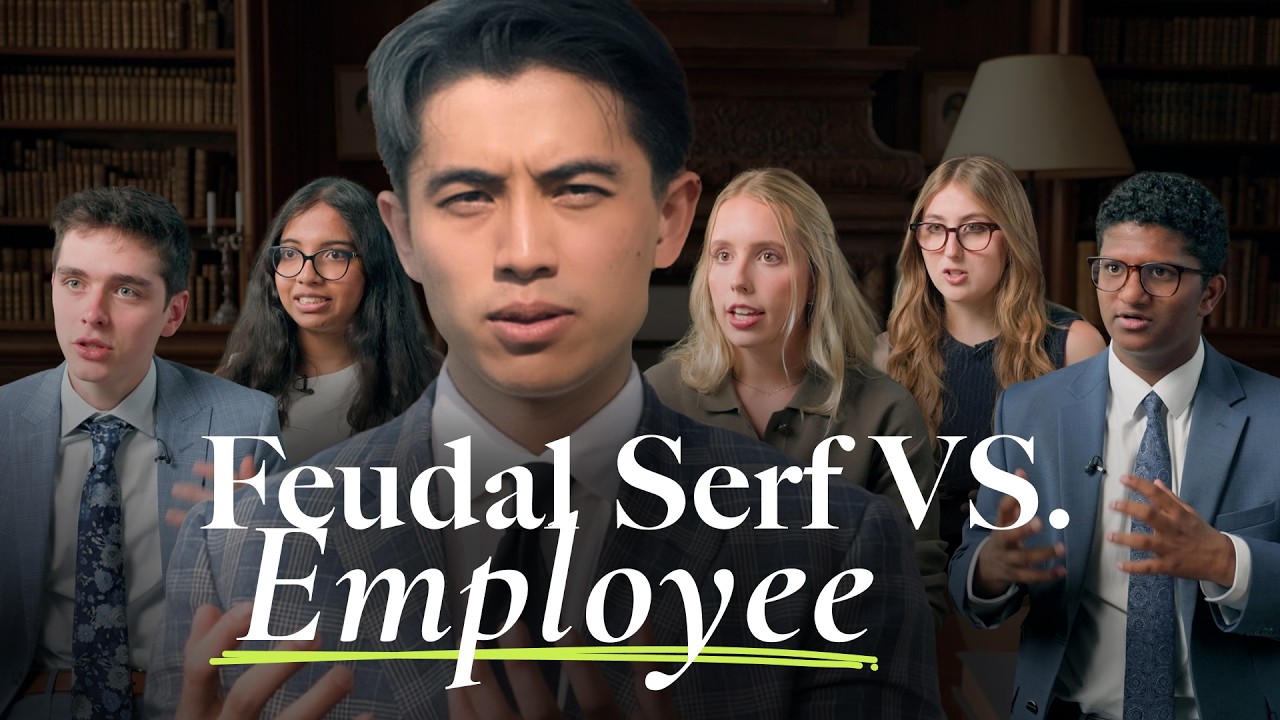
Five students from Alpha School — a U.S. private school where an AI tutor compresses core academics into two hours a day, freeing students for entrepreneurial ventures — join the host at the Château de Tocqueville in Normandy to read and discuss Democracy in America in the very rooms where Tocqueville wrote it, using the seminar to examine the origins, strengths, and limits of an American entrepreneurial education and to hear how the next generation thinks about AI, inequality, capitalism, and the future of work.
Capitalism, industry, and equality go hand in hand for Tocqueville because capitalism destroys aristocratic fixed status and creates mobility
In aristocracy, primogeniture ties family identity to undivided land; the eldest son inherits the estate intact, binding sentiment, memory, and ambition to its preservation across generations.
Democratic equal partition breaks that bond: land becomes a fungible asset, sold for liquid capital, and family spirit detaches from place.
The students note that modern families often go further — renting, refusing inheritance — so each generation must prove itself anew, turning equality of condition into equality of opportunity rather than outcome.
Aristocratic inheritance forms a character of leisure and tradition; democratic inheritance (or its absence) forms a character of restless industry, but also of constant comparison and dissatisfaction.
Tocqueville is ambivalent: his aristocratic taste delights in great men, but his reason acknowledges democracy’s justice
He confesses that the spectacle of democratic uniformity “saddens and chills” him; he prefers the greatness of aristocratic elites, yet recognizes this preference springs from his own limited vision.
Invoking God, he argues the Creator sees the whole race at once and wills the greatest well-being of all — equality is less elevated but more just, and that justice is its greatness.
The students debate which system they would choose: most prefer democracy for its freedom and mobility, but acknowledge the restlessness and status anxiety it breeds; one pushes back that aristocratic peasants likely felt jealousy too, though Tocqueville would say their self-conception as a different species made upward mobility unthinkable.
American education favors breadth and pragmatism over depth, mirroring the Chinese imperial-exam trap Tocqueville describes
U.S. college admissions weigh essays, activities, and academics equally, producing well-rounded entrepreneurs rather than narrow specialists; public schools, however, can flatten everyone to the same level, stifling individual excellence.
Tocqueville’s China example: imperial exams forced rote mastery of formulas without understanding principles; when conditions changed, the Chinese could not innovate because they had lost the science behind the methods.
The students recognize this in their own pre-Alpha schooling — high-stakes testing killed curiosity and creativity — and worry that an exclusively application-focused education eventually fails even at application.
Alpha’s entrepreneurial model tries to escape the theory-practice trap by making deep research the foundation of every venture
Each student’s “masterpiece” project follows three steps: become an expert through daily research, build an audience around that expertise, then build a product for the audience.
Tocqueville would be surprised by the depth (hour-long daily deep-research blocks), but might critique the pragmatic frame: even “knowledge for its own sake” becomes instrumental when it serves a venture.
The school’s semi-autonomous structure (students call it “autocratic” in a protective sense) gives them space to pursue theory without immediate market pressure — a modern echo of the aristocratic leisure Tocqueville thought necessary for high thought.
Modern technology and finance have made theory commercially valuable, but also envelop every pursuit in market gravity
In Tocqueville’s time, a merchant needed weeks of practical knowledge; today an AI engineer or macro investor needs years of advanced mathematics and theory — commerce has grown complex enough to require and reward deep knowledge.
Patents and IP law now let inventors capture value from pure theory, aligning heaven and earth.
The downside: nothing remains “holy”; even philosophy must fight the pull of optimization (thumbnails, hooks, monetization), creating a constant bait-and-switch between substance and audience capture.
Democratic art sacrifices form for accessibility and speed; theater becomes a spectacle driven by the pit, now mirrored in social media
Aristocratic art follows tradition and form, aimed at a cultivated elite; democratic art is energetic, relatable, fast, and ruled by the audience — the pit controls the box.
One student, developing a teen-performed, social-media-driven musical, navigates the tension: she uses viral hooks as “bait” to draw audiences into substantive work, a deliberate compromise Tocqueville foresaw — great artists in democracy must negotiate with the democratic mechanism.
She sees social media as today’s theater: the most accessible, fast, relatable entertainment, satisfying but often substance-poor.
Tyranny of the majority in democracy targets the soul, not the body — today it looks like cancel culture and algorithmic echo chambers
Tocqueville: despotism struck the body to reach the soul; democratic tyranny leaves the body alone and goes straight for the soul — social exile, loss of esteem, “worse than death.”
Students identify cancel culture as the modern form: no martyr’s glory, just hatred then oblivion; the soul cannot rise because the canceled are forgotten, not remembered.
Social media fragments the majority into many “mini-majorities” (echo chambers), letting the canceled migrate to a new tribe — a feudalization of opinion where each group imposes its own orthodoxy.
Yet an Overton window persists: no major party challenges republican form or popular sovereignty, so the range of thinkable thought remains historically narrow.
Soft despotism — a paternalistic, nudging state that rocks citizens to death with convenience — finds a new engine in AI
Tocqueville feared a mild despotism that degrades citizens by relieving them of the burden of thinking and acting: welfare, administrative micromanagement, loss of local participation.
Students compare it to WALL-E: not the bloody conflict of Julius Caesar (where passion drives action), but apathetic consumption of frictionless pleasure — autonomy atrophies because convenience removes the need to exert effort.
AI accelerates this: students outsource thinking to models that “want to help” but also erase the struggle that builds judgment; unlike GPS (which only erodes map-reading), AI threatens every cognitive domain at once.
The host frames the students as Tocqueville’s “Americans” for the AI age: they are the society already learning to self-govern with the new power, while the rest of the world is still in the chaotic French-revolution phase.
Alpha’s structured AI integration offers a model for using the technology to reclaim freedom and theory rather than surrender to soft despotism
The school’s ed-tech team acts as “founding fathers,” building guardrails (curated tutors, hackathons, research blocks) so students consume AI as a tool, not an oracle.
Freed from rote work, students gain time for hard reading, conversation, and deep projects — reintroducing the “heaven” Tocqueville thought democracy lost.
One student warns that even with good tools, a portion of life must be lived as if AI did not exist — memorizing, wrestling with difficult texts unaided — to preserve the connection between mind and knowledge that Socrates feared writing would sever.
The seminar itself — reading Tocqueville in his chateau, debating his insights against their lived experience — exemplifies the hybrid autonomy they aim to cultivate: using the machine to clear space for the human.