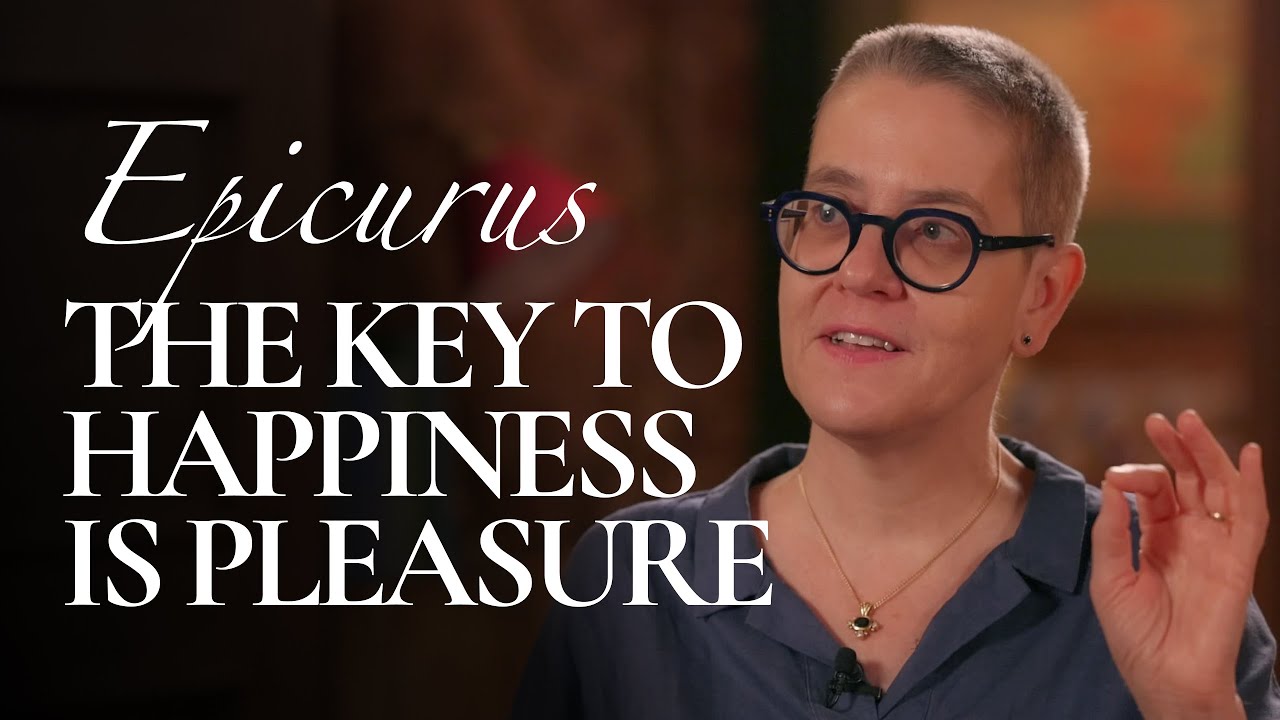
This episode explores the paradox of Roman Epicureanism: a philosophy whose core doctrine is withdrawal from political life became surprisingly popular among the political elite of the late Roman Republic, including figures like Caesar, Cassius, and Piso. Classicist Katharina Volk explains Epicurean doctrine, examines how prominent Romans reconciled (or failed to reconcile) it with political ambition, and contrasts it with Stoic and traditional Roman justifications for civic engagement.
Epicurean doctrine and its political implications
Epicureanism identifies pleasure as the highest good (summum bonum), but defines pleasure primarily as the absence of physical pain and mental disturbance (ataraxia), not sensual indulgence.
Everyday pleasures (food, drink, sex, beautiful sights) are permitted but secondary; the key is adjusting expectations so that one desires only what is easily obtainable.
Friendship is highly valued but creates a theoretical tension: if the only good is pleasure, friendship must be instrumental to it, yet genuine friendship seems to require valuing the friend for their own sake.
Epicureans advise withdrawal from politics, marriage, and public ambition because these generate anxiety, danger, and unfulfillable desires; the ideal is a hidden, simple life among like-minded friends.
They participate in civic rituals to avoid trouble but do not believe the gods intervene in human affairs.
An “emergency clause” allows political action in a crisis, but critics (like Cicero) mock the idea that lifelong non-participants could suddenly save the state.
Atticus: the Epicurean financier who survived by befriending everyone
Titus Pomponius Atticus, an equestrian businessman and moneylender, lived in Athens (hence “Atticus”) and was a devoted Epicurean and close friend of Cicero.
He refused to enter politics despite his wealth and connections, embodying the Epicurean ideal of a quiet, self-sufficient life.
During the civil wars, he financially supported opposing factions (Brutus and Cassius, Mark Antony, Cicero) behind the scenes, preserving his safety and influence without holding office.
His survival and behind-the-scenes role foreshadowed the imperial-era pattern of wealthy equestrians wielding power as courtiers and advisers (e.g., Maecenas) rather than as magistrates.
Why some Epicureans entered politics anyway
Several non-exclusive explanations exist for why Roman elites adopted Epicureanism while remaining politically active.
Selective adoption: individuals embraced the physics, ethics of simplicity, or fear-of-death teachings while ignoring the political quietism — just as religious adherents often pick and choose doctrines.
Patron-dependent philosophers: Epicurean teachers dependent on Roman patrons may have softened the anti-political message to suit their audience.
Family obligation: a senator born into a political dynasty could not plausibly retire to a commune without disgrace; the hedonistic calculus might favor staying in place over the disruption of withdrawal.
Emergency justification: in a collapsing Republic, one could argue that political action restores the stable conditions necessary for ataraxia.
Cassius (in a surviving letter) defends an Epicurean acting as a peacemaker, arguing that virtue serves pleasure by securing peace.
A similar logic could justify tyrannicide: removing a destabilizing dictator restores the mental tranquility that is the Epicurean goal.
Conditioned desire for glory: if ambition is so deeply ingrained that suppressing it causes more disturbance than pursuing it, the Epicurean might rationally choose to satisfy the desire — though this contradicts the school’s explicit warnings against glory-seeking.
Caesar and Cassius as alleged Epicurean politicians
Cassius (one of Caesar’s assassins) is identified as an Epicurean in the sources; his lost justification for the assassination likely invoked the emergency clause: Caesar’s dominance made peace and ataraxia impossible, so killing him served pleasure.
Caesar reportedly said late in life that he had “lived enough for both nature and glory.”
“Lived enough for nature” echoes the Epicurean view that a complete life needs no extension and death is not to be feared — the satisfied party-goer who leaves voluntarily.
“Glory” is un-Epicurean, but a philosophy that devalues both life and death might make risky political gambles easier to undertake.
Piso and the clash between Epicurean quietism and Roman honor culture
Lucius Calpurnius Piso Caesoninus (Caesar’s father-in-law, consul 58 BCE) rejected a triumph — the highest military honor — and later tried to decline the censorship.
Cicero attacks him as a “criminal, plague, stain” for lacking ambition, revealing how suspect lack of desire for glory was in Roman eyes.
Piso’s career (moderate politician, peacemaker before the civil war) may model a distinctively “Roman Epicurean” style: do the job, avoid unnecessary honors and enemies, prioritize stability.
Traditional Roman and Stoic justifications for political engagement
All other Hellenistic schools (Stoics, Peripatetics, Academics) held that humans are naturally social and political; virtue is exercised in the polis, so engagement is a duty, not a choice.
This meshed seamlessly with Roman mos maiorum: elite families simply did politics as their hereditary role, blending duty, glory, and self-interest without needing a philosophical defense.
Cicero attempted to philosophically refine Roman glory: true glory serves the res publica, not private ambition; Caesar’s glory was therefore “false” because it threatened the Republic.
He similarly redefined friendship: a friend who asks you to betray the Republic is no true friend — a move that justified Brutus and Cassius turning on Caesar.
Epicureanism’s later fate and modern echoes
Epicureanism persisted in antiquity but never rivaled Stoicism’s imperial popularity; its atomism, mortal soul, and indifferent gods made it anathema to Christianity.
It resurfaced in the early modern period (Lucretius’s rediscovery, atomism in natural philosophy, 18th-century freethought) but never became a mass movement.
Volk suggests modern Western life is implicitly Epicurean: materialist metaphysics, focus on private pleasure and friendship, withdrawal from civic engagement — though without the ancient minimalism that restrained desire.