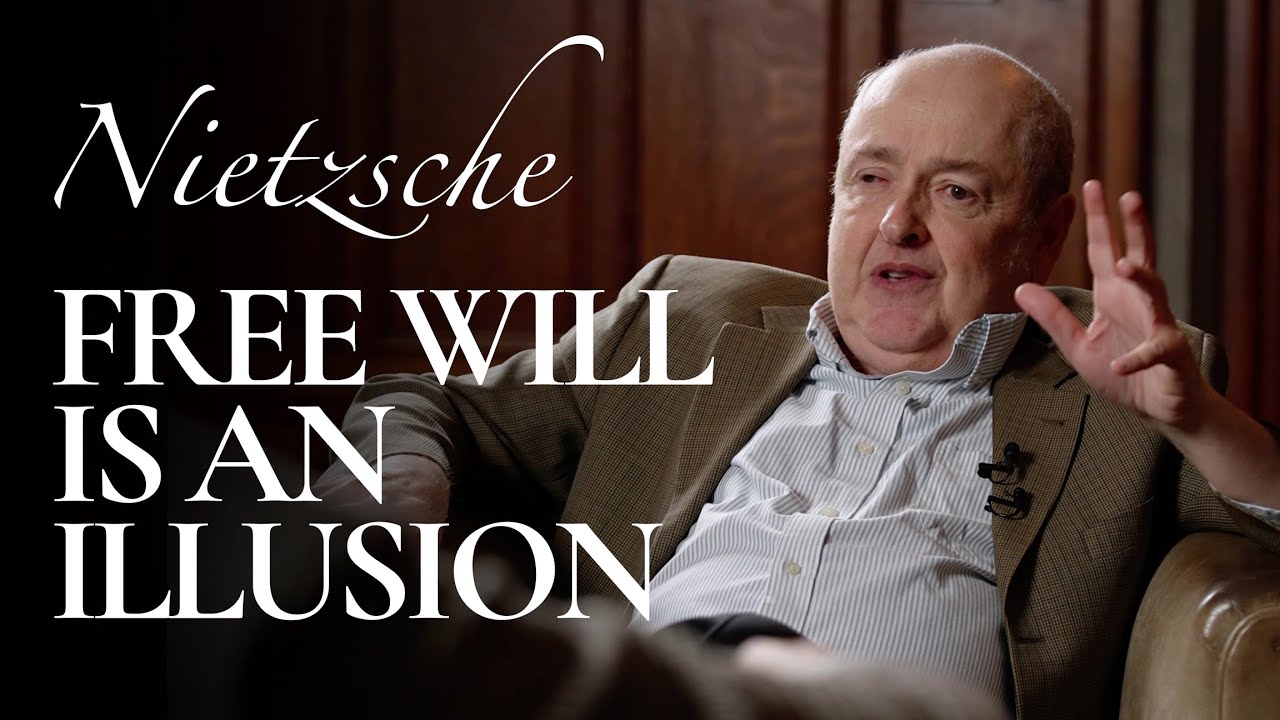
This episode is an interview with Professor Brian Leiter, a leading Nietzsche scholar, on Nietzsche’s critique of free will and its practical implications. Nietzsche rejects free will entirely — not on metaphysical or theological grounds, but because physiology, unconscious drives, and heredity determine our actions. Leiter explains why this view is central to Nietzsche’s revaluation of values, how it differs from both compatibilist and incompatibilist positions, the arguments Nietzsche offers (genealogical, grammatical, phenomenological, and empirical), and why giving up free will can be freeing rather than paralyzing: it replaces self-creation with self-discovery, reduces moralizing blame, and allows one to “become who you are.”
Nietzsche’s Central Project: The Critique of Free Will
Free will is a metaphysical ground of Judeo-Christian morality: it justifies blame, punishment, and moral responsibility, which Nietzsche aims to undermine.
Nietzsche’s rejection is tied to his naturalistic picture of the mind: humans are embodied beings; conscious life is superficial; unconscious drives do the real explanatory work.
We discover who we are by observing our behavior, not by privileged introspection — the bulk of mental life is unconscious.
The Two Main Philosophical Positions on Free Will — and Why Nietzsche Rejects Both
Incompatibilism holds that free will requires the will to stand outside the causal order (self-caused). Nietzsche rejects this as supernatural nonsense — only God could be self-caused.
Compatibilism (Hume/Frankfurt) says freedom is acting on desires you identify with, even if determined. Nietzsche objects: (1) those desires are determined by factors beyond your control; (2) we don’t actually know which drive we’re acting on — we confabulate stories.
Reasons-responsive compatibilism appeals to conscious reasoning. Nietzsche sees conscious reasoning as epiphenomenal — not what actually explains action.
Nietzsche’s Arguments Against Free Will
1. Genealogical Suspicion: Free Will as an Invention to Justify Punishment
Free will is attractive because it licenses justified punishment: “you chose wrong, so I may be cruel to you.”
The Genealogy parable of the birds of prey and the lambs: birds eat lambs by nature; lambs invent “evil” to condemn them. Punishing the bird for its nature is absurd.
The inverse incentive also exists: people exaggerate their own agency to claim credit and praise (e.g., “innovation” narratives in tech, art, academia).
Nietzsche’s own autobiography (Ecce Homo) mocks this: chapter titles like “Why I Am So Clever” are answered with “it was just luck / a stroke of fate.”
2. Grammatical Seduction: Language Creates the Illusion of a “Will”
Indo-Germanic grammar requires a subject for active verbs (“I hit the ball”). This grammatical fact seduces us into positing a substantial “I” or “will” as the cause.
The subject is a linguistic artifact, not a metaphysical entity.
3. Phenomenological Deconstruction: The Experience of Willing Is Unreliable
Introspection is unreliable (empirical psychology: Ouija board effects, confabulation). Nietzsche anticipated this skepticism.
When we raise an arm, why identify with the “commanding will” rather than the “commanded arm”? Because it produces a feeling of power — a debunking explanation.
Thoughts “come when they want, not when I want.” Even if a thought precedes action, if the thought was not willed, the action isn’t freely willed either.
The occasional experience of “working through an argument” is rare; most thoughts arise unbidden. This already shrinks the domain of putative free will.
Consciousness evolved for social coordination via language, not for accurate self-knowledge. It flattens and falsifies the rich unconscious mental life.
4. Physiology, Unconscious Drives, and Heredity: The Positive Evidence
The mind is a bundle of unconscious drives seeking expression. This picture explains observable behavior better than conscious reasoning models.
Behavioral genetics supports this: adoption studies (criminality variance 59% explained by biological parents vs. 19% adoptive parents) and Minnesota twin studies (separated twins share personality traits: extraversion, neuroticism, etc.).
A psychological “core” is present at birth; environment shapes expression but not fundamental type (e.g., a conformist in LA vs. a Muslim country veils daughters — same disposition, different manifestation).
Schopenhauer influenced Nietzsche: “children arrive with a character and it just unfolds.”
Reflective consciousness (moral deliberation) is epiphenomenal — its function is social display and coordination, not causal control.
The Interviewer’s Skeptical Position and Leiter’s Response
Interviewer: physics is uncertain (quantum, simulation hypotheses, Kantian atemporality); no conclusive theory of causation exists; therefore default to phenomenology.
Leiter: Nietzsche’s arguments don’t depend on Newtonian vs. quantum physics — only on ordinary causal determination. Radical skepticism about metaphysics doesn’t rescue free will; it just leaves you with no grounds for believing in it.
Practical Prescriptions: How to Live Without Free Will
Legal and Moral Implications
Contemporary philosopher Derk Pereboom (Nietzschean view) proposes punishment as quarantine: certain people are criminal by nature. Leiter thinks this is dangerous policy; criminal law’s “fiction” of responsibility works better for public order.
The real change is in how we view individuals: less moralizing, less blame and vindictiveness. No one is “evil” in a blameworthy sense; they act by nature.
Admiration without desert: admire Beethoven or Nietzsche without thinking they freely chose greatness — it was a “lucky stroke of nature.” Praise and blame are symmetrical; both lose their desert basis.
First-Person Perspective: The Necessary Illusion
From the first-person standpoint, the illusion of free will is inescapable and functionally necessary for agency. You cannot think of yourself the way you think of your dog.
Great figures (Caesar, Alexander) often felt fate/destiny, not free choice — “this is what I must do.” Absolute certainty of purpose, not agency, drove them.
”Become Who You Are”: Self-Discovery Over Self-Creation
“One becomes what one is without having the slightest idea what one is.” Self-knowledge is discovery through observing one’s life — choices, relationships, patterns — not introspection.
Parenting and education: observe the child’s arrived character; don’t force foreign ideals. Be alert to proclivities and capacities.
Past actions (repeated) become strong evidence of deep nature. Change is limited; the framework makes us judge people more harshly based on consistent patterns, not as “one-off choices.”
Practical takeaway: stop trying to be an abstract ideal; live a life suitable to your type.