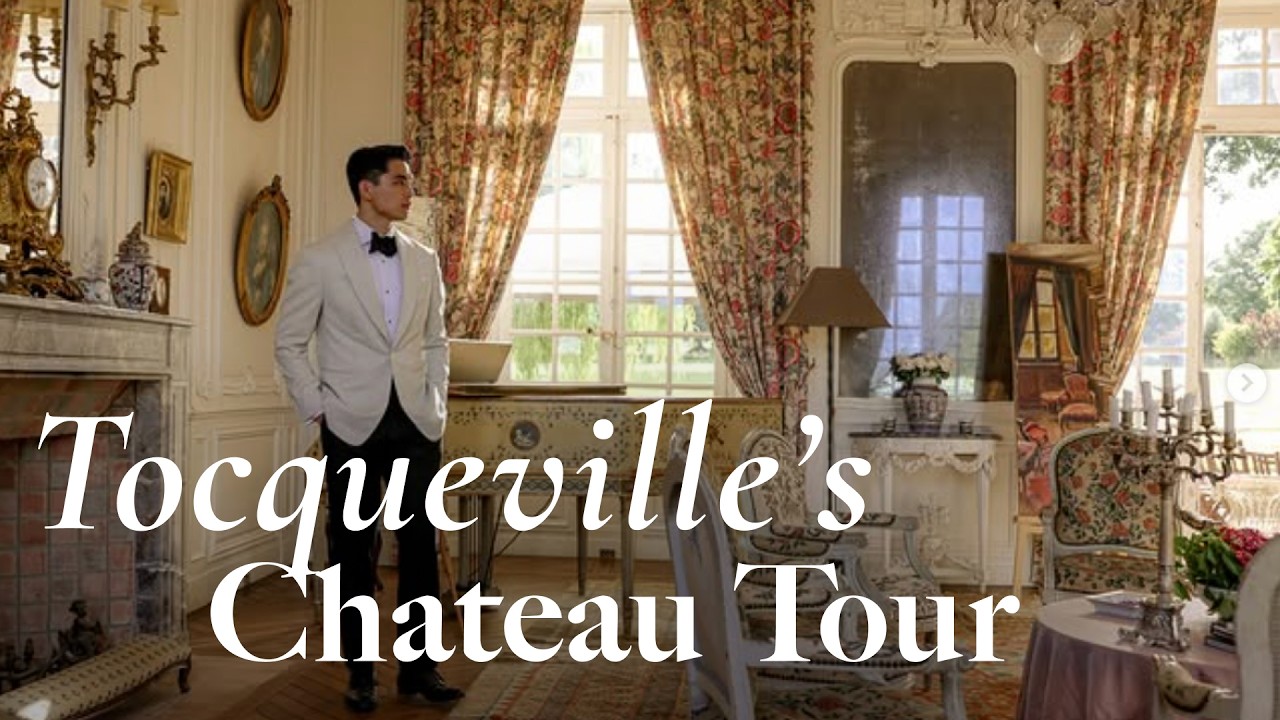
This episode documents a guided tour of the Château de Tocqueville in Normandy — the ancestral home where Alexis de Tocqueville wrote Democracy in America — led by his living descendant (also named Alexis de Tocqueville) for a group of Alpha School students on a transatlantic grand tour organized by Alpha School, which uses AI tutors to compress K–12 academics into two hours daily.
Tocqueville’s Office — The Intellectual Workshop
The office is preserved exactly as it was when Tocqueville worked there; the wing behind it burned in 1954 but this room survived intact.
Double windows were installed to give Tocqueville the quiet concentration he required for writing.
The shelves hold his father’s library: Greek classics, Enlightenment encyclopedists (Voltaire, Rousseau, Montesquieu), Pascal, and a portrait of Vauban — Louis XIV’s military engineer who fortified France’s borders for 52 years and was a Tocqueville ancestor.
A gift volume commemorates Tocqueville’s first major work, The Penitentiary System in America; another rare complete set documents the scholars who accompanied Napoleon’s 1797 Egyptian campaign, with engravings of temples, the Nile, and antiquities.
Tocqueville’s literary style was influenced by his uncle Chateaubriand, founder of French Romanticism (Atala), though Tocqueville quickly turned from fiction to democratic theory.
Entrance Hall — Heraldry and Family Continuity
The Tocqueville coat of arms bears the motto Virtus Sola Nobilitat (“Virtue alone ennobles” / “Faith will always prevail”).
Surrounding shields display the arms of women who married into the family from 1380 onward, ending with the current generation.
Because the line produced only daughters for a time, the elder brother (who inherited the château) petitioned the Conseil d’État to reclaim the Tocqueville name so it would not die out; the younger Alexis declined, joking that “Alexis de Tocqueville would be ridiculous.”
Two portraits depict ancestors who served as governors of Normandy.
Dining Room — The Solomon Fireplace
The fireplace depicts Old Testament scenes from the life of King Solomon: the construction of the Temple and the famous judgment (the baby threatened with division).
The guide uses the fireplace as a teaching moment, drawing the students into close observation of the iconography.
First Living Room — Revolution’s Shadow on the Family
A portrait shows Tocqueville’s father (a royal prefect) speaking to 15- or 16-year-old Alexis.
The father’s hair is white despite his youthful face: both parents were imprisoned for nine months during the Terror; five of nine relatives entered the guillotine, and the Tocqueville parents were two days from execution when Robespierre fell.
The mother never recovered, sinking into depression; the father’s hair turned white from the ordeal — a visceral family trauma that shaped Tocqueville’s lifelong preoccupation with revolution, democracy, and the fragility of liberty.
Second Living Room — Light and Lineage
This room has five windows versus two in the first, making it far brighter — a deliberate architectural distinction.
Two portraits stand out: Alexis’s brother Édouard (from whom the current family descends) and another key ancestor.
The contrast between the two salons reflects evolving tastes and the family’s shifting fortunes across generations.
Grounds and Towers — Architecture as Palimpsest
The oldest core (mid-17th century) sits between two towers; the square tower was added in the late 19th century, funded by a wealthy marriage.
An 18th-century pediment displays the Tocqueville arms; carriage buildings and stables reflect the estate’s working-agriculture past.
A statue of Alexis de Tocqueville stands in the courtyard; the Norman-style half-timbered buildings are characteristic of the region.
The Latin lintel inscription Hospes ingredere bonis vultibus arride (“Guest, enter; good faces will welcome you”) contrasts with Dante’s Abandon all hope — a deliberate note of hospitality over menace.
Pigeon House — Feudal Power Made Visible
The pigeonnier’s 3,000 nesting holes and its size signaled the lord’s power; pigeons were raised for sport shooting, not messaging — the primary aristocratic pastime under the ancien régime.
The central bondo (stone pillar) symbolized low justice: the lord’s right to adjudicate minor local disputes.
During the Revolution, pigeonniers were typically destroyed as feudal symbols; here, only the roof was burned — a sign the family was locally respected.
Lake and Gardens — English Romanticism vs. French Order
The lake was commissioned by Tocqueville’s English wife, who preferred the “English garden” style: long, naturalistic views with water features, not the rigidly domesticated geometry of French gardens (Versailles, Vaux-le-Vicomte).
She managed all domestic affairs; the guide notes this gendered division of estate governance.
A lone swan remains — its mate was taken by a fox.
Palm trees grow naturally on the grounds, sustained by the Gulf Stream’s microclimate along the Norman coast — not imported, but native to this latitude.
Storms periodically fell trees; each generation replants: the current owner’s parents planted the avenue’s now-mature trees; his brother recently added new plantings.
The guide connects this stewardship to the tour’s intellectual theme: primogeniture (eldest-son inheritance) preserved the estate intact across generations, making it a microcosm of the aristocratic continuity Tocqueville contrasted with democratic fragmentation.
Courtyard and Stables — Estate Origins and Wartime Survival
The 18th-century courtyard with its three arches exemplifies period architecture; stables and agricultural buildings supported the working domain.
The family’s Norman ancestor (Clarel) accompanied William the Conqueror to England in 1066, but the current land was acquired via a 17th-century estate swap.
In WWII, a German naval admiral occupied the château — he drank the wine but caused no structural damage; he reportedly wore Tocqueville’s Académie française ceremonial sword as a curiosity.
The guide reflects that the estate shaped Tocqueville’s “melancholy and energy” — he walked the grounds talking with peasants to escape political writing’s intensity.
Back of the Château — Defensive Origins and Schist Roofs
The oldest section (between the two towers) has tiny windows designed for 17th-century defense against bandits and raiders — “the olden-time Ring camera.”
The roof’s distinctive wave pattern and its material — schist, a heavy, expensive stone — are highlighted; its color and durability surpass common slate.
The guide notes that attacks were a real, recurring threat in an era of widespread poverty and lawlessness, not merely theoretical.