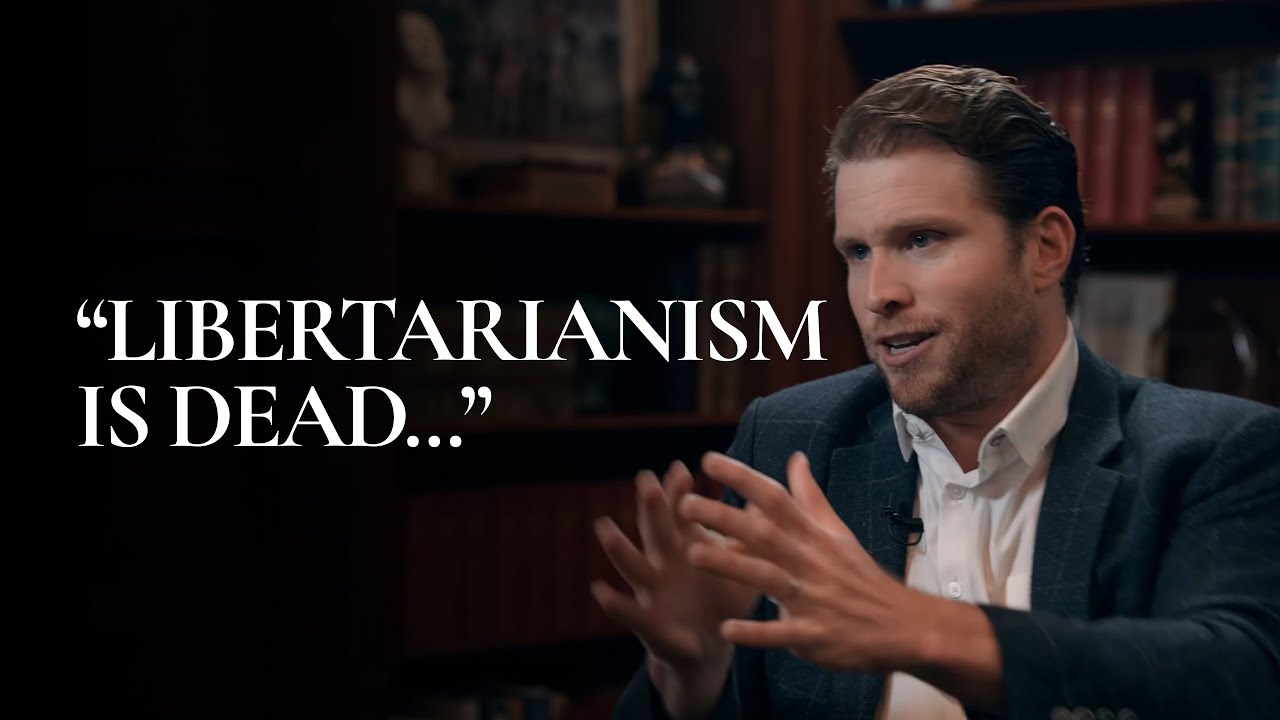
This episode features Joe Lonsdale — co-founder of Palantir, founder of the Cicero Institute and University of Austin — explaining the classical political philosophy that animates his ventures, arguing that America’s dysfunction stems from the loss of a natural aristocratic body and the rise of an unaccountable bureaucracy, and showing how he applies Ciceronian pragmatism to reform policy through incentive alignment, competition, and technology that embeds liberty-preserving guardrails.
The Missing Aristocratic Body and Cicero’s Mixed Constitution
Lonsdale argues that a healthy republic requires three balanced elements: a popular house (one person, one vote), an executive, and a natural aristocratic senate that represents competence and duty rather than mere heredity.
He draws on Cicero’s De Re Publica and the British model (House of Lords, Commons, monarchy) which the American founders adapted (Senate, House, President), but contends the 17th Amendment and the rise of the administrative state destroyed the aristocratic check.
A natural aristocracy, in his view, is not inherited privilege but a rotating elite selected by merit — e.g., top taxpayers, successful entrepreneurs, military leaders — who have skin in the game and a duty to govern.
Without this body, politics collapses into a “lowest common denominator” contest between populist factions, while real power shifts to an unelected, unaccountable bureaucracy.
Bureaucracy as the Core Enemy: The Pendleton Act and Its Consequences
Lonsdale identifies bureaucracy — defined by lack of accountability, competence, and drive to build — as the primary threat to civilization, worse than foreign adversaries or “wokeism.”
He traces the modern civil service to the 1883 Pendleton Act, which replaced the spoils system with merit exams; for a century this produced competent administrators (winning wars, reaching the moon).
Exams were abolished in the 1970s because they produced racially disparate outcomes; the result is a maximally large, maximally incompetent state that protects special interests (contractors, NGOs, incumbent firms) who benefit from sclerosis.
Contraction only happens under existential pressure (war, fiscal crisis); America’s wealth and reserve-currency status delay that reckoning, allowing “comically broken” government to persist.
Cicero Institute’s Method: Incentives, Accountability, and Ciceronian Pragmatism
The Institute operates on two tracks: a 501(c)(3) research side that defines the ideal policy end-state, and a 501(c)(4) action side (Cicero Action) that pursues the art of the possible in state legislatures.
Core mechanism: replace input-based funding with outcome-based incentives so that government programs mimic market discipline.
Vocational schools in Texas funded by graduates’ salaries → schools partner with employers, teach relevant skills.
Prisons: profit should flow only from hitting recidivism and employment targets, not from headcount.
Homelessness: the “Housing First” vulnerability index perversely rewards addiction, crime, and truancy with priority housing; Cicero pushes “Treatment First” models with accountability.
The approach is neither pure libertarian abolition nor status-quo management: apply liberty’s values (competition, transparency, skin in the game) inside existing programs to make them 10× more functional.
Competition and Monopsony: Why One Buyer Is as Dangerous as One Seller
Lonsdale emphasizes monopsony power — a single government buyer — as a root cause of stagnation in defense procurement and NIH research funding.
With one buyer, there is no competitive pressure to adopt better technology; with multiple competing buyers (e.g., separate acquisition authorities in CIA, DIU, SOCOM), laggards look foolish and lose budget.
NIH operates like a mafia: one centralized, risk-averse pathway that funds famous labs; alternative models (Damon Runyon’s scientist-nominated grants) show 50–100× better results per dollar but are blocked by bureaucratic capture.
Solution: pluralistic funding mechanisms, competing authorities, and constant challenge — the same dialectic that makes markets and science work.
Palantir: Embedding Liberty in the Architecture of Security
Palantir was founded to solve the post-9/11 dilemma: the state needs data to stop Islamist terrorism, but unchecked surveillance erodes liberty.
The answer was not less data but a permissioning layer: audit trails, role-based access, sharing rules, and civil-liberties overlays so analysts see only what they are legally authorized to see.
This reflects a Girardian insight: fighting monsters risks becoming them; technology can transcend the trade-off by building guardrails into the tool itself.
Lonsdale acknowledges no system is future-proof (the Palantir stone in Lord of the Rings falls to Sauron), but argues the alternative — letting attacks succeed to teach a lesson — is morally indefensible; the founders’ values and the software’s design are the best durable safeguard.
Motivation: Virtue, Duty, and the Philosopher-Builder
Lonsdale rejects the Augustinian critique that greatness is disguised vanity; he sees virtuous leadership as necessary to stop evil (Nazis, Islamists, corrupt bureaucracies) and build cures, prosperity, and defense.
He invokes Xenophon’s Cyropaedia (Cyrus the Great) as the lost Western ideal: the leader who combines mercy, discipline, and competence — contrasted with the modern default of Machiavellian cynicism.
Duty calls him to engage (NIH, FDA, DOD reform, AI cost-disease battles) rather than retreat to a private life; he views ease as a trap that lets special interests win.
The “philosopher-builder” archetype — first-principles thinkers who hack institutions like coders hack systems — unifies his work: philosophy supplies the framework, building supplies the feedback loop.