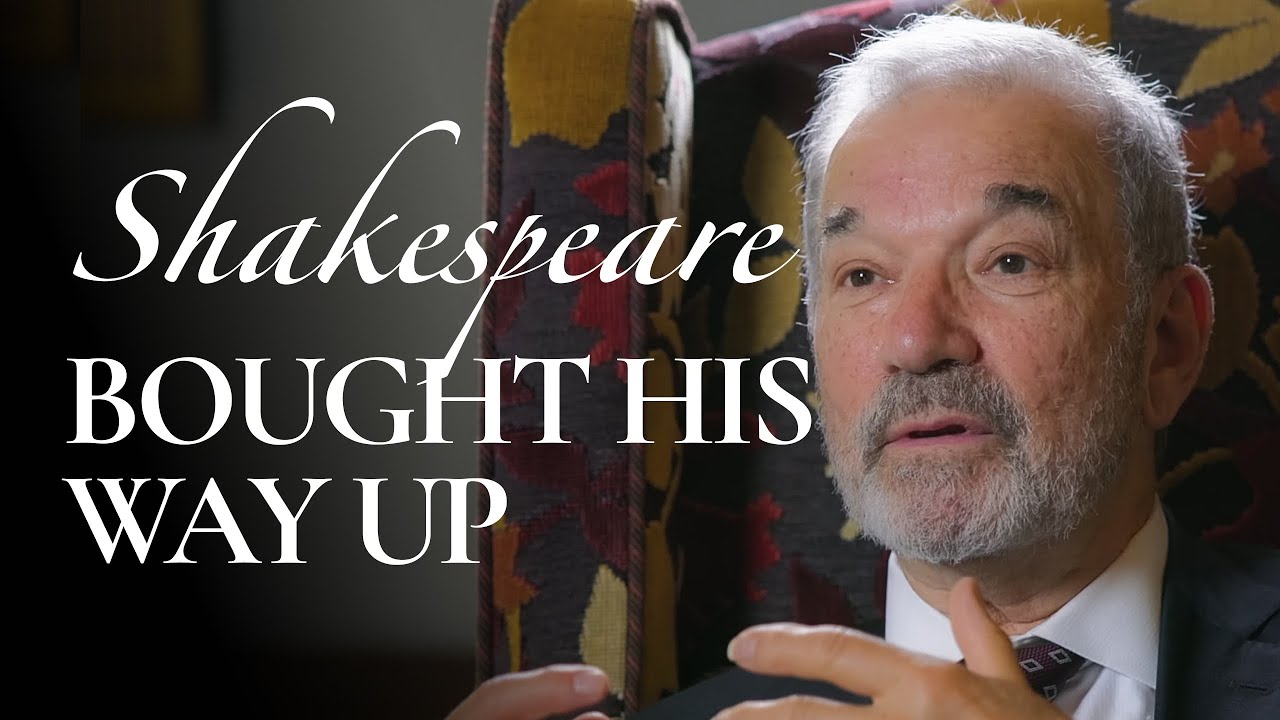
This episode is an interview with Harvard Shakespeare scholar Stephen Greenblatt about Shakespeare’s lifelong pursuit of social status, exploring how the playwright bought his way into the gentry, how his profession straddled low and high culture, how his plays treat ambition and mobility, and what his contradictions reveal about human nature.
Shakespeare’s Social Ambition and the Coat of Arms
Shakespeare was born a commoner in 1564 to John Shakespeare, a glover and alderman on an upward trajectory, and Mary Arden, from a once-noble family that had fallen into obscurity.
John Shakespeare applied for a coat of arms to make the family gentlemen, but financial ruin halted the process; roughly a decade later, Shakespeare himself used his theatrical earnings to complete the application and secure gentleman status for himself and his descendants.
In Elizabethan England, the gentleman-commoner divide carried legal weight: gentlemen were entitled to deference (hats off, standing when they entered), could be tried in ecclesiastical courts (avoiding death penalties), and the distinction could literally mean life or death — as when Christopher Marlowe, a university-educated gentleman, escaped execution for counterfeiting by claiming his status.
The College of Heralds both facilitated and policed this mobility: they verified claims but also resisted dubious applicants; one herald later objected that “Shakespeare the player” should never have received arms, since actors ranked near the bottom of the social order.
The grant fabricated or “enhanced” a genealogy linking Shakespeare to respectable ancestors, and the motto Non sans droit (“Not without right”) was recorded by a clerk as Non, sans droit (“No, without right”) — a possible sarcastic jab.
Ben Jonson later mocked the episode in a play where a rustic buffoon pays 30 pounds for a ridiculous coat of arms and is offered the motto “Not without mustard”; Shakespeare likely performed in that play and heard the joke onstage.
The Profession of Acting: Then and Now
In Shakespeare’s time, the player was a low-status person impersonating high-status characters onstage, while sumptuary laws forbade actors from wearing noble clothing offstage; today, high-status actors often play low-status characters, and clothing no longer marks class visibly.
Actors like Richard Burbage and Edward Alleyn were famous and wealthy, but the profession was considered tainted — close to prostitution — because performing before a jeering, garlic-chewing crowd was seen as degrading.
The shift reflects a broader social transformation: Western societies erased official markers of rank (sumptuary laws, distinct dress), making inequality less visible but not less real.
Social Ambition in Shakespeare’s Plays
Shakespeare’s plays rarely depict genuine low-to-high mobility; characters who rise (Viola in Twelfth Night, the lost princes in Cymbeline) are revealed to have been noble all along — a conservative “return to station” rather than an exceeding of it.
Ambition for power among equals (Caesar, Brutus, Cassius) is portrayed as dangerous and destabilizing, reflecting Elizabethan court factionalism where Elizabeth I balanced rival nobles to prevent any one from rising too far.
Prince Hal in the Henry IV plays and Henry V embodies the ideal pattern: the heir descends to the tavern world, then rises back to his rightful place and beyond — loss and recovery, not invention of a new self.
This pattern mirrors Shakespeare’s own life: paternal loss (father’s ruined prospects) and recovery (Shakespeare’s restoration), plus maternal restoration of the Arden name.
Shakespeare’s Motivations: Pleasure, Glory, and Power
In the plays, Shakespeare articulates a modest goal: “to please” the audience (the clown in Twelfth Night, Prospero’s epilogue in The Tempest), while the sonnets make grandiose claims of immortalizing verse — a genre-appropriate difference, since plays were seen as ephemeral entertainment.
Greenblatt argues Shakespeare understood theater as a dangerous, manipulative power: the ability to make crowds cry, laugh, love, or hate (exemplified by Antony in Julius Caesar and Iago in Othello) was necromantic, demonic, and morally suspect — not a vehicle for unambiguous moral improvement.
Shakespeare knew his greatest gifts lay in theatrical plotting and impersonation, not in abstract philosophy; he invested his deepest energies in the stage while remaining wary of its power.
Double Consciousness: Contradiction as Truth
Shakespeare embodied contradictions: he bought a coat of arms while mocking social pretension, invested in real estate while ridiculing entrepreneurs like himself in Hamlet, and devoted his life to theater while laughing at its artifice.
Greenblatt defends this as “double consciousness” — not hypocrisy but fidelity to human experience, which is inherently inconsistent; Socrates and Plato demanded coherence, but Shakespeare (and Christianity, with its God-man paradox) embraces the coexistence of opposites.
The interviewer challenges this with a Jefferson analogy (writing emancipation while owning slaves); Greenblatt responds that we inherit contradictory legacies and must process them with forgiveness and self-awareness rather than simple condemnation.