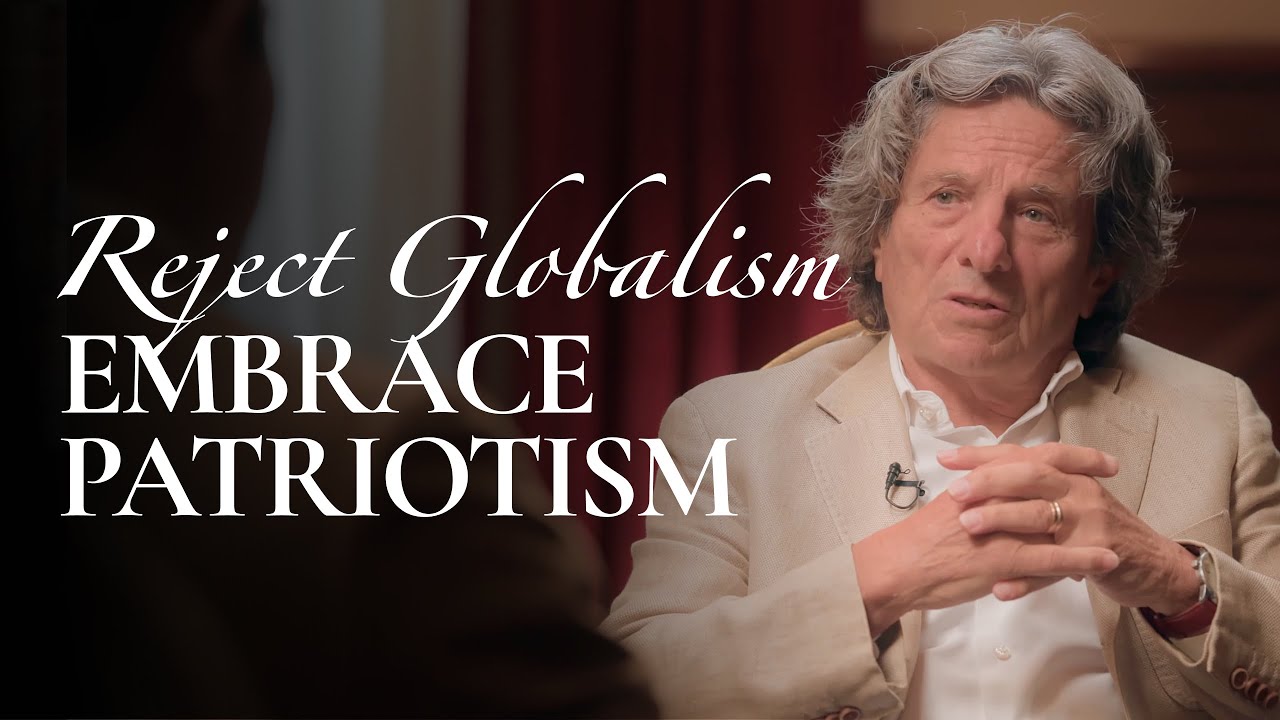
This episode features an interview with Princeton political theorist Maurizio Viroli, who argues that patriotism — understood as devotion to the liberty and dignity of one’s republic — is the only viable alternative to the dangerous extremes of nationalism (ethnocultural homogeneity) and cosmopolitanism (an elite ideal that fails to move ordinary citizens). Viroli draws on historical tradition, his own experience advising Italian President Carlo Azeglio Ciampi (1999–2006), and a social-democratic conception of freedom to show how a rhetoric of patriotism can win elections, inspire sacrifice, and ground international solidarity without surrendering national attachment.
Nationalism vs. Patriotism: Core Distinction
Patriotism and nationalism have different historical origins, objects, and moral logic.
Patriotism traces to Roman antiquity, the Italian Renaissance, the Enlightenment, and the Risorgimento; its object is the republic and the liberty of the state.
Nationalism emerges around 1766 with Johann Gottfried Herder; its object is cultural, linguistic, and religious oneness and homogeneity, indifferent to political form (monarchy, republic, communist, capitalist).
Viroli considers ethnocultural homogeneity a vice: it makes the republic “asphyxiatingly dull, soporific, and oppressive” and citizens “narrow-minded bigots, intolerant and boring.”
The patriotic task is not to reinforce “Italianness” but to focus on the political values of democratic citizenship and defend them as part of the people’s culture.
National traditions (food, dress, language, memory) are not rejected; they are enhanced when joined with republican liberty.
Authoritarian regimes foster homogeneity and obedience; a free republic enriches traditions rather than flattening them into expressions of servility.
The interviewer presses a thought experiment: if Italy kept liberal institutions but lost its ethnocultural character (St. Peter’s a mosque, bowing not handshakes, dandan noodles not spaghetti, Islamic dress, ethnic Italians a minority), would nothing be lost?
Viroli insists he has nothing against national cultures; they become “more refined” when combined with liberty.
The nationalist error is trading liberty for cultural preservation; the patriot refuses that trade.
Patriotism in the United States
The U.S. demonstrates that cultural pluralism and republican liberty can coexist — a “nation of nations” (Richard Rorty).
American identity is contested: military greatness and “Americana” (monster trucks, NFL, KFC) are one version; Martin Luther King’s moral witness is another, no less American.
Similarly, Italy contains the Italy of Garibaldi, Mazzini, the Rosselli brothers, and anti-fascist martyrs — and the Italy of fascist imperial conquest. One must choose.
The interviewer worries whether abstract republican ideals can motivate sacrifice (e.g., dying in war) as powerfully as ethnocultural heroes and myths.
Viroli answers with evidence from his own political work.
Viroli’s Political Life: Advising President Ciampi
From 1999 to 2006, Viroli served as consultant to Italian President Carlo Azeglio Ciampi, who enjoyed enormous popularity.
Viroli advised Ciampi to use the rhetoric of Risorgimento patriotism — the patriotism of liberty and anti-fascist resistance — predicting it would generate enormous consensus.
Ciampi accepted; his public speeches using this language were strikingly successful.
A key symbolic act: restoring the June 2nd Republic Day military parade (interrupted since the 1970s), but placing representatives of concentration-camp martyrs and anti-fascist associations in the front rank, ahead of soldiers.
This was an “enormous political success,” proving that correctly used patriotic language wins in politics.
Contrast with nationalism’s slogan: “Make America Great Again” (superiority, power, conquest).
The patriotic alternative: “Make America Free Again” — liberty, not dominance.
Nationalist theory (from Herder onward) is realist: the world is a contest of rivalries; the test of national unity and strength is war.
Today the language of nation triumphs globally — economic domination, territorial expansion, war, persecution of minorities and immigrants in the name of homogeneity.
The interviewer marvels that a 21st-century president sought a philosopher’s counsel — like Machiavelli advising princes.
It happened simply: a permanent advisor showed Ciampi Viroli’s book Per amore della patria (For Love of Country); Ciampi read it, invited Viroli, and said, “That’s what I have always thought.”
Crafting a patriotic campaign: teach history.
In every country’s history there are extraordinary examples of patriotic citizens.
Viroli spoke in schools and universities; students initially saw him as an alien, but after an hour the common reaction: “Professor, nobody had told us this story before.”
Opera (Verdi’s choruses) moves young people; they experience “intellectual and moral transformation” — a dignified, noble, generous way to be a patriot, freeing them from the false choice between rootless cosmopolitanism and nationalism.
Songs and shared memories are the instruments that touch hearts; abstract principles do not move people.
Cosmopolitans have the EU but no shared memories or music that stirs the soul (Beethoven’s Ninth is borrowed, not native).
Even cold skeptics are moved by Verdi; the generous are moved to act for their country.
What’s Wrong with Cosmopolitanism?
Viroli respects Martha Nussbaum’s cosmopolitanism as intellectually and morally defensible — but it requires privileges few possess: multilingualism, travel, cultural capital to interpret other cultures.
Those without these privileges (stuck in one place, speaking one language) resent cosmopolitan elites and turn to nationalist leaders who say: “Your way of life is right, not theirs.”
Cosmopolitanism is politically and rhetorically weak; even elites should be patriots.
Lincoln and FDR were elites who used patriotic language powerfully at pivotal moments.
Viroli’s hope: inspire intellectual and entrepreneurial elites to be true patriots — benefiting their own country and, by making it better, the world — without forgetting their country to “work for the world.”
Can One Be a Patriot of Two Countries?
Yes, with a generous heart one can love two countries, in different ways.
Viroli owes his career to the U.S.; he is loyal but severely critical (as he is of Italy).
His strongest attachments remain in Italy: birth, language, parents’ graves, youth.
Language is crucial: he understands and speaks Italian in a way he never will English.
Patriotic love respects other countries; no conflict between patriotisms.
Nationalism is inherently competitive (“uno solo”); patriotism is not.
Historical example: Mazzini-inspired Italian patriots fought for Italy’s liberty (1820–1870) and went to fight for Greece against the Turks, for Poland against Russia — not as internationalists but as patriots: “I love my country’s liberty and I want your country to have that too.”
Contrast with communist internationalism: communists help each other to build an international order led by communist parties; patriots help others simply to extend liberty, remaining attached to their own nation.
Can Patriots Emigrate? Conditions for Leaving
A country must deserve patriotic love: it must be free, generous to others, tolerant, and provide social rights for the poor.
If one’s country is unjust, aggressive, intolerant, the patriot does not simply leave (physically or intellectually); one stays and works with compatriots to correct its wrongs.
Love for the ideal is unconditional; love for the reality is conditional.
Nationalist motto: “My country, right or wrong.” Patriot: “If my country is wrong, I say it is wrong — but I don’t leave.”
To immigrants: welcome, preserve your cultural traditions, but add (plus sign) the values of republican citizenship — duties, rights of others, loyalty to the constitution, willingness to serve.
To emigrants (e.g., young Italians leaving for careers abroad): Viroli does not condemn the decision, but urges them to stay if they can and endure the sacrifice of reforming society — a better life in a just homeland than a successful life abroad.
If they cannot stay, they should absorb the best of their new country and consider returning or doing something for Italy (as Viroli did through advising Ciampi, writing, speaking).
Viroli’s Conception of Freedom
Not libertarian freedom; a social-democratic vision.
Civil and political liberties must be enriched by social rights: education, labor, health care (as in the Italian Constitution).
Without social rights, the right to vote or speak is impoverished; these rights are essential to individual dignity.
Patriotism vs. Ancient Republicanism
Viroli’s patriotic republicanism differs from ancient republicanism (Aristotle, Machiavelli) in its openness to international solidarity.
Ancients: love for one’s own city, indifference or hostility to others (Machiavelli: “I love my country more than my soul,” but cared about other countries only as threats).
Viroli’s model: Giuseppe Mazzini — patriotism of compassion, liberty, solidarity.
This ideal — loyalty to one’s country’s liberty and standing for the liberty and dignity of all countries — is the only alternative to the horrors that nationalist triumph inevitably brings.