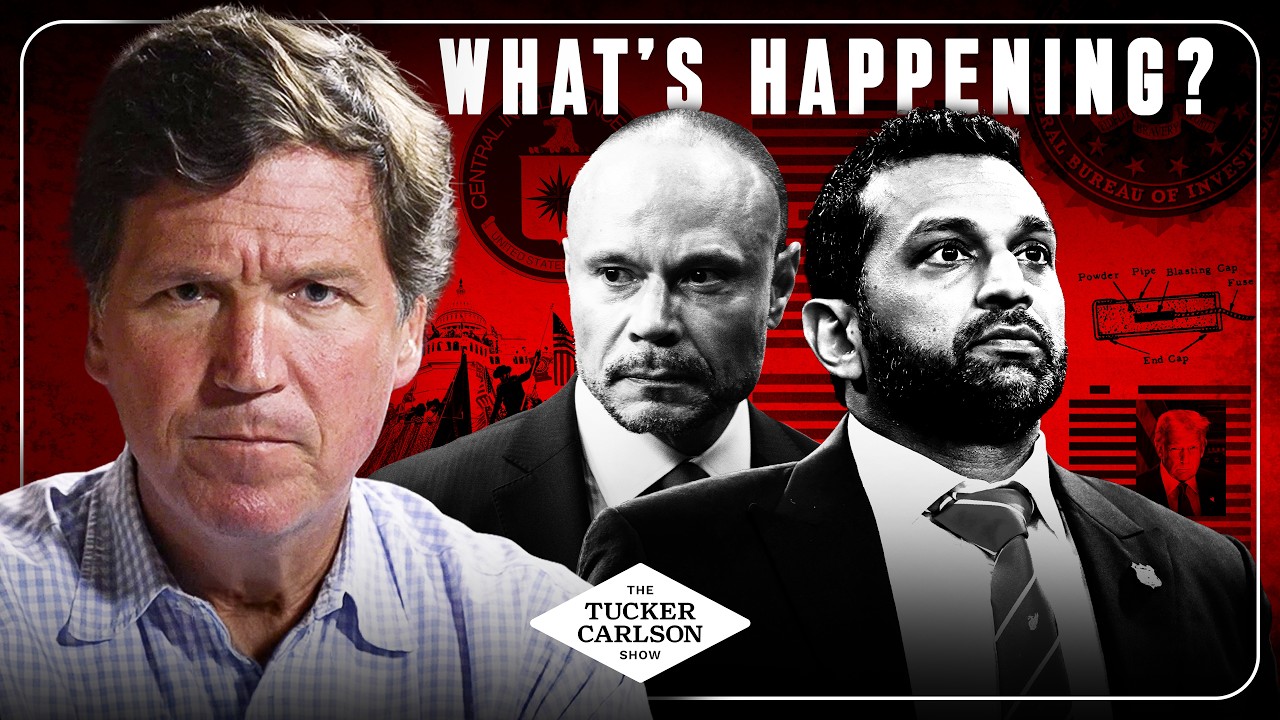
This episode features investigative journalist Steve Baker detailing his years-long investigation into the January 6 pipe bomb case, arguing the devices were inert training tools planted by a Capitol Police officer who later joined the CIA, and that the FBI arrested an innocent autistic man to cover up the operation.
The January 6 Setup and Information Control
Tucker opens by arguing that major events like the Las Vegas shooting and January 6 are memory-holed by design or technological overload, leaving the public with official narratives that collapse under scrutiny.
He contends January 6 was not an insurrection but a bipartisan operation by Permanent Washington to destroy Trump politically, citing the largest FBI investigation in history that arrested 1,500 people while ignoring provocateurs like Ray Epps and Nick Fuentes.
The pipe bombs at the RNC and DNC were central to the “insurrection” narrative but were never solved despite Capitol Hill being one of the most surveilled places on Earth.
Darren Beattie at Revolver News first questioned why the FBI couldn’t identify the bomber after years, suggesting federal law enforcement knew exactly who did it.
Steve Baker, then at The Blaze, pursued the question and named a suspect; days later the FBI arrested Brian Cole Jr., an autistic Black man, claiming he confessed.
Steve Baker’s Access and J6 Conclusions
Baker was on the Capitol grounds January 6 as a journalist, entered the building with a camera, and was later prosecuted for four misdemeanors after the DOJ initially threatened racketeering charges over his video licensing revenue.
He gained early access to the 41,000 hours of Capitol CCTV footage released by Speaker McCarthy and spent months analyzing it with a team.
Baker concludes January 6 was a setup engineered by elements of the Department of Defense, Capitol Police, and CIA to provoke a crisis that would permanently disqualify Trump from office.
A Tier 1 special operator friend identified plainclothes U.S. Army special operators in Baker’s own footage, confirming “boots on the ground” from Task Force Orange (TFO), a clandestine unit out of Fort Belvoir that officially does not exist.
Newsweek later confirmed “secret commandos with shoot-to-kill orders” were present, but the author William Arkin disavowed his own story when contacted by Baker.
The Pentagon refuses to acknowledge TFO’s existence; the unit specializes in domestic operations, deep insertion, signals intelligence, and isolation endurance.
Federal Agents in the Crowd and Baker’s Prosecution
The 247 FBI agents cited by Kash Patel arrived after 4:00 PM for crowd control, not as undercover provocateurs; the real question is how many plainclothes agents or confidential human sources were embedded in the crowd beforehand.
The FBI admits 20+ CHSs were embedded in groups like the Proud Boys and Oath Keepers; Baker believes the real number is far higher.
Baker was arrested in Dallas after a 20-month silence from the DOJ following a press offensive; he pleaded guilty to four misdemeanors days after the 2024 election when Charlie Kirk told him a pardon was assured.
Judge Christopher Cooper denied Baker a selective prosecution defense (80+ other journalists entered the Capitol uncharged) and a First Amendment defense, then delivered an eight-minute sentencing tirade attacking Baker’s post-J6 journalism, not his actions that day.
Baker received a dismissal with prejudice rather than a pardon, meaning legally it never happened.
The Pipe Bombs Were Inert Training Devices
The public narrative: a terrorist planted pipe bombs at RNC and DNC headquarters the night of January 5 to divert police from the Capitol on January 6.
FBI agents on the investigation were told by leadership the devices were inert; bomb experts reviewing FBI forensic photos and reports concluded they were typical training devices, not functional bombs.
The devices were “found” at 12:35 PM (RNC) and 1:05 PM (DNC), bracketing the 1:00 PM congressional gavel drop; Capitol Police Chief Son and others confirm they were diversionary devices to pull already-depleted officers away.
Capitol Police had 2,000 uniformed officers but only ~250 on duty despite six permitted protests; Assistant Chief Yogananda Pittman signed off on permits but didn’t inform officers.
Kamala Harris was inside the DNC at 1:00 PM, not at the Capitol as a senator; Secret Service had swept the building at 8:30 AM and walked past the device location multiple times.
When Capitol Police counter-surveillance officers (“Man Bun Guy” and “Backpack Guy”) alerted the Secret Service SUVs to a “suspicious device,” agents sat for 2.5 minutes finishing lunch, then casually walked around without cordoning the area or stopping pedestrian traffic 10 feet away.
Baker argues the only explanation for this non-reaction is that Secret Service was told it was a training exercise.
The Hooded Bomber and Capitol Police Complicity
The bomber appears on multiple cameras (Ring, DNC, Capitol CCTV) from 7:34 PM to 8:18 PM on January 5, planting both devices and exiting through a hidden gate in Ramsay Court behind the RNC that blends perfectly into the fence and is absent from Google Maps.
The bomber knew Capitol CCTV blind spots, carried one device at a time, and reloaded in a blind spot at Folger Park where a car or accomplice waited.
On January 6, the same two counter-surveillance officers deployed to “search for devices” drove to Metro South, walked directly to the Congressional Black Caucus Institute bush (where the bomber had paused the night before), then to the DNC bench — the only two spots the bomber sat — ignoring all other potential locations.
Man Bun Guy and Backpack Guy were interviewed by the January 6 committee together, not under oath, in what investigators called the most rehearsed interview they’d ever seen; Johnson and Jordan restricted the committee from investigating Capitol Police.
Backpack Guy is now the Capitol Police liaison to the FBI; Baker argues Capitol Police act as a “Praetorian Guard” with kompromat on members, controlling leadership through the Speaker.
Directed Energy Weapons and the Identification of Shauni Kerkhoff
Baker investigated three heart-attack deaths within 50 yards on the West Terrace; a retired SOCOM three-star general confirmed the existence of a backpack-sized “agitation weapon” (directed energy) that can stop hearts or cause incontinence, used in color revolutions.
While scanning footage for the weapon, Baker’s team found a Capitol Police less-lethal officer on the upper terrace firing pepper balls criminally — into heads, faces, and fellow officers’ helmets at point-blank range.
A CDU source identified the officer as Shauni Kerkhoff, who left Capitol Police six months post-J6, wiped her social media, and allegedly joined a three-letter agency.
Kerkhoff was the first witness in the first J6 trial (Guy Reffitt); the judge held sidebars about “under seal aspects” and warned defense counsel not to “wave Miss Kerkhoff’s 302s around.”
Under cross-examination, Kerkhoff said she had applied for her new government position before January 6.
Baker’s ODNI sources identified her as a current CIA employee on a dignitary protection detail, possibly protecting Director John Ratcliffe.
Gait analysis: Kerkhoff suffered a compound tibia fracture in college, leaving a distinctive circumduction gait (right foot dragging, crossing in front of left). Baker’s intelligence source ran gait recognition on 21 minutes of bomber footage vs. Kerkhoff’s soccer and Capitol Police footage: 94% software match, 98% human expert match.
FBI used gait recognition to eliminate a Virginia gym owner who bought the same rare Nike Air Max Speed Turf 2018 shoes (gray/gold/black) as the bomber.
FBI Raid, Failed Polygraph, and Brian Cole Jr.’s Arrest
Baker took the Kerkhoff evidence to ODNI’s Director’s Initiative Group (DIG), which was shut down by CIA after this case; DIG members were hauled in for 4-hour polygraphs but refused, citing ODNI’s oversight authority.
A draft ODNI memo on Kerkhoff was leaked by CIA to FBI to White House to press before Baker’s November 8 story; on November 7, FBI raided Kerkhoff’s house with 12-hour advance notice to her partner (highly irregular).
Kerkhoff was called in for a 4-hour polygraph the night before publication; she failed and was admonished for rehearsed answers to pipe-bomb-specific questions.
Five days after Baker named Kerkhoff, FBI surveillance appeared on Brian Cole Jr.’s house in Woodbridge, VA; he was arrested a month later on Dan Bongino’s birthday with a press conference by Bondi, Pirro, Patel, and Bongino.
Cole is a 25-year-old (now 30) autistic Black man with extreme OCD; neighbors including an FBI whistleblower say “it ain’t him” — his gait is duck-footed, butt-out, nothing like the bomber’s pigeon-toed circumduction.
Cole wears size 12 shoes; the bomber’s footprints in Ramsay Court bricks measure 9 to 9.5 (Baker bought three pairs of the Nike model to verify).
Autistic individuals give the highest rate of false confessions; Cole was interrogated for two hours without counsel, claimed motivation from “the Irish troubles” and hatred of both parties.
The bomber visited two other sites (Congressional Black Caucus Institute, a congressional housing unit) before choosing RNC/DNC; Cole’s confession doesn’t mention them.
Armitas, Baker’s video analyst, discovered a smartwatch flashing on the bomber’s wrist and the bomber speaking into it at least five times; Cole never owned a watch, let alone a smartwatch.
A superseding indictment added terrorism and WMD charges (life in prison) to pressure a plea; Cole’s attorneys demanded a trial date; he remains in general population pre-trial.
The FBI whistleblower neighbor says “nobody in my shop is buying this arrest”; White House sources say nobody in the White House buys it either; Trump has never mentioned the arrest.
Dan Bongino’s Reversal and the Defamation Lawsuit
Bongino praised Baker’s pipe bomb work in February 2024, then made five calls to Blaze executives (twice personally) trying to get Baker fired; FBI officials Ben Williamson and Marshall Yates also called.
Bongino told Thomas Massie he would personally fund Kerkhoff’s defamation suit; Baker speculates Bongino had a breakdown at FBI, is terrified, and now covers for the permanent state.
Kerkhoff denied the allegations through Clare Locke (the firm that represented Dominion vs. Fox); New York Times ran a sympathetic puff piece on her.
FBI leaked to CBS that Kerkhoff had an alibi video “playing with her puppies”; Baker’s team found dark-web evidence she had one adult greyhound adopted a month prior and a 5-star review for a dog walker referencing one dog.
Clare Locke’s preservation letter changed the story to “caring for her dog”; the lawsuit claims a video shows the dog sleeping on the couch with her voice off-camera — only a screenshot has been shown.
Baker is sued for defamation (no damages stated); his attorneys (now representing Cole) say they have nothing to worry about once discovery proceeds.
The Death of the HSI Agent Investigating the Case
An HSI senior agent (19-year career, vetted non-deep-state) was brought into the DIG to investigate the pipe bomb case using HSI tools and personnel; he was briefed in late October/early November.
On November 26 (day before Thanksgiving), his girlfriend found him dead in his Fairfax condo; a longtime IC operative told Baker on December 22 (after Baker’s own acute heart failure) that the agent was dead, showing his business card.
The operative said “none of us believe it was suicide”; Fairfax County Police have issued no medical examiner report six months later, ignored FOIA requests, and stonewalled Baker’s PI.
The condo was sold quickly; the new buyer told Baker (posing as a real estate prospect) he was told “the previous owner was murdered.”
Baker’s sources confirm a gunshot to the head; body cremated December 19 before ME report; HSI issued only an internal memorial memo; family issued no obituary; no public reporting.
The agent with the authority, tools, and personnel to investigate the case is dead; Baker views this interview as a “dead man’s switch.”