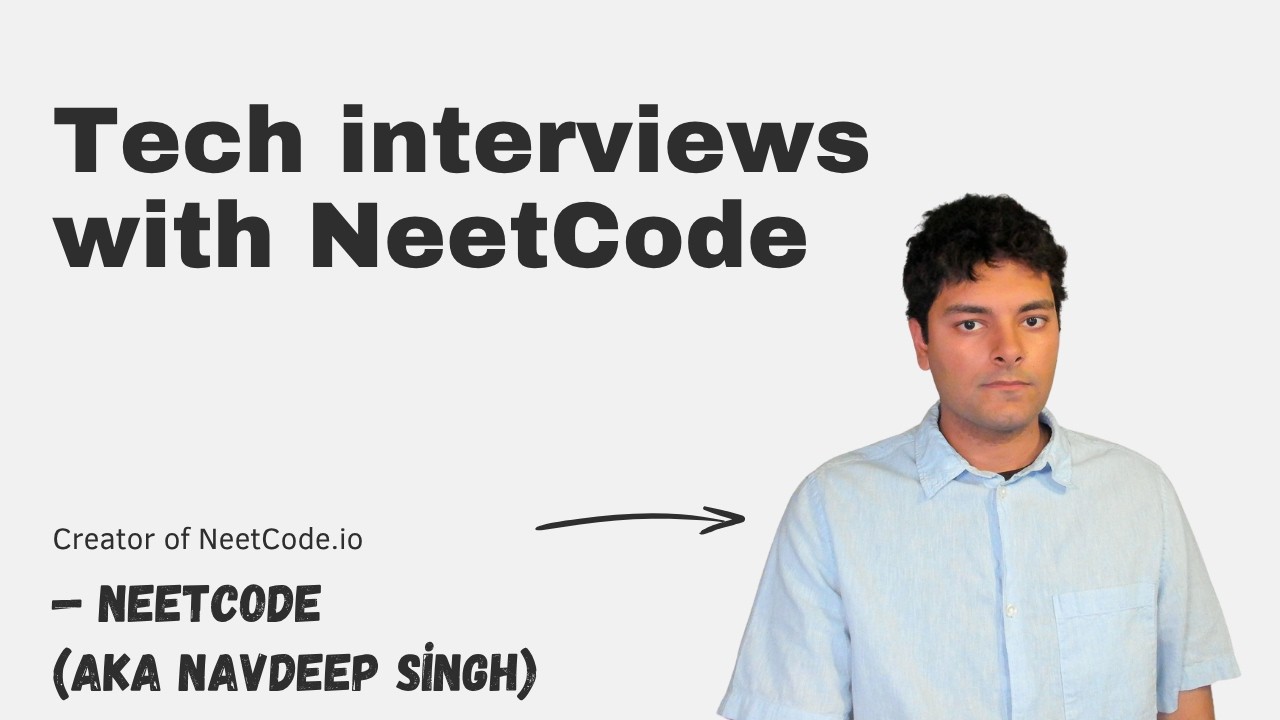
Neet (Nav Singh), creator of NeetCode, discusses why DSA interviews persist despite AI coding tools, what interview prep actually teaches, and why personality traits like agency and effort now matter more than raw coding skill. He shares his own unconventional path — quitting Amazon after two months, getting promoted quickly at Google, then leaving to scale NeetCode — and offers a grounded, often contrarian view of where engineering careers are heading.
Why coding interviews haven’t died
Data structures and algorithms interviews have remained surprisingly sticky even as AI can now write 90% of the code, because companies have never had a reliable way to predict who will actually perform well on the job.
The real signal from DSA interviews was never the algorithms themselves — it was evaluating whether a candidate can think, reason about trade-offs, and communicate their approach.
Changing the interview process at large companies is bureaucratically hard: interviewer training is difficult, standardization is critical, and introducing new variables (like AI-assisted evaluations) makes an already-impossible measurement problem even harder.
Cheating tools and remote formats increased the noise, and some companies (like Google) are moving back to in-person on-site whiteboard interviews as a result.
Neet’s own career arc
Studied electrical engineering, initially struggled with C, then fell in love with programming once concepts like loops and functions clicked — the “infinite complexity from primitive building blocks” excited him.
Quit Amazon after two months in a stressful, under-supported Alexa team environment where new grads were left alone and experienced engineers were visibly overworked; he regrets the impulsiveness but acknowledges he wasn’t ready for that environment.
Joined Google with only two months of professional experience and Amazon-related anxiety, but a supportive manager and team helped him get promoted from L4 to L5 in about a year — unusually fast, driven more by working independently on a hard project than by raw coding skill.
Started NeetCode as a hobby while jobless after Amazon, making explanation videos because existing resources were poor; the channel grew after he got into Google because it added credibility, then he eventually left Google to go all-in on NeetCode when it became viable full-time.
What interview prep actually teaches you
Preparing for DSA interviews builds deep thinking, communication, and trade-off reasoning — skills that transfer directly to real engineering work even though the algorithms themselves rarely do.
Engineering is fundamentally about trade-offs with no single correct answer, unlike math or science; this mindset is what separates effective engineers and is hard to develop through prompting alone.
Systems thinking and domain expertise compound over a career: the ability to architect processes and understand context across domains is what creates outsized value, and it cannot be shortcut.
How NeetCode operates today
Most code is now written by AI; Neet was initially “a really big AI hater” but became pragmatic once the tools became good enough for CRUD work.
He still runs on Angular, Firebase, and Google Cloud — deliberately outdated stack — because the product value (video explanations) matters far more than the tech choices.
He knowingly leaves a memory leak bug in a self-built code-execution service unfixed because running extra instances is cheaper and faster than debugging it — a deliberate business trade-off he’s comfortable with.
A $2,500 redesign contest produced mostly low-effort AI-generated submissions where contestants couldn’t articulate why they made their design choices, reinforcing that prompting without understanding doesn’t produce real value.
Skills AI is eroding vs. skills that compound
Eroding: The ability to write code from scratch, deep focus, and the habit of going deep into fundamentals — many students now learn everything through LLMs and lose foundational skills.
Compounding: Agency (the drive to figure things out without being told), communication, understanding what people actually care about, and the effort to dig deep even when it’s uncomfortable.
Neet predicts more in-person interviews because it’s much harder to fake understanding face-to-face when someone asks “why did you do it this way?"
"Some people should give up on tech careers”
Neet’s hot take was deliberately provocative: he doesn’t literally want people to quit, but he thinks those unwilling to put in effort, dig deep, or do things they don’t enjoy should honestly evaluate whether tech is right for them.
Many people who disagreed with the framing still admitted they had gotten worse from over-relying on prompting and wanted to refocus on learning.
How to be a standout engineer
Know your audience — whether in interviews or at work, understand what the other person cares about and communicate accordingly.
Actively seek feedback from managers and peers; asking for criticism early signals care and accelerates growth.
Put in genuine effort and avoid shortcuts when the goal is learning; take shortcuts only when there’s a clear business reason.
Be willing to change and course-correct iteratively — the feedback loop of figuring out what matters, working hard at it, and adjusting is difficult but essential.
Other notable points
Neet dislikes the CAP theorem because it’s incomplete and hand-wavy; he prefers the PACELC theorem, which he finds more complete and no harder to understand.
He believes personality traits like agency and energy now outweigh coding skills in hiring because information is cheap to prompt but the drive to learn and execute is not.
On YouTube and in tech, authenticity and knowing your audience matter more than raw correctness — people care about the value you deliver, not how smart your solution is.
His book inspiration comes from deep thinkers like Martin Kleppmann, who go deep and provide rich references, satisfying his desire to always understand things more fully.