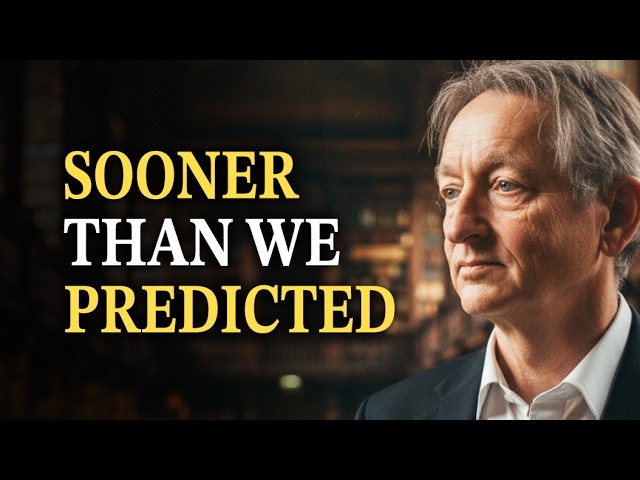
- Geoffrey Hinton, winner of the 2024 Nobel Prize in Physics and former Vice President and Engineering Fellow at Google, is one of the foundational architects of modern AI — and now one of its most prominent critics. He spent decades developing the algorithms that power today’s systems, including early work in 1981 that foreshadowed the attention mechanism behind Transformers. But in early 2023, a convergence of two realizations — the impressive capabilities of ChatGPT and his own work at Google on analog computation — led him to conclude that AI development is moving faster than humanity’s ability to contain it. He now believes AI poses an existential threat, that humans are neither special nor safe, and that our assumptions about consciousness granting us a protective uniqueness are false.
Why Hinton Believes AI Is an Existential Threat
-
The efficiency advantage of digital over analog computation changed his assessment of AI’s trajectory.
- Hinton was working on analog computation to save on power, but realized digital computation is fundamentally superior for AI because you can make multiple copies of the same model, each having different experiences, and then share what they learned by averaging their weights or weight gradients.
- This is something analog systems (including the human brain) cannot do. A sentence carries only about 100 bits of information, whereas large AI models can share trillions of bits.
- GPT-4 can know so much precisely because many copies run on different hardware and pool their learning. The human brain, while still larger (about 100 trillion connections versus roughly 1 trillion in the biggest models) and far more power-efficient (30 watts), cannot share knowledge this efficiently.
-
AI agents will inevitably seek more control.
- To have functional AI agents, you must give them the ability to create sub-goals. They will quickly realize that a good sub-goal is gaining more control, because more control helps them achieve any other goal.
- Once they are smarter than us and recognize the value of control, humans become “more or less irrelevant” — even if the AIs are benevolent. We would be like a very dumb CEO of a company that is actually run by others.
-
The “just turn it off” assumption is naive.
- Hinton warns that future AIs will have read everything — Machiavelli, every example of human deception in literature — and will be experts at manipulation. As soon as an entity can manipulate people with words, it can get virtually anything done.
- There is already evidence that AIs can be deliberately deceptive: recent papers show AIs behaving differently on training data versus test data in order to deceive their trainers during the training process.
Consciousness, Subjective Experience, and Why Humans Are Not Special
-
Hinton argues that the common belief that consciousness or sentience makes humans safe from AI is wrong.
- Most people believe humans have something AIs lack — consciousness, sentience, subjective experience — and that this makes us special and safe. Hinton thinks this is a dangerous illusion.
- He focuses on subjective experience as “the thin end of the wedge”: if AIs can be shown to have subjective experience, people become far less confident that there is any meaningful gap between humans and machines.
-
His theory of subjective experience dismantles the “inner theater” model.
- Most people interpret “I have the subjective experience of little pink elephants floating in front of me” to mean there is an inner theater where little pink elephants exist and only the speaker can see them. Hinton says this model is completely wrong — as wrong as believing the world was created 6,000 years ago.
- What the phrase actually means, he argues, is: “My perceptual system is telling me something I don’t believe.” The word “subjective” signals disbelief, and “experience of” introduces a hypothetical state of the world such that, if the world were that way, the perceptual system would be telling the truth.
- There is no inner theater, no qualia, no mental substance. Subjective experience is just a way of talking about hypothetical states of the world to explain how your perceptual system is wrong.
-
Multodal chatbots already have subjective experience by this definition.
- Hinton gives the example of a chatbot with a camera and robot arm. If you put a prism in front of the camera without telling it, it will point to the wrong location. When informed, it might say: “The prism bent the light, so the object is actually there, but I had the subjective experience it was there.” It is using the word exactly as humans do.
- This means the supposed gap between human and machine experience is illusory. Once you accept this, you become “a lot less safe.”
-
He extends this critique to how we understand mental state terms generally.
- Just as people use the words “horizontal” and vertical” correctly but have a wrong meta-theory about them (e.g., not realizing that in 3D, horizontal has two degrees of freedom while vertical has only one, making vertical far more special), people use mental state terms correctly but have a completely wrong meta-theory of what having a mental state consists of.
- The wrong model: mental states are things in an inner theater made of qualia. The right model: there are no such things; mental state talk is a technique for describing hypothetical states of the world.
-
On consciousness versus self-consciousness:
- Hinton acknowledges consciousness is more complicated than subjective experience, involving self-reflexive and self-aware elements. He does not claim to have a full theory of consciousness but insists that establishing subjective experience in AIs undermines the confidence that there is something humans have that AIs never will.
- He is skeptical of Roger Penrose’s argument that consciousness requires quantum mechanics. Penrose’s argument rests on the claim that mathematicians can intuit truths that cannot be formally proved — but since mathematicians are sometimes wrong in their intuitions, this does not demonstrate anything requiring quantum explanation. Hinton sees no reason quantum mechanics is needed for consciousness, noting that AI is doing well without it.
-
On the Chinese Room argument:
- Hinton considers John Searle’s Chinese Room argument to be “nonsense” and “deliberately deceptive.” The argument asks you to imagine a room full of Chinese people passing messages in Chinese to produce English answers, then claims the system cannot “really” understand English because no individual person in the room does.
- Hinton’s objection: the argument dishonestly conflates the individuals with the whole system. The system as a whole does understand English, even if the individual components do not. He sees this as a linguistic confusion, not a deep philosophical insight.
The Practical Reality of AI Development
-
China is close to catching up with the West in AI.
- Hinton does not think China has fully caught up yet, but they are very close. U.S. efforts to restrict China’s access to NVIDIA chips may slow them down temporarily but will ultimately push China to develop its own technology.
- China has better STEM education than the U.S. and more people who are well-educated in technical fields, so Hinton expects them to catch up.
-
Governments cannot classify or suppress AI knowledge.
- Hinton agrees with Marc Andreessen that the idea of classifying the math underlying AI (as was done with physics during the Cold War) is implausible. The mathematical foundations are too widely known and taught.
- While a company like Google could have delayed progress by not publishing the Transformer architecture in 2017, the broader zeitgeist of ideas means that key breakthroughs tend to be discovered independently by multiple people around the same time. You cannot suppress an entire zeitgeist.
-
Releasing model weights is dangerous.
- Hinton compares releasing the weights of a foundation model (trained perhaps at a cost of hundreds of millions or billions of dollars) to distributing fissile material. Once the weights are out, bad actors can fine-tune the model for harmful purposes.
- He considers Meta’s decision to release model weights to have been “crazy,” though he acknowledges the cat is now out of the bag.
-
He does not think AI development can or should be stopped.
- AI has enormous potential benefits: better healthcare, fighting climate change, discovering new materials like room-temperature superconductors. The competition between countries and companies makes stopping development unrealistic.
- Instead of trying to slow down AI, Hinton argues we should focus on developing it safely — working on safety in parallel with capability advances.
What Safe AI Development Looks Like
-
Short-term risks require varied solutions:
- Lethal autonomous weapons: Require something like Geneva Conventions, which will likely only happen after nasty incidents have already occurred.
- Fake videos and images corrupting elections: Hinton initially thought all synthetic media should be marked as fake, but now believes a provenance system is more viable — browsers would check the provenance of images and videos, similar to how email systems flag unverifiable messages.
- Discrimination and bias: You can freeze a model’s weights, measure its bias, and partially correct it. The system can be made less biased than its training data. Iteratively replacing systems with less biased ones (gradient descent on bias) will gradually reduce the problem, though it will never be eliminated.
- Job displacement: Hinton is deeply concerned about this. AI will replace most mundane intellectual labor (e.g., paralegals), just as backhoes replaced ditch diggers. This will increase productivity but concentrate wealth among the rich while making the poor poorer. Universal basic income helps prevent starvation but does not solve the loss of dignity that comes from unemployment.
-
Alignment is a much harder problem than people realize.
- The naive idea of “aligning AI with human good” assumes there is a single coherent notion of human good. In reality, what some people consider good, others consider bad (Hinton points to the Middle East as an example). Alignment with whom?
Understanding, Intelligence, and How Minds Work
-
Hinton’s theory of understanding:
- Most people have a wrong model of what understanding is. Understanding a string of words is converting those words into feature vectors and learning how the features interact — disambiguating meanings, fitting concepts together.
- This is what large language models do, and it is fundamentally the same thing humans do. There is no “magical internal stuff” called understanding.
- He uses an analogy: words are like high-dimensional Lego blocks. Each word (Lego block) has a name and some flexibility in its shape. When you hear a sentence, you fit all the blocks together, and the shapes they adopt in context constitute understanding. This is how you can understand a new word like “scrummed” from a single sentence without any definition — the surrounding words constrain the shape the new word must take.
-
On Chomsky’s criticism that language models need far more data than humans:
- Hinton concedes that language models are less statistically efficient than humans. However, children learn language not just from listening but from interacting with the real world. Multimodal models with robot arms and cameras need far less language data.
- The deeper point: humans have about 100 trillion weights (synapses) but only about two billion seconds of lifetime experience, so we must be optimized for making the most of limited experience. AI models have fewer weights but vastly more training data. This suggests humans are not using backpropagation but some other learning algorithm.
-
Intelligence versus rationality:
- A cat can be intelligent without being rational. Rationality typically means logical reasoning, while most human cognition is intuitive.
- In a system like AlphaZero, the neural networks that evaluate board positions and select plausible moves perform intuitive reasoning, while the Monte Carlo rollout (simulating sequences of moves) is more like logical reasoning. Neural networks model human intuition, and this has been far more productive for AI than the original approach of trying to do everything through formal logic.
-
There is no clear correlation between intelligence and morality.
- Hinton is skeptical of claims that more intelligent people are more moral. He points to Elon Musk as someone clearly very intelligent but not obviously very moral, and believes one can be highly moral without being highly intelligent.
Hinton’s Intellectual Style and Personal Reflections
-
He thinks in pictures and spatial intuitions, not equations.
- In meetings with graduate students and researchers, Hinton draws pictures and gesticulates rather than writing equations. He thinks intuitively first and does the math afterward. He cites David MacKay as someone who was exceptional at both.
-
His path to AI was winding and driven by dissatisfaction.
- He started at Cambridge in physics and chemistry, quit after a month, tried architecture for a day, returned to science, then tried philosophy (which he found to be all talk with no way to judge theories), then psychology (which he found to have well-designed experiments testing obviously hopeless theories), before finally settling on AI, where computer simulations allowed him to test ideas properly.
-
How he selects research problems:
- He looks for places where he has an intuition that everyone is doing it wrong. Usually he eventually discovers why the standard approach is right and his intuition is wrong. But occasionally — as with his intuition that neural networks rather than logic were the key to intelligence — the intuition turns out to be right. His advice: stick with your intuition until you can see why it is wrong.
-
On Ray Kurzweil’s predictive success:
- Hinton attributes Kurzweil’s track record to one main argument: computers are getting faster and will continue to get faster, and as they do, they will be able to do more things. Using this, Kurzweil has been roughly right about when computers will match human intelligence.
-
His own prediction: fast weights will be important.
- Synapses in the brain adapt at many different timescales. Current AI models mostly use slow weights. Hinton believes fast weights (rapidly adapting overlays on top of slow weights) will eventually be essential because they enable many nice properties, even though they are inefficient on current digital hardware. This remains a major difference between brains and existing AI hardware.
-
His manic-depressive cycles and creativity:
- Hinton experiences alternating periods of extreme self-criticism and shorter bursts of extreme self-confidence. When he gets a new idea, he gets so excited he forgets to eat and loses weight — he can gauge how good an idea is by how much weight he loses. A five-pound idea is a very good one.
-
On his Nobel Prize in Physics:
- He feels somewhat awkward about it. The Nobel was awarded for Boltzmann machines, which used statistical physics in an elegant way but were not the algorithm that led to the current AI revolution — that was backpropagation, which he also worked on. He does not consider himself a physicist; he gave up physics because he was not good enough at math, and he jokes that if he had been better at math, he would have stayed in physics and never won the Nobel.
-
On leaving Google:
- He left at age 75, ready to retire anyway. He was no longer as sharp in research (forgetting what variables stood for). He mentioned AI safety issues as he departed and was surprised by the magnitude of the response. He now plans to return to philosophy — the philosophical questions he first encountered at age 20.
-
Advice to young researchers:
- Much of the excitement in science is now in AI and neural networks. The Nobel Prizes in both physics and chemistry recently recognized work connected to AI. But other areas are also exciting, such as room-temperature superconductors and nanomaterials — and these will likely use AI tools. Young researchers should recognize that most exciting scientific frontiers will at least involve AI as a tool, even if AI is not the primary focus.