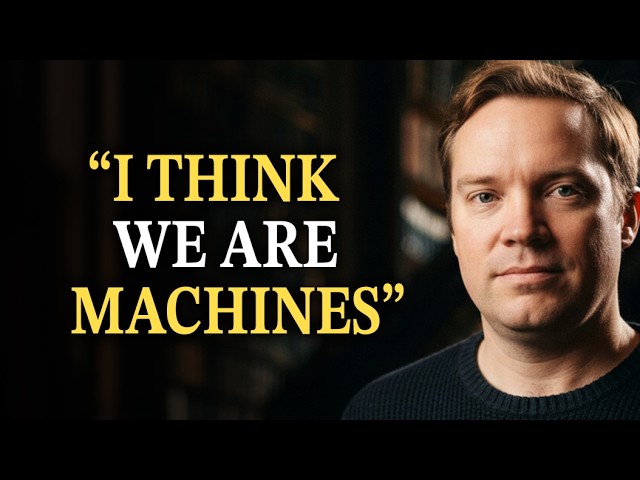
William Hahn returns to the MIT Media Lab to discuss how consciousness, computation, and language might converge in modern AI, drawing on Stephen Wolfram’s computational equivalence and Leibniz’s hierarchy of representations to argue that consciousness is not binary but a graded ladder — and that AI may inevitably climb it.
Consciousness as a Ladder, Not a Light Switch
The traditional view treats consciousness as binary — either present or absent — but Leibniz proposed a hierarchy: first-order sensation and response, then the ability to represent those responses, then represent those representations, and so on.
Simple animals operate at the first level: stimulus-response without any internal model of that response.
Humans climb far up this ladder through language, philosophy, and self-reflection — thinking about thinking about thinking.
This creates a “discontinuum” — not a smooth gradient but a stepwise hierarchy of increasingly abstract representational capacity.
The key question for AI in 2025 is where systems like large language models sit on this ladder: are they merely producing token outputs in knee-jerk reaction to prompts, or do they have some capacity to know what they know and think about what they’re thinking?
Current systems may not yet close the loop, but Hahn argues it seems almost inevitable that continued progress will bootstrap something resembling consciousness inside machines.
A graded scale — rather than a binary test — will be needed to understand this transition, and it may also illuminate animal consciousness and potential future stages of human consciousness.
Wolfram’s Computational Equivalence and Natural Computers
Stephen Wolfram’s principle of computational equivalence holds that the natural world stumbles upon universal computation frequently — that any system with interesting dynamics is likely capable of universal computation.
Turing showed that a universal machine can simulate any other machine; Wolfram showed that such universality is easy to arrive at, even in simple cellular automata.
This means computers are not rare human artifacts but abundant throughout nature — what Hahn calls “natural computers.”
The metaphor of software and programming now gives modern philosophy a language that earlier thinkers lacked.
If universal hardware is easy to find in nature, the question becomes: what is the chance it runs interesting software — and specifically, software somewhere on Leibniz’s consciousness ladder?
Hahn raises the question of whether there is a ceiling to representational depth analogous to the ceiling of universal computation.
Wolfram’s universality is an upper bound on computational power — nothing exceeds it.
Is there a corresponding “universal representation” — a level beyond which no further abstraction is possible? Have humans already hit it, or is there another layer (spirituality, for instance) waiting?
Unthinkable Thoughts and the Limits of Human Cognition
Hahn takes seriously the idea that there are thoughts humans cannot think — not just thoughts they haven’t had, but thoughts structurally inaccessible to human cognition.
Richard Hamming argued that just as dogs can smell things we cannot smell, there may be thoughts we cannot think.
Arithmetically, numbers like Graham’s number exceed our capacity to conceive them; we can write them down but not genuinely comprehend them.
The philosophical concept of umwelt — the bounded perceptual and cognitive world of an organism — suggests our conceptual window is limited and only partially overlaps with other species.
Two possible barriers prevent humans from reaching “unthinkable” thought spaces:
Natural/structural: insufficient neurons or cortical layers to support deeper representational hierarchies.
Evolutionary/protective: a kind of mental immune system that filters out thought patterns which would destabilize the mind — an evolved defense against “going nutty.”
From a Darwinian perspective, extreme intelligence may actually be a Fermi-style filter: too much abstract thinking could be maladaptive for species survival.
Whales and dolphins, by contrast, could plausibly continue their current existence for millions of years — humans may not.
Language as a Living Organism and the Question of Universal Representation
Hahn has come to doubt that English (or any single natural language) is sufficient as a universal representational framework.
AI language models are trained not just on all human languages but on computer code and mathematical notation, giving them representational tools that map into but do not operate within any single natural language.
Their “thoughts” exist in language-independent vector spaces — more compact and expressive than any one human language.
This suggests the need to explore musical languages, constructed languages (conlangs), and esoteric languages as vehicles for thoughts that natural languages cannot compactly express.
Hahn distinguishes between untranslatable and uncommunicable thoughts:
No word is truly untranslatable — if it were, you couldn’t even describe its untranslatability.
But there may be thoughts that cannot be decomposed into sequential symbols at all — experiences like gnosis (knowing from the inside) that resist being taken apart and reassembled, like Lego bricks.
Religious texts and rituals approximate these experiences but cannot transmit them directly.
Faith, in this sense, is precisely the kind of idea that cannot be serialized — it must be experienced whole.
The Mind’s Immune System and Mental Diversity
Extending the immune system metaphor: just as the body attacks foreign substances, the mind may attack destabilizing thought patterns — even beneficial ones.
This could be the basis of mental diversity and what are classified as mental disorders: variations in how the cognitive immune system filters or attacks certain patterns.
Hahn suggests that building AI language models gives humanity a “petri dish” for understanding how language and thought work — revealing that language itself was never fully understood as a phenomenon.
Hahn proposes thinking of language not as mere communication but as a living organism — a parasite of sorts that inhabits the brain but is not the brain.
Multiple personality disorder may be evidence that the brain can run multiple language-personality “operating systems” on the same hardware, multiplexed like apps on a phone.
When Hahn speaks to someone, he may be talking not to their brain but to the language entity instantiated in their brain.
Hardware, Software, and Virtual Machines All the Way Down
The distinction between hardware and software in the brain may be far less clear than traditionally assumed.
Drawing on the concept of emulators: just as a MacBook can simulate a Nintendo which then runs Mario, the brain may consist of multiple layers of virtual machines — software simulating software simulating software.
Traditional neuroscience assumes a one-to-one mapping between neural activity and mental states; Hahn argues there may be multiple representational layers between the neurons doing the firing and the person doing the talking.
This extends to matter itself: quantum information theory suggests that below the level of atoms, there may be another layer of software — information all the way down, completing a circle from information to atoms to computers to software.
At the cellular level, Michael Levin’s work reveals electrical activity and computational-like behavior in cells that classical biology overlooked — suggesting nature builds virtual machines at every scale, just as human engineers do with abstraction layers like Python and PyTorch over GPU hardware.
Animal Consciousness and the Role of Language in Self-Modeling
Hahn takes a strong position on animal consciousness: animals likely experience suffering (pain, pleasure) but lack the representational framework to know what is happening to them.
Without language or a labeling system, an animal cannot refer to its own past mental states — it has no episodic memory in the human sense.
Infant amnesia in humans illustrates this: before language is acquired (ages 1–2), children cannot form retrievable episodic memories because they lack the symbolic catalog — like a Dewey Decimal System — to label and reference experiences.
Similarly, a bat may have a fleeting sensory loop but no way of knowing it went out for fruit that morning.
The vast majority of human experience is also outside our conscious thought window — we don’t know we have a gallbladder, we don’t think about our toes, and most of the time we are not thinking about thinking.
The self that speaks is largely unaware of the parallel systems operating beneath it.
Whether the self-model is binary or continuous, Hahn leans toward the view that we have multiple selves — that the brain carries representations of other people as lower-resolution “holograms,” and that the breakdown of this multiplicity manifests as conditions like multiple personality disorder.
Language as a Phase Transition in Capability
The emergence of symbolic language may have created a new layer of reality — a phase transition analogous to water boiling.
While other intelligent animals (whales, primates) may have achieved one kind of universality, language instantiates another — like comparing an Apple II to a modern Mac: both are universal machines, but the practical capabilities differ by orders of magnitude.
Marvin Minsky’s analogy: a car is either running or it’s not — consciousness may similarly be an emergent digital-seeming property arising from the dynamics of many parts, fragile but not mysterious.
Scaling laws in large language models demonstrate this phase-transition behavior practically:
Systems that once produced word salad can, with scale, suddenly do arithmetic, then algebra, then theoretical physics.
Adding embodied experience — video, robotic interaction, sandbox play — will likely trigger further phase transitions toward artificial general and superintelligence.
Hahn does not think a fundamentally new recipe is needed; more data and experience will produce these transitions.
Lethal Thoughts, Madness, and the Cost of Exploration
Hahn introduces the concept of lethal text — ideas that can do harm to the thinker or to others, not because they are false but because they destabilize the mind’s existing framework.
He was initially afraid to share even the meta-idea that harmful ideas exist, fearing it could plant a seed that opens someone to dangerous thought patterns.
New layers of thought are lethal to previous selves — adulthood is lethal to the childlike self; transcending normal cognition may be lethal to the current self.
The experience of “losing one’s mind” may be a necessary part of intellectual exploration — going into abstract vector spaces where no one else is, leaving the shared human “herd.”
But there is a genuine distinction between exploring uncharted territory and simply having a wrong representation of reality — between the gold nugget and the cheese balloon.
Hahn suggests that those labeled mentally ill may not be broken but may be “astronauts who have been to the moon” — experiencing genuine states of mind that the rest of us cannot access or comprehend.
Their descriptions may sound like nonsense (balloons of cheese) because the rest of us lack the framework to interpret them correctly.
Misattribution is possible: a genuine insight may be wrapped in an incorrect metaphor, causing it to be dismissed.
Hahn shares that he himself experienced a period of feeling he was losing his mind, triggered in part by the demands of his work — emulating radically different worldviews week after week, each guest asserting a different model of reality as correct.
Recovery involved ACT (Acceptance and Commitment Therapy) and learning to “read the code without running the program” — to see triggering statements as mere words on paper, not as truths one must accept.
He notes that this experience is more common than people realize, including among prominent academics, but cultural and personal shame prevents open discussion.
The Cultural Immune System and the Path Forward
Just as individuals have cognitive immune systems, cultures have mechanisms that suppress the sharing of destabilizing ideas — for fear of damage to relationships, social standing, or financial wellbeing.
Overcoming this cultural immune response is necessary if humanity is to reach the next stage of evolution.
The ideas that seem most insane in one era — software, quantum physics, information theory — become the foundations of the next.
Someone from 200 years ago transported to modern Boston would think they had traveled a million years into the future.
Hahn believes the vistas opened by AI tools in the coming decades will either drive humanity mad or spark a new renaissance — and the outcome depends on whether we can embrace cognitive diversity and the people previously “laughed off the stage.”
He invites the audience — especially researchers and students in physics, math, philosophy, and computer science — to share their own experiences of thinking uncharted thoughts, whether in ecstasy, despair, or discovery.