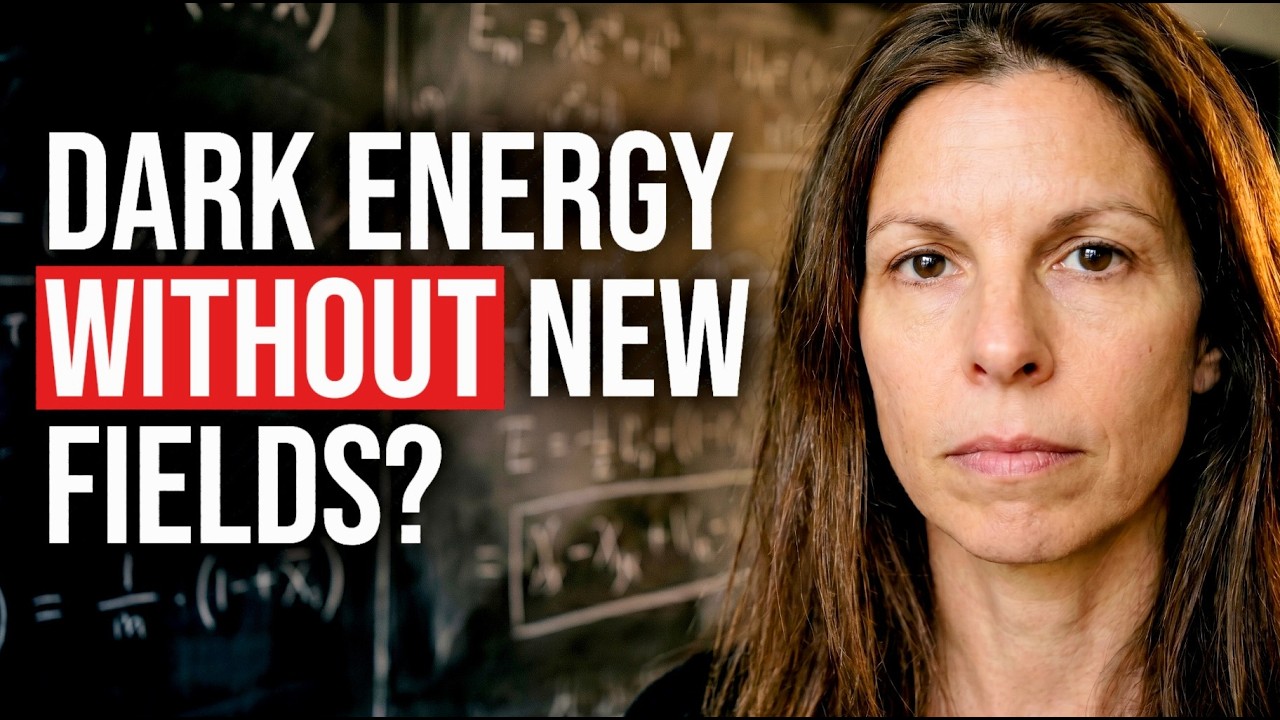
Claudia de Rham, a theoretical physicist at Imperial College London, is the co-creator of massive gravity — a theory in which the graviton, the particle that carries gravity, has a small but nonzero mass. This idea was long thought to be ruled out by powerful “no-go” theorems, but de Rham and collaborators found a way around them, opening a new approach to the cosmological constant problem and the accelerating expansion of the universe.
What massive gravity is and why it matters
In Einstein’s general relativity, gravity is described as the curvature of spacetime, and the graviton (the quantum carrier of the force) is massless — analogous to the photon in electromagnetism.
It is natural to ask whether the graviton could have a mass, just as one can ask whether the photon might have a mass. Observationally, we can put bounds on such masses, and there is no fundamental obstacle to the question itself.
The problem is that when the graviton interacts with other particles or with itself (as it must, since gravity couples to everything), earlier work — from Fierz and Pauli (1939) through the 1970s, 80s, and 2000s — suggested that a massive graviton would excite extra polarization modes carrying negative energy, leading to catastrophic instabilities in spacetime.
These results were codified as no-go theorems (including the Boulware-Deser ghost), which convinced most physicists that massive gravity was impossible.
How de Rham circumvented the no-go theorems
De Rham did not set out to overturn the theorems. She was originally trying to address the cosmological constant problem — the puzzle of why the universe’s accelerating expansion is so much smaller than quantum field theory predicts vacuum energy should produce.
Working with collaborators on models inspired by extra dimensions (motivated by string theory and M-theory), they constructed a model that appeared to violate the no-go theorems.
When viewed from a purely four-dimensional perspective, the model still seemed to evade the expected pathologies. This motivated a careful re-examination of the assumptions behind the no-go theorems.
They discovered that the proofs relied on shortcuts and implicit assumptions that could be bypassed. By constructing the theory more carefully, they formulated a version of massive gravity free of the Boulware-Deser ghost — at least at the classical level and to all orders in a derivative expansion.
The key was a specific structure of interaction terms (the de Rham-Gabadadze-Tolley or dRGT model) tuned so that the dangerous ghost mode never appears as a dynamical degree of freedom.
The cosmological constant problem
Quantum field theory predicts that vacuum fluctuations of known particles (electrons, quarks, the Higgs, etc.) should contribute an enormous energy density to spacetime — one that would cause the universe to accelerate at a rate roughly 10^120 times larger than what is observed.
This discrepancy has been recognized since the earliest days of quantum mechanics (noted by Pauli and others) and remains one of the deepest unsolved problems in physics.
Supersymmetry can cancel contributions from high-energy particles, but since supersymmetry is broken at low energies (we do not observe superpartners of known particles), a large residual contribution from standard model particles remains.
The renormalization procedures used to compute these contributions are extremely well-tested in other contexts (e.g., LHC predictions), making it puzzling that they would fail only when gravity is involved.
One possibility is the string theory landscape: a vast number of possible vacuum states with different values of the cosmological constant, and we happen to live in one compatible with our existence. De Rham finds this unsatisfying because it is not experimentally testable.
Massive gravity offers an alternative: if gravity is modified at very large distances (cosmological scales), the effect of vacuum energy on the expansion of the universe could be suppressed relative to what general relativity predicts.
Dark energy and the DESI results
Dark energy is the placeholder name for whatever is causing the accelerating expansion of the universe. The simplest model is a cosmological constant (constant energy density filling space uniformly).
Recent results from the DESI (Dark Energy Spectroscopic Instrument) experiment hint that dark energy may be dynamical — that is, its equation of state parameter w may vary over time rather than being fixed at −1.
If w < −1, the acceleration would increase over time, potentially leading to a “big rip” where even cosmic voids are torn apart.
If w > −1, the acceleration could slow or reverse.
Dynamical dark energy could mean either that the source itself evolves, or that the relationship between the source and its gravitational effect evolves — the latter pointing toward modified gravity (such as massive gravity).
De Rham finds any departure from a pure cosmological constant exciting because it would signal new physics and provide clues about the mechanism behind cosmic acceleration.
Causality, unitarity, and ghosts
Causality (no signals faster than light) and unitarity (probabilities sum to one and are never negative) are foundational principles that de Rham regards as non-negotiable in any physical theory.
The Boulware-Deser ghost in massive gravity is problematic precisely because it violates unitarity — it introduces negative-probability states — and is linked to causality violation because it involves modes that “jiggle” time in uncontrolled ways.
This is different from Faddeev-Popov ghosts, which are mathematical tools used in gauge theories to maintain consistency and are fully under control.
The ghost is also different from an instability (like the Higgs potential being metastable): an instability describes a system transitioning between configurations, whereas a ghost means there is no stable vacuum at all — no ground state from which to build a quantum theory.
Energy in general relativity
In ordinary (non-gravitational) physics, energy is a conserved quantity arising from time-translation symmetry (via Noether’s theorem). This requires a timelike Killing vector — a symmetry of spacetime under shifts in time.
In general relativity, the stress-energy tensor is covariantly conserved, but this does not translate into a local, gauge-invariant, ordinarily conserved notion of energy. Energy can be exchanged between matter and the geometry of spacetime itself.
For example, two stars losing energy to gravitational waves cannot be accounted for by a local energy balance at finite distance — one must go to asymptotic infinity (and assume asymptotically flat spacetime) to define a conserved total energy.
In our actual universe, which is accelerating and expanding (approximately de Sitter, not Minkowski), there is no timelike Killing vector at infinity, and thus no conserved notion of energy at all. Particles can be created from the vacuum by borrowing energy from spacetime.
This is one reason why AdS/CFT holography is more tractable than a hypothetical dS/CFT correspondence: anti-de Sitter space has a boundary with a timelike Killing vector, allowing a conserved energy, whereas de Sitter space does not.
Graviton mass, photon mass, and the weak gravity conjecture
Observationally, the photon mass is bounded to be less than roughly 10^−20 eV (from galactic magnetic field coherence), and the graviton mass is bounded even more tightly.
De Rham is exploring whether a consistent high-energy completion (even a strongly coupled one) could allow both the graviton and the photon to have mass, and whether there is a theoretical reason the graviton must always be lighter than the photon — a “long gravity” principle ensuring gravity dominates at the longest distances.
This connects to the weak gravity conjecture, which states that gravity must be the weakest force in any consistent quantum gravity theory, motivated by the requirement that black holes can evaporate their charge faster than their mass to avoid naked singularities.
Symmetry as emergent
A striking insight from massive gravity is that diffeomorphism invariance (the symmetry underlying general relativity) may not be a fundamental postulate but rather an emergent consequence of stability.
If one starts with a more general theory that breaks diffeomorphism invariance, the resulting models generically contain ghost instabilities. The only stable subsector is the one where the symmetry is restored.
The same logic applies to gauge invariance in Yang-Mills theories and electromagnetism: the symmetry is required to protect the theory from pathologies.
This suggests that the symmetries we observe in nature are not arbitrary choices but are forced on us by consistency — they emerge from deeper requirements like unitarity and stability.
Gravitational rainbows
Just as light disperses into a rainbow when passing through water (because different frequencies travel at different speeds in a medium), gravitational waves could in principle be dispersed by the medium of the universe — for example, by dark energy.
High-frequency gravitational waves (like those from stellar-mass black hole mergers detected by LIGO) would pass through unaffected. But very low-frequency waves (from supermassive black holes in the early universe) could interact with dark energy in a frequency-dependent way, propagating at slightly different speeds.
This gravitational rainbow effect could be detected by future observatories like LISA (space-based gravitational wave detector) and would provide a new way to probe the nature of dark energy.
The double-slit experiment and the quantum nature of gravity
Gravitational waves should exhibit interference patterns in a double-slit setup, just like light, since they are waves.
However, detecting the quantum nature of gravity — observing a single graviton — is extraordinarily difficult because gravity is so weak. The displacement caused by a single graviton in an interferometer would be below the Heisenberg uncertainty principle threshold, making it not just an engineering challenge but a fundamental quantum limit.
Moreover, attempts to probe gravity at very high energies create black holes, which “hide” the quantum gravitational degrees of freedom from observation.
Positivity bounds and constraints on massive gravity
Positivity bounds are constraints derived from the S-matrix (scattering matrix) that any consistent low-energy effective theory must satisfy if it is to have a unitary, causal high-energy completion.
The idea is that when particles scatter at low energy, the contributions from unknown high-energy physics must add positively to certain combinations of amplitudes — otherwise, probabilities could become negative.
Applied to massive gravity, these bounds carve out an island of parameter space where the theory could in principle be embedded in a consistent high-energy completion.
However, if one assumes the high-energy completion is weakly coupled (perturbative), massive gravity appears to be ruled out. A viable completion would need to be strongly coupled, which is much harder to analyze but not impossible.
Positivity bounds are also being applied to the Standard Model Effective Field Theory (SMEFT) to constrain physics beyond the Standard Model in a model-independent way, now that specific proposals (like supersymmetry) have not been found at the LHC.
Cosmological signatures: CMB and structure formation
The extra longitudinal mode of a massive graviton could leave imprints on structure formation — the way galaxies and clusters form from initial quantum fluctuations — because it slightly modifies the strength of gravity on certain scales and at certain epochs.
For the Cosmic Microwave Background (CMB), the effect is less clear because the energy scales at the time of CMB formation are so high that the longitudinal mode would be screened. However, the spectrum of primordial gravitational waves (detectable through CMB polarization) could carry signatures of the graviton mass, particularly at very large angular scales.
The thermodynamics of black holes is also modified in massive gravity, as shown by Rachel Rosen, though the corrections are tiny for the small graviton masses allowed by observations.
The future: experiments and observations
De Rham is excited about the coming generation of cosmological and gravitational wave experiments:
DESI (ongoing) and Euclid for large-scale structure and dark energy.
LISA for space-based gravitational wave detection at low frequencies.
The Simons Observatory and Simons Telescope for CMB observations.
Pulsar timing arrays for nanohertz gravitational waves.
Together, these will provide a broad spectrum of gravitational wave data and could reveal deviations from general relativity, constrain the graviton mass, and potentially detect signatures of massive gravity or dynamical dark energy.
Symmetry emergence and current research
De Rham’s current research focuses on understanding why symmetries emerge from more fundamental principles — not just stability, but deeper requirements like unitarity and consistency of the high-energy completion.
She is also exploring the “long gravity” conjecture (gravity as the longest-range force), the interplay between massive gravity and the weak gravity conjecture, and the implications of strongly coupled high-energy completions.
She remains agnostic about the ultimate nature of quantum gravity (string theory, emergent gravity, or something else) and focuses on connecting theoretical consistency requirements to observable low-energy physics.