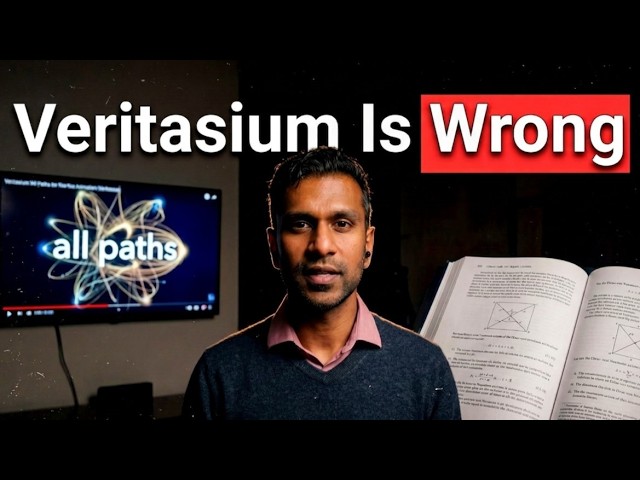
Curt Jaimungal debunks the viral claim—popularized by Veritasium—that quantum particles literally take “all possible paths” simultaneously, arguing this misrepresents Feynman’s path integral formalism as a literal description of reality when it is actually a powerful computational tool defined in abstract configuration space, not physical 3D space.
The “All Possible Paths” Myth and Why It’s Misleading
The phrase “particles take all possible paths” is not a rigorous physics statement—“possible” is not a defined physical term, and the claim inherits a spatial misconception from oversimplified single-particle wavefunction visualizations.
For one particle, it’s tempting to picture the wavefunction as a ripple in 3D space splitting through two slits, but this picture breaks down completely for multi-particle systems.
With n particles, the wavefunction lives in a 3n-dimensional configuration space, assigning amplitudes to each possible arrangement of all particles—not to points in physical 3D space.
The “all paths” narrative incorrectly extrapolates the intuitive single-particle case and treats trajectories in this high-dimensional configuration space as if they were literal paths in 3D space.
The word “possible” is especially unhelpful: classically impossible paths (like backward-in-time or non-differentiable trajectories) are already included, yet blocked paths through barriers are excluded—so the term is vague and uninformative.
Jaimungal compares this to other unexamined slogans in physics (e.g., “space and time on equal footing,” “decoherence solves the measurement problem”) that get repeated by doctrinal inheritance without rigorous justification.
What Path Integrals Actually Are
Path integrals are a computational shortcut for combining unitary evolution and the Born rule in a specific measurement basis—not a literal movie of what particles do between measurements.
Standard quantum mechanics (Dirac–von Neumann axioms) does not describe what happens between measurements; to say anything about that requires an interpretive theory (e.g., Bohmian mechanics, many worlds, or Jacob Barandes’s indivisible stochastic processes).
The core idea originated with Paul Dirac in 1932, who sought to understand the quantum role of the Lagrangian, which had been sidelined by the Hamiltonian-focused Schrödinger and Heisenberg formulations.
Dirac expressed the transition amplitude by dividing time into infinitesimal intervals and inserting complete sets of states.
Feynman, as a PhD student, turned Dirac’s formal insight into the practical computational recipe now known as the path integral—but Feynman himself noted in his 1948 review that it couldn’t calculate anything standard methods couldn’t.
The motivation was always mathematical representation and calculation, not painting a literal picture of particle trajectories.
The Mathematical Tricks Behind Path Integrals
To make path integrals mathematically well-defined and convergent, physicists must employ regularization techniques that undermine any literal ontological reading.
A common trick is giving time a small imaginary component, or performing a full Wick rotation—calculating in Euclidean (imaginary) spacetime and rotating back at the end.
If the path integral literally depicted reality, one would have to claim reality fundamentally occurs in complex or imaginary time—which is not a standard ontological commitment.
Other quantization methods—canonical quantization and geometric quantization (based on symplectic geometry)—are equivalent in most cases but have no obvious “particle takes all paths” interpretation.
If all correct math were equally ontologically binding, there would be no basis to privilege the path integral’s picture over these alternatives.
The Veritasium Experiment: What It Actually Shows
The Veritasium video uses a laser, mirror, and diffraction grating experiment to argue that particles take all possible paths—but this is a misinterpretation.
Mithuna (Looking Glass Universe) showed the phenomenon is fully explained by standard wave optics: Huygens’ principle and diffraction.
Even laser beams are not perfectly localized—they spread out and hit the whole grating, producing diffraction patterns via well-understood wave physics.
The path integral can calculate this outcome because wave equations can often be derived from action principles, but the wave explanation is sufficient and more direct.
The “all paths” interpretation only seems necessary if one incorrectly assumes the laser beam is perfectly localized and doesn’t hit parts of the mirror away from the primary reflection point—but it demonstrably does.
The experiment confirms wave behavior that can be modeled via path integrals; it does not prove the “all paths” ontology is physically real.
Why Physicists Actually Use Path Integrals
Path integrals are widely used in advanced quantum field theory and string theory primarily because they are computationally convenient, not because they are ontologically privileged.
They streamline field-theoretical expansions, perturbation series, and sums over topologies (important in string theory).
They simplify gauge fixing (selecting convenient field configurations to remove overcounting) and Feynman diagrams (each diagram is actually a visual shorthand for a complex integral).
There is no consensus among physicists that the path integral represents the correct ontological picture of reality; it is favored for its practical utility.
Broader Context: Unexamined Slogans in Physics
Jaimungal situates this debunking within a larger pattern of uncritically repeated claims in physics communication:
“Decoherence solves the measurement problem”—it doesn’t.
“Heisenberg uncertainty is caused by measurement disturbing the system”—it’s actually inherent in the algebra.
“Distances below the Planck length are meaningless”—this assumes operationalism, which is a philosophical stance, not a proven fact.
“Erasing one bit must dissipate kT ln 2 of heat” (Landauer’s principle)—John Norton has raised longstanding objections to its universal validity.
He also previews upcoming content on how Bell’s theorems depend on specific causal assumptions (locality, counterfactual definiteness, statistical independence) and particular theories of causation (interventionist in 1964; Reichenbachian factorization in 1975/1990), which Bell himself doubted—meaning the theorems’ power to prove inherent non-locality is weaker than popularly claimed.
Another upcoming topic: quantum expectation values are statistical averages of measurement outcomes weighted by Born probabilities, not averages of an observable’s value between measurements—a category error pervasive in discussions of the classical limit (e.g., Ehrenfest’s theorem, semi-classical gravity).
Final Note on Veritasium
Despite the criticisms, Jaimungal acknowledges Veritasium videos are useful as initial overviews—but warns against wholesale acceptance of any introductory-level claims, including his own.