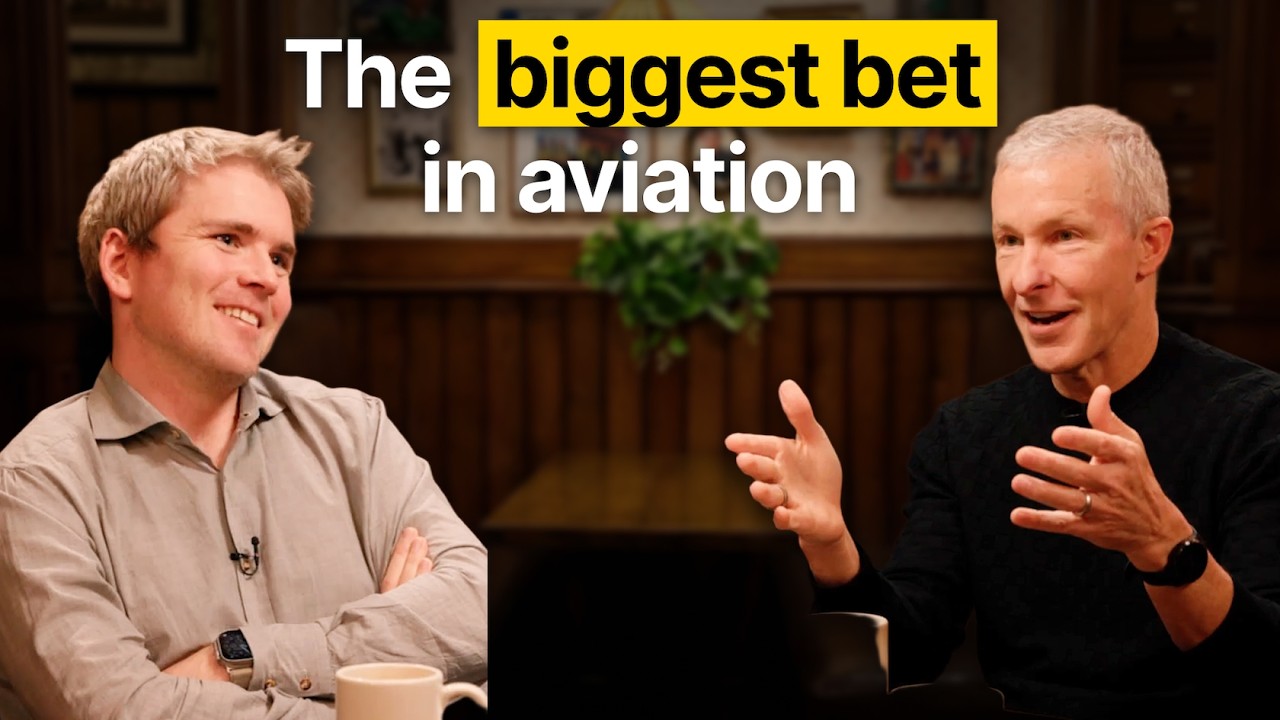
Scott Kirby, CEO of United Airlines since May 2020, explains how contrarian bets during COVID — massive fleet orders, technology modernization, and Starlink Wi-Fi — created durable competitive differentiation in an industry historically defined by commodity dynamics and thin margins.
The COVID fleet bet: contrarian sizing when everyone else shrank
Kirby ordered 200 wide-bodies and several hundred narrow-bodies in 2020 while every other global long-haul carrier permanently retired wide-body capacity.
The consensus view was that travel demand would stay down 50% forever; Kirby believed COVID would be deep but temporary, and that demand would recover.
He framed the risk asymmetrically: because competitors were shrinking, United didn’t need to be right — just “not totally wrong” — and secured exceptional pricing as the sole buyer.
The logic mirrors Samsung’s memory strategy: invest systematically in downturns when assets are cheap and terms are favorable, accepting 30-year asset lives that span multiple cycles.
Kirby dismisses expert forecasts and surveys as unreliable in tail events; surveys captured fear in the moment, not post-crisis behavior, and models like VaR and Black-Scholes fail because they assume normal distributions in fat-tailed realities.
Technology as the core differentiator: modern stack, AI experimentation, and Starlink
During COVID, United committed several hundred million dollars to move off mainframes onto modern cloud databases with no immediate ROI — a bet on optionality that now enables speed other airlines cannot match.
Kirby’s “AI epiphany” came after three one-hour tutoring sessions: he vibe-coded a sports-betting aggregator in 2.5 hours, realizing AI lets non-engineers build functional tools fast enough to skip surveys and just ship.
The tech stack now powers real-time customer communication: weather radar maps sent during delays flipped NPS from -60 to +60 (120-point swing) because people tolerate uncertainty poorly but accept safety constraints when shown the reason.
AI simulations for Denver summer thunderstorms could cut 50–75% of weather delays by using dynamic routing instead of the FAA’s worst-case static restrictions.
Seat-back entertainment software is being taken in-house from Panasonic to enable personalization (default map view, milestone celebrations, drink preferences) and integration with the app for proactive rebooking alerts.
Kirby’s philosophy: “Wow” is the job — every cool feature becomes table stakes, so the culture must constantly invent the next surprise.
Starlink: the only fast option, free is not the value prop
United rolled Starlink to 48% of flights (50% within a week), starting with regional jets because they were certified first; 787 certification lags due to Boeing.
Kirby made it free, but emphasizes: “Free was never the value proposition. Fast is the value proposition, and there’s only one option for fast. It’s Starlink.”
Legacy free Wi-Fi on competitors is “dial-up” — physics limits bandwidth on geostationary satellites; making it free degrades experience for everyone.
The economic case wasn’t painful: higher cost, but “you often get what you pay for.” United didn’t initially grasp the magnitude of customer switching behavior (“I’m switching to a regional flight because it’s got Starlink”).
Certainty matters: United will show Starlink probability in the app; LA will be the first 100% Starlink hub in H1 2025.
Window: 2–3 years of exclusivity at scale to convert loyalty — customers try for Starlink, stay for the broader tech stack.
Air traffic control: the 90% bottleneck, political not technical
ATC is the single biggest limiter; capacity grows ~5% annually but ATC cannot keep pace — already causing flight caps in New York, Chicago, San Francisco.
Modernization is a 5–10 year capital project hamstrung by annual appropriations, political pork (450 facilities for congressional districts vs. centralized centers), and private-jet lobby opposition to user-fee reform (airlines pay 100% of fees; private jets pay ~0%).
Kirby: “If the people at Stripe were allowed to run it, they’d really increase. More progress would happen.” Best FAA/DOT leadership in his career, but structural government inefficiency caps progress.
Privatization is politically toxic; user-fee reform blocked by private-jet lobby. Result: fewer flights, higher fares, creaking system.
Hub strategy and route discipline: network as foundation
Chicago example: United and American run duplicative catchment flights (e.g., 16/day CHI-MKE); a single hub would run 8 on larger gauge and redeploy slots to Paris/Tokyo — driving more economic activity for the city.
Atlanta and Dallas (single hubs) outperform Chicago on international seats and passengers despite smaller populations.
Kirby: “Schedule is the #1 reason people pick an airline. But everything else matters for brand-loyal customers: service, product, reliability, technology.”
Route selection is the make-or-break discipline: “If you hear the word ‘strategic flying,’ you don’t need to know the route — cancel it.” Negative-margin flying justified as “strategic” (corporate contracts, credit cards) is usually a lie.
United’s creative route team (Patrick Quayle) finds non-data-backed opportunities: Nuuk (Greenland), pilgrimage routes in Spain/Portugal, Uzbekistan/Kazakhstan scouting — try, measure, kill fast if it loses money (assets are fungible).
New hubs are effectively impossible post-deregulation: need 600 flights/day to compete; no Southeast airport has gates/runways; airport expansion takes decades.
Competition: Delta, American, low-cost carriers, and the premium/loyalty model
Delta gets respect for pioneering brand loyalty; United’s Starlink push is now the biggest competitive lever against them.
American’s Chicago losses (~$1.5B) stem from Sun Belt focus and gate reallocation rules they ignored — not United aggression.
Low-cost model works only with discipline: Ryanair (only successful global LCC) sticks to secondary airports, high turns, short flights; US LCCs abandoned the model for big airports, got priced out (NYC airports: $52/pax vs. Spirit’s $58 avg fare).
Southwest trying to be like legacy carriers; legacy carriers failed to out-Southwest Southwest. “Know who you are, stick to your knitting.”
Frequent flyer economics: 50k people/day fly free on miles — revenue is disclosed, cost is ignored. “Airlines are a credit card business with airplanes attached” holds the P&L upside down.
United’s loyalty changes (simplified thresholds, club expansion during COVID) aim to grow brand loyalty, not extract short-term revenue; clubs doubled in square footage, growing another 50%.
Star Alliance and partnerships: making partners feel like United
Value: connectivity to places United doesn’t fly (60% of Frankfurt/Munich passengers connect beyond via Lufthansa).
Downside: inconsistent experience. United forced partners to offer seat assignments to United customers by threatening to cut partnerships.
Goal: United customer on any partner feels like they’re still on United — tech integration, service standards, recognition.
Industry structure: two winners, ego-driven losses elsewhere
US industry now has two structurally profitable airlines (United, Delta) with brand loyalty; 6 of 10 US carriers will lose money in 2024.
Ego still drives negative-margin flying globally (“negative 100% margins” possible via cost allocation).
United’s constraint on tech investment is management bandwidth, not money; competitors cut investment to hit quarterly CASM-X targets.
Consolidation logic: eliminate duplicative capacity at slot-constrained airports, create a US flag carrier that can compete with state-subsidized global giants (Emirates, Singapore) on every dimension.
Personal operating system: time efficiency, sleep, and quirks
2–3 hours of meetings/day; no social media (writes own LinkedIn/Instagram but doesn’t browse); no TV; 8.5–9 hours sleep/night.
“Short-sleeping contest in American business is funny — proven deleterious cognitive effects. You can see brains turned off in meetings.”
Quirk: eats salad with a serving spoon — faster, mixes ingredients, gets all the bits. Wife annoyed but admits it’s tastier.
Card-counting phase taught him sleep deprivation kills edge: maximizing table time at 3 hours sleep caused mistakes; returned to 8.5 hours.
Barred from blackjack in Vegas (still allowed poker); casinos now use 6/5 payouts and rule changes that make counting mathematically impossible.