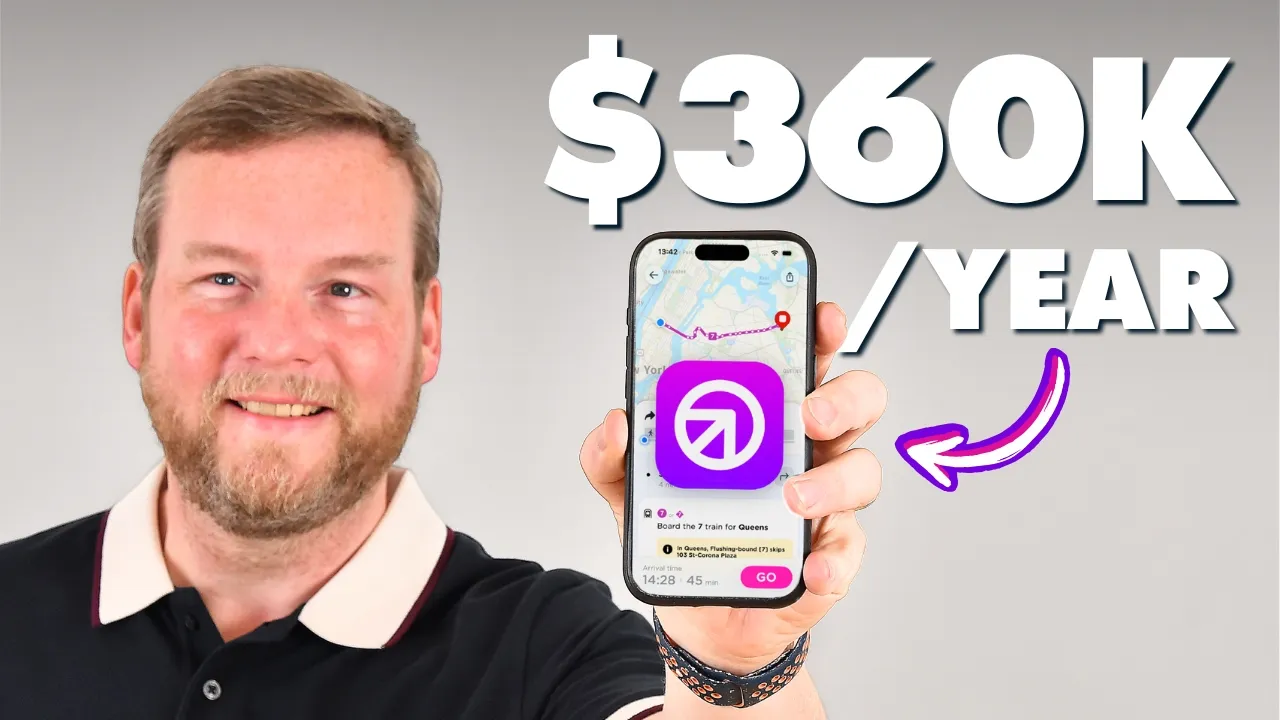
-
John Makavoy
- Is a solo founder from Scotland.
- Built Mumigo without previous smartphone app development experience.
- Started his career in graphic design.
- Became curious about development, JavaScript, backend systems, and databases.
- Built the app because he wanted a better way to see buses on a map.
- Got the idea while working for a bus company in Edinburgh.
- Wanted the same map-based arrival experience that Uber provided for taxis.
- Wanted to finish his morning coffee instead of waiting 10 or 20 minutes at a rainy bus stop.
-
Mumigo
- Is a bus and train tracking app.
- Covers over 160 cities.
- Shows live buses and trains on a map.
- Helps users plan trips and avoid missed connections.
- Includes Trip Assist, which tracks a journey and uses server-side machine learning to watch for delays or missed connections.
- Can notify users and suggest alternative routes when problems appear ahead.
- Uses an onboarding flow designed for people installing the app at a bus stop or train station.
- Quickly asks for location permission because it is critical to the app.
- Shows value, social proof, and premium features before the paywall.
- Offers a yearly plan with a seven-day free trial, a weekly plan, and a lifetime plan.
- Uses a reverse trial when users close the paywall, giving one week of Pro without payment or commitment.
-
Metrics and Financials
- Has been downloaded about 5.2 million times since 2017.
- Makes around $30,000 in monthly recurring revenue.
- Has about 400,000 monthly active users.
- Has around 75,000 ratings.
- Previously made around $8,000 per month from banner ads before the pandemic hit ad revenue.
- Rebuilt around subscriptions in August 2020.
- Used paywall and onboarding A/B tests in 2021 to increase conversion from 0.5% to 8%.
- Grew from around $8,000 per month to over $30,000 after optimizing conversion.
- Runs about 20 dedicated servers costing around $2,500 per month.
- Spends about $1,000 per month on third-party APIs such as mapping.
-
Build Journey
- Started by creating designs in Illustrator.
- Built the first versions in Xamarin using C# and .NET because that matched his existing comfort zone.
- Spent months building, failing, and tweaking because mobile app development differed from web development.
- Improved the messy code after launch.
- Rebuilt the iOS app in native Swift after Swift had matured.
- Rebuilt quickly with Flutter because the app uses maps and sliding panels.
- Completed the rebuild in roughly two or three months.
-
App Store Optimization Playbook
- Finds specific phrases people search for and adds them to the app title, subtitle, and keyword list.
- Uses location-specific keywords such as New York subway and Chicago train.
- Adapts metadata to local terminology.
- Uses terms like MTA subway for New York.
- Uses terms like CTA L train for Chicago.
- Updates screenshots for each localization so users immediately see the app works in their city.
- Uses additional localizations to index more keywords in the US App Store.
- Finds more keywords through Apple Search Ads or App Store autocomplete.
- Targets specific lower-popularity phrases where it is easier to reach the top five.
- Asks for ratings at golden moments inside the app.
- Uses moments when users see a live bus or train moving on the map.
- Relies on continuous ratings to rise organically for target keywords.
-
Tech Stack and Tools
- Uses Laravel and PHP for the backend.
- Uses Adobe Creative Suite for marketing materials, UI graphics, and app graphics.
- Uses Lottie for animations created in After Effects.
- Uses Appfigures for ASO research.
- Uses RevenueCat for subscription management.
- Uses Mixpanel for event analytics.
- Uses Cloudflare as a geographic load balancer for about $90 per month.
- Uses ChatGPT for many tasks at about $20 per month.
-
Lessons and Advice
- Solve a problem you personally have.
- Use your own problem as motivation when working nights and weekends gets difficult.
- Avoid relying only on vanity metrics such as monthly active users.
- Move to event-based analytics when trying to grow.
- Use A/B testing and data to understand customers and improve conversion.