-
Lucas Herman
- Background and Origin Story
- Started his first development job in 2007 while still in high school, riding his bicycle to work and building HTML pages.
- Began studying in 2017 because his father wanted him to have a degree.
- Freelanced while studying because he wanted to understand what it felt like to run his own developer business.
- Joined a startup after finishing his degree in 2020.
- Made the first commit for Stage Timer in November 2020, shortly after COVID hit.
- Quit his job in 2022 after his wife encouraged him and Stage Timer reached about $3,000 per month.
- Pivotal Moments and Turning Points
- Found the idea by watching a friend use an old Flash app on an old laptop to run timers in a studio.
- Realized the workflow was awkward because his friend had to walk into another room to start a timer.
- Shipped the MVP in three days by using technologies he already knew.
- Took 224 days to earn the first dollar because Stage Timer was still a side project.
- Reached $10,000 in monthly revenue by September 2023.
- Background and Origin Story
-
Products and Offerings
- Stage Timer
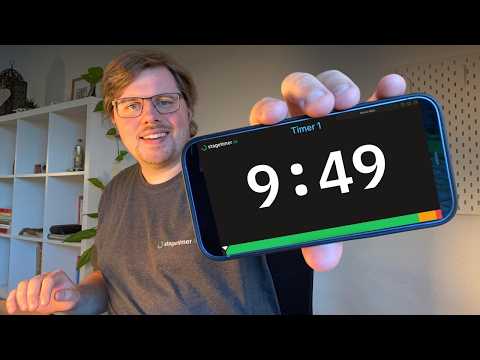
- Built Stage Timer as a simple timer for live events, presentations, and video productions.
- Let one person control a timer while multiple people view it on other screens.
- Helped event teams communicate with people on stage more easily than holding up paper signs.
- Supported use cases such as TED-style talks, TV broadcasts, election coverage, and horse races.
- Included messaging so operators could show notes such as asking a speaker to hold a microphone closer.
- MVP
- Started with one core feature: clicking a button in one place to start a timer somewhere else.
- Launched as a free tool before monetization.
- Stage Timer
-
Metrics and Financials
- Revenue and Users
- Reached $25,000 in revenue per month.
- Served 20,000 total users.
- Had 4,400 users who were paying or had paid at some point.
- Received 86,000 unique visitors per month.
- Costs and Profitability
- Spent about $280 per month on servers and infrastructure.
- Spent about $250 per month on tools and services.
- Spent about $1,400 per month on paid ads.
- Ran the business at an 80% to 90% profit margin.
- Revenue and Users
-
Strategy and Growth
- Reddit Validation
- Found niche subreddits where video production people gathered.
- Posted once per subreddit with a link and asked people to try the tool and give feedback.
- Kept the early website free so users treated the post as a feedback request rather than a sales pitch.
- Received detailed feedback from people who wanted the app and suggested improvements.
- Search and Niche Content
- Generated about 50% of traffic from Google.
- Created documentation pages and videos for specific niche workflows and integrations.
- Targeted high-intent keywords from people looking for concrete answers.
- Found useful keyword opportunities by publishing documentation and articles, then doubling down on what people clicked.
- Word of Mouth and Product-Led Growth
- Generated about one-third of traffic from people recommending Stage Timer to others.
- Put the Stage Timer logo and name on every shared link.
- Used a memorable domain in the logo so people could recall it after seeing it at events.
- Kept a free tier so freelancers could bring Stage Timer to events and expose new customers to the product.
- Family Business
- Invited his wife to join after the first customers arrived and marketing and support needs grew.
- Had his wife handle Google ads, sales emails, and customer support.
- Focused himself on product, finances, development, and overall direction.
- Reddit Validation
-
Tech Stack and Infrastructure
- Development
- Built the MVP with JavaScript, Vue.js, and NodeJS.
- Avoided unfamiliar technologies so he could ship quickly and keep working in one-hour evening sessions.
- Used Sublime Text and Sublime Merge as his development tools.
- Business Operations
- Used Airtable as a CRM with automations on top of customer data.
- Used Postmark to send emails.
- Development
-
Lessons and Advice
- Simple Ideas
- Learned that many businesses still use awkward, outdated tools that developers could improve.
- Recommended observing people outside the developer bubble to find simple workflows worth automating.
- Believed there are many small niches that can support million-dollar app businesses.
- Founder Advice
- Encouraged builders to get started even if regulations, taxes, or bureaucracy feel intimidating.
- Said people can build and scale simple businesses even in Germany.
- Treated the key challenge as finding the right small opportunity rather than building something technically complex.
- Simple Ideas