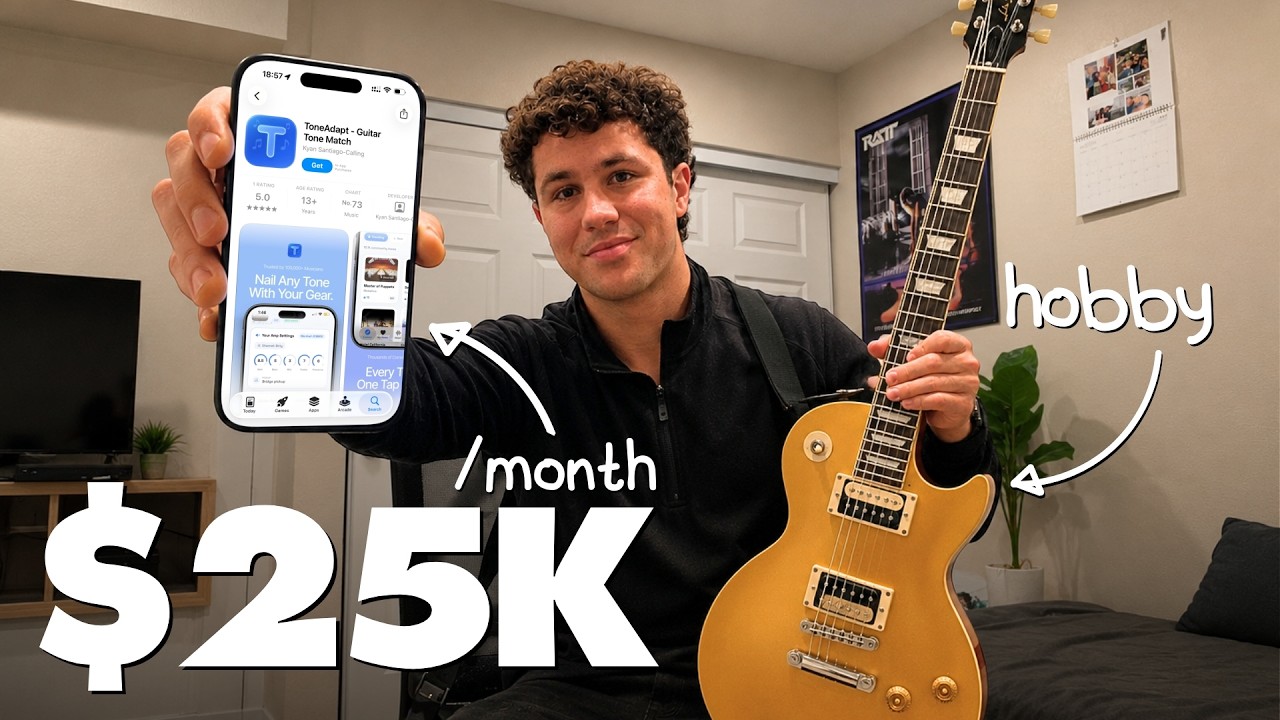
Ken, a 21-year-old CS student at San Diego State, built Tone Adapt — a guitar tone-matching app — in about a week using AI coding tools, and grew it to $25K/month within 5 months, largely by posting on social media 3x/day and putting his face behind the brand from day one.
What Tone Adapt does
Tone Adapt is a website and mobile app that tells guitarists exactly how to set up their gear to sound like any song, in under 30 seconds.
Users input their guitar, amp, and pedals, search a song (e.g., “Hotel California”), and the app returns the original artist’s gear, estimated amp settings, and adapted presets matched to the user’s own rig.
The database covers 1,500+ guitars and 2,000+ amps.
Pricing: ~$10/week or ~$60/year.
Combined web and mobile revenue hit ~$25K/month, with the mobile app alone doing ~$14K/month and 397+ active subscribers within a month of launch.
How Ken got the idea
He was struggling to get internships and wanted a resume project.
He noticed he was using ChatGPT to figure out guitar tones, but it was inaccurate.
He validated the idea by talking to other guitarists on Reddit and Instagram comment sections who had the same problem.
His core insight: if he had a tiny problem, thousands or tens of thousands of others probably did too.
Build process and tech stack
V1 was built over Thanksgiving break in about a week; Ken says it would take a couple hours today.
Every line of code was “vibe coded” using Cursor — Ken wrote no code himself.
Web stack: Supabase (database), Vercel (hosting/analytics), Mailgun (emails), Stripe (payments), OpenAI API, Tavily web search API, Cloud Code for code writing.
Mobile stack: Swift native app, Supabase, RevenueCat (subscriptions), Superwall (paywalls and A/B testing).
Growth and marketing playbook
Ken’s first video about Tone Adapt went viral overnight.
He committed to posting 3x/day across Instagram, TikTok, YouTube, and Facebook, reposting across platforms.
He put his face behind the brand immediately to build trust and make users feel like they were joining a journey.
He embraced being “cringe” — the first video was embarrassing, but after it was online, every video after got easier.
Once a content format converted, he scaled it aggressively: remade it 50 times with small variations, planned to hire UGC creators to copy it 60 times/month, and intended to put money behind it on Meta and TikTok ads.
His formula: post relentlessly until you find one winning format, ride it until it dies, then repeat.
Ken’s advice for others
Pick a hobby or niche you already know. You understand the pain points without market research because you are your own target customer.
Find a tiny problem. Any inconvenience, slow process, or inaccurate result in a hobby is a business opportunity.
Ship V1 fast on the web. Don’t polish, don’t design a logo — just build something, put it online, and charge money for it to get revenue and feedback immediately.
Post every single day for at least a month. Any content is better than no content; someone will see it and use the app.
Start posting on social media today, even if you’re not selling anything — it’s the most valuable skill for growing a business.
Key takeaways from Pat and Gus
Simple, niche tools that solve a specific painful problem can be very profitable — Tone Adapt isn’t a learn-guitar app, just a tone-matching tool, and that simplicity is its strength.
AI coding tools like Cursor now let anyone build and ship an app extremely fast, which means the real differentiator is attention and content, not technical ability.
As AI makes it easier to build apps, standing out will depend more than ever on consistently creating content that gets eyes on the product.