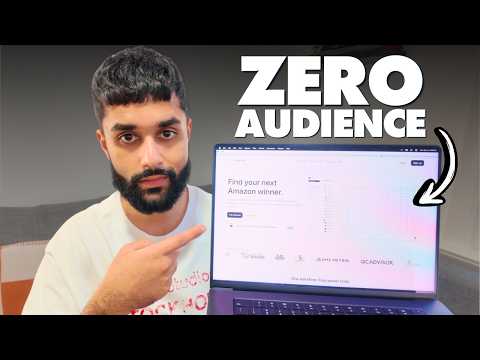
-
Ham
- Built Launch Fast as his first SaaS from his Amazon business experience.
- Is a non-technical founder.
- Worked a corporate job while running two Amazon brands on the side.
- Discovered Cursor and AI tools early through Twitter.
- Built about 10 to 12 projects across different spaces before Launch Fast.
- Said most earlier projects never made it to production.
- Realized his Amazon domain knowledge was an advantage most developers did not have.
- Built a tool he wished he had as an Amazon seller.
-
Launch Fast
- Is an AI-powered Amazon product research tool.
- Is built specifically for private label sellers.
- Helps users find, validate, and source products in minutes instead of weeks.
- Replaces manual research that had taken Ham 20 to 30 hours per product idea.
- Serves a niche audience of Amazon sellers.
- Has an official Chrome extension with 330 active users.
- Has only paying users at the time discussed.
-
Metrics and Pricing
- Reached over $20,000 in MRR within 90 days.
- Hit about $10,000 MRR around day 30.
- Reached around $17,000 to $18,000 MRR around day 60.
- Reached about $21,800 MRR around day 90.
- Offers $50 per month pricing to Legacy X coaching customers.
- Offers $199 per month regular pricing to the general public.
-
Distribution Partnership Strategy
- Recognized that no audience meant no distribution.
- Remembered Legacy X, a coaching program he had bought two years earlier.
- Saw that Legacy X already had thousands of active Amazon sellers.
- Chose to partner with someone who already had distribution instead of building an audience from scratch.
- Traded equity for instant access to target customers and validation.
- Believes 50% of $20,000 MRR is better than 100% of zero MRR.
- Reached out to Legacy X and offered to build a better product research tool in 48 hours with no strings attached.
- Sent a demo and woke up to a call telling him to quit his job and work on it full time.
-
48-Hour Build Process
- Spent the first four hours mapping Legacy X systems, SOPs, data, and workflows.
- Combined their workflow with his own Amazon seller process to define the MVP.
- Used hours 5 to 12 to build core features in Cursor.
- Prioritized functionality over perfection.
- Used hours 13 to 20 for bug testing and iteration.
- Used hours 21 to 30 to polish the UI and branding.
- Treated branding as important because of his Amazon experience.
- Used hours 31 to 40 for more testing and edge cases.
- Finished with demo prep, recorded a video, and sent it to Legacy X.
-
Domain Knowledge Playbook
- Identify three to five industries or domains where you have deep knowledge and have personally solved problems.
- Find validated markets inside those domains.
- Look for niches with existing successful SaaS tools.
- Use tools such as Sensor Tower, Ahrefs, or Google Search Console to study competitors.
- Remember the idea does not need to be unique if execution is better in a proven market.
- Deep dive on user pain points.
- Study Reddit, Facebook groups, Twitter, and review sites.
- Identify the user, their ultimate goal, and the defects in current tools.
- Build the MVP around the highest-ROI feature with the easiest implementation.
- Partner for distribution instead of building an audience from scratch.
- Look for coaching companies, communities, influencer groups, and others with target customers.
- Send demos and offer partnerships.
- Iterate daily after launch.
- Use bugs, feature requests, and user feedback as inputs.
- Ship at least one improvement every day for 30 days.
-
Tech Stack and Costs
- Uses Cursor to write code.
- Hosts on Vercel and deploys with the CLI from Cursor.
- Uses Supabase for database, auth, and storage.
- Uses Resend for personalized onboarding emails.
- Uses Apify for data aggregation.
- Builds with TypeScript and Next.js because Ham sees it as modern and AI-friendly.
- Expects costs to stay low early, with Cursor Max at about $200 as the main expense before finding a winning product.
-
Lessons and Advice
- Monetize domain knowledge by turning it into software.
- Stop waiting and stop overplanning.
- Ship something this weekend and put it in front of at least 10 people.
- Listen to feedback, iterate, and ship again.
- Repeat when the first attempt does not work.
- Remember that AI tools closed much of the gap between idea and execution.