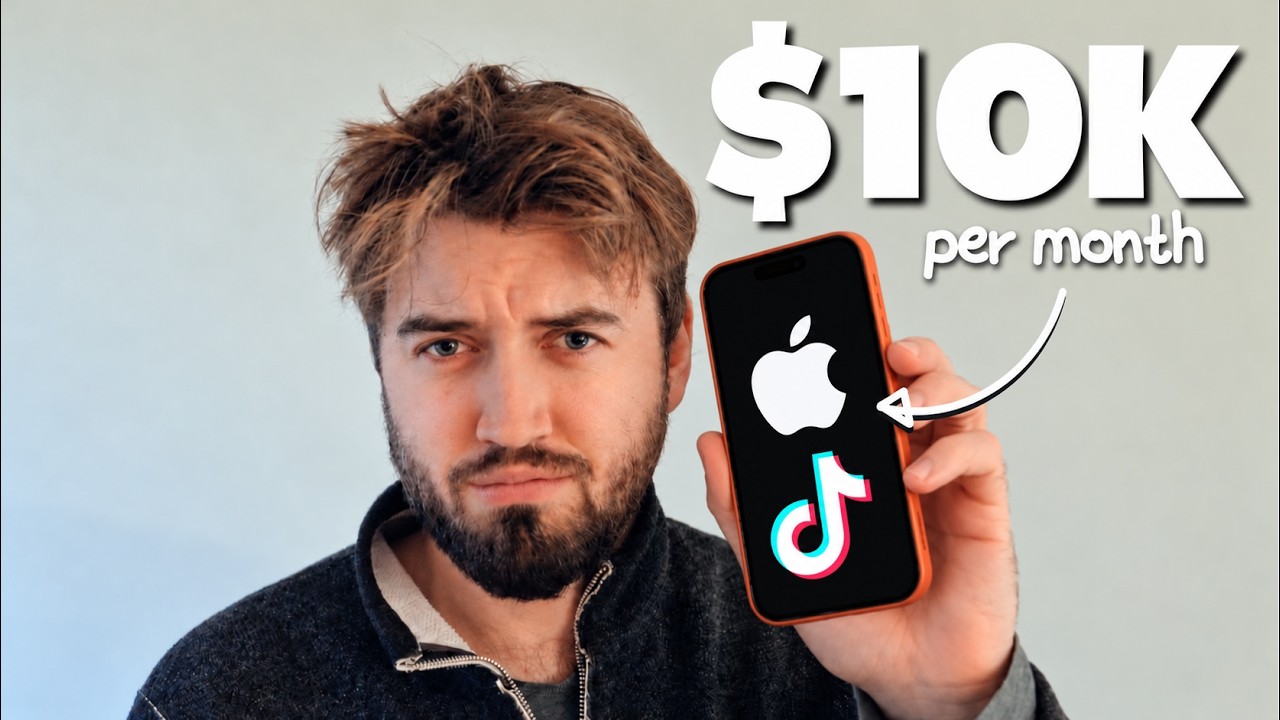
Frederick James, a software developer formerly in big tech, built a habit-tracker iOS app in the health and fitness niche that peaked at $13K/month and currently hovers around $10K/month, achieving this in roughly three months after a health scare prompted him to pursue financial freedom through app development.
App overview and positioning
The app is a habit tracker with a focus on premium design and polished UI as its main value proposition; Frederick acknowledges it is not unique or innovative.
He chose the idea after seeing a breakdown of a competitor’s onboarding flow on X, realizing he could replicate the concept, elevate the design, add a few obvious missing features, and likely sell it.
Category: health and fitness; download-to-paid conversion ~7%; refund rate ~0.7%; ~$25K revenue in the last 90 days; ARR peaked just under $100K.
Background and motivation
Frederick has been a software developer since childhood; spent the past five years in London working in big tech.
Felt dissatisfied with the “regularness” of a 9–5; a health scare last year pushed him to “life max” and go all-in on building apps while sharing the journey publicly on X.
Previous ventures: reselling Supreme hoodies at 15, dropshipping, music production (moderately successful but low monetization).
Build process and tech stack
Stage 1 – Design & planning: Creates mock UI in Figma first (wireframes improve AI one-shot success); maps a basic entity-relationship diagram (ERD) for data structure; drafts an infrastructure diagram for data flow; designs App Store screenshot MVPs in Figma, polished with GPT-image.
Stage 2 – Assets: Sources visual assets from Pinterest, customizes them with GPT-image (2.5) for onboarding and in-app visuals; feeds all mockups to ChatGPT, which builds out the full UI flow.
Stage 3 – Post-launch iteration: A/B tests paywalls, pricing, and pricing options daily after release.
Backend: Cloudflare stack — R2 for free asset storage, D1 for serverless database, Cloudflare Workers for compute.
Analytics & monetization: AppsFlyer (free up to 12K installs) for MMP; RevenueCat for subscription tracking, monetization, and remote paywalls.
AI coding agents: ChatGPT Pro ($100/mo) as primary agent; recently added Claude Pro to test Opus 3.5.
Branding: Purchased a custom font ($300 one-time) used across all apps, websites, and video subtitles to differentiate visually.
Growth phase 1: Zero to ~$5K/month — Apple Search Ads
Core playbook: Start with a “cracked” App Store page (AI-generated or designer-hired screenshots for ~$50–100); set up attribution via RevenueCat (few lines of code + dashboard clicks).
Campaign setup: Turn Search Match off; bid on exact-match keywords — specifically the names of large competitors (e.g., Duolingo) so the app appears when users search for them.
Bidding: Start with Apple’s recommended max bid; wait at least 2 days for spend to stabilize; if not spending, increase bid to compete.
Daily routine: Export data from RevenueCat and Apple Ads each morning, combine, feed to AI agent to identify best performers; iterate daily.
Budget: $100 free credit to start; no massive budget required.
Growth phase 2: ~$5K to ~$10K/month — TikTok Ads (hockey-stick growth in ~1 week)
Creative strategy: Found organically viral videos in the niche, remade them personally; tested five distinct formats, one post per format ($50 ad spend each).
Early signal gathering: Accepted initial unprofitability on the ad account (not the app) to feed TikTok’s targeting algorithm; stopped only “super unprofitable” ads.
Profitability target: Aimed for breakeven on initial transaction alone; rough P&L: realized LTV minus CPA, minus 15% App Store fee (or 5% on Small Business Program), minus 1% RevenueCat fee, minus VAT (~20% for EU subs, 0% for US direct).
Budget scaling: Increase budgets by ≤20% every few days (TikTok explicitly warns against larger jumps).
Inflection point — Goal-based budget optimization: Set a target CPA; let TikTok auto-adjust spend to maximize conversions at that CPA. Campaign jumped from ~$200/day to ~$1K/day, driving revenue from $5K to $10K in about a week.
Profitability and unit economics
Paid ads require upfront risk tolerance: Frederick was unprofitable for the first couple of weeks; first-timers may burn up to ~$1K before seeing return.
Ongoing paid-ad margin ~30% (not high); relies on volume and LTV.
Recommends enrolling in Apple’s Small Business Program (15% → 5% fee) immediately.
Paid ads vs. other acquisition channels
Framework: Marketing is paid with either time or money.
Founder-led content / organic: all time.
Influencer / UGC campaigns: middle ground (manage creators, higher margin but time-intensive).
Paid ads: all money, minimal time.
Why paid ads? Managing influencers is a “nightmare”; running UGC armies consumes time; paid ads scale with capital instead of labor.
Caveat: Sole reliance on paid ads is non-optimal — thin margins, hard to sell the business, single-point-of-failure risk (e.g., TikTok ban). Recommends combining channels for resilience and sustainability.
Advice for aspiring app builders
Try everything, fail fast: Success is “failure on a long enough timeline”; be willing to fail repeatedly and accelerate the cycle.
Entrepreneurship is a marathon: Pace for physical and mental health; it can be a grind; overnight success is a myth — most founders fail for years before breakthrough.
Build in public: Frederick’s authentic storytelling on X attracted attention, partnerships, and this interview; stands out in an era of AI-generated content and “dead internet” skepticism.
Any idea can work: Even a “boring,” saturated habit tracker can hit $10K/month with execution, design, and paid acquisition; saturation is not a blocker.
Host’s closing takeaways
Multiple valid paths to win in apps: paid ads, UGC/influencer, founder-led content — choose what you can stomach (time vs. money).
Building in public authentically is a powerful springboard for distribution and future projects.
Proven ideas in crowded markets still work; execution and distribution matter more than novelty.