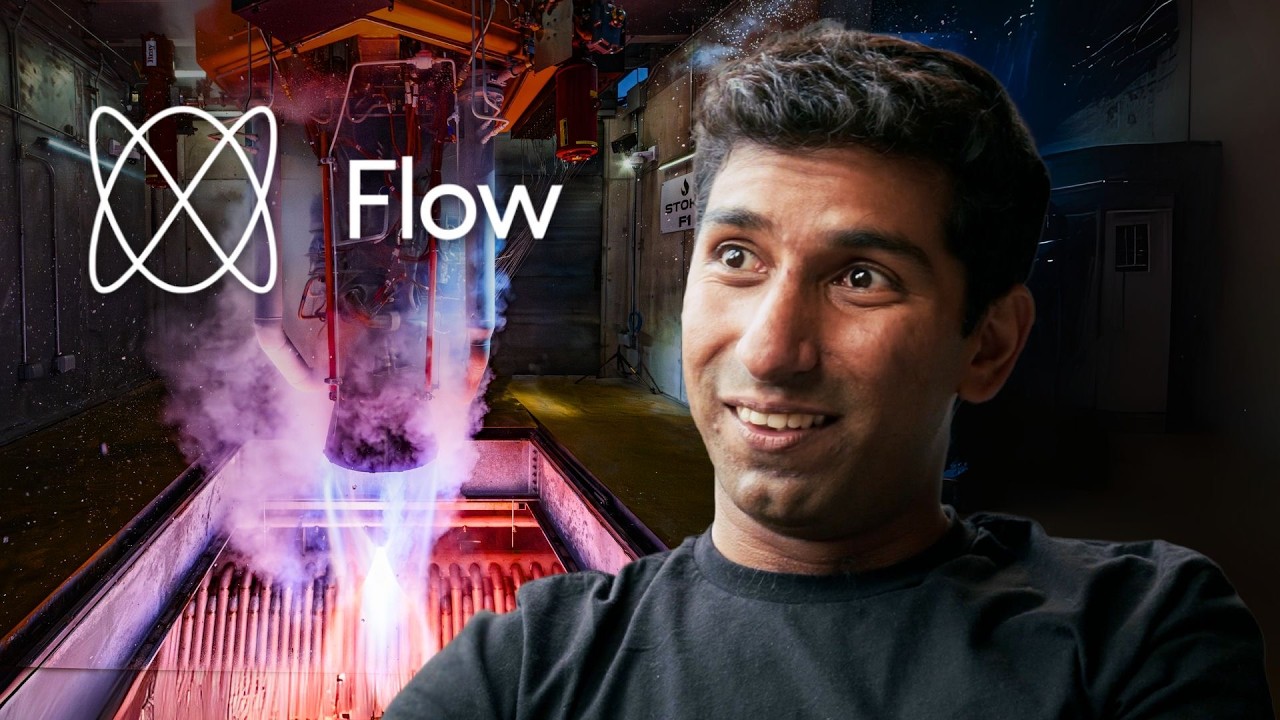
Pari Singh, founder and CEO of Flow Engineering, describes how his company pivoted from building rocket engines to creating a software platform that reinvents how complex hardware is designed, arguing that the fundamental bottleneck across aerospace, nuclear, robotics, and energy is not physics but the outdated waterfall engineering process that breaks down as system complexity grows.
The origin: from rocket engines to a new engineering paradigm
Singh started as a mechanical engineer wanting to build machines that matter; after working at BAE Systems and BP, he saw that engineering workflows had not fundamentally changed since the space race.
He founded a “rocket company” to prove a new way of working: instead of selling software, they would design rocket engines 100x faster (requirements to detail design in 2.5 hours vs. 12 weeks) using an internal platform called Flow that linked requirements, MATLAB, CAD, CFD, and FEA in a tight loop.
The breakthrough realization: they had not built an automation tool but an abstraction layer that let them start with low-fidelity models and increase fidelity multiple times per day — a software-style agile approach applied to hardware.
Two conclusions followed: (1) this bottom-up, iterative way will become how everyone designs complex systems, and (2) the tooling to enable it is so painful to build that every company would need 10 years to replicate it — so Flow should productize it and give it to the industry.
SpaceX and the generational shift from waterfall to iterative
The industry is undergoing a generational change from top-down, 10-year waterfall cycles (NASA, Boeing) to bottom-up, 3-month iterative cycles (SpaceX, Anduril, Joby, Figure).
The core difference: traditional primes decompose requirements upfront, lock them into Gantt charts, and execute; new companies accept that unknown-unknowns dominate high-complexity systems, so they build, test, learn, and integrate in thousands of small cycles.
Software engineering made this shift in the 2000s; chip design followed as transistor counts exploded; gaming moved from waterfall to agile; now hardware is making the same transition because complexity has crossed the threshold where top-down control fails.
Boeing Starliner vs. SpaceX Dragon illustrates the cost: Starliner spent 2x more and took 4 years longer yet delivered lower quality because waterfall cannot handle the cross-domain coupling (engine ↔ structures ↔ avionics ↔ software) of modern vehicles.
Apollo was actually iterative: Mercury → Gemini → Apollo, each step attacking the next layer of risk, learning from flight heritage, not from a million upfront requirements.
How hardware teams will work in the future
The differentiator is avoiding analysis paralysis: new-wave companies ask “what can we ship in 3 months?” not “what could go wrong?” — they accept probability of failure, build multiple shots on goal, and learn by doing.
This iterative philosophy will become the default for all hardware (smartwatches, robotics, nuclear, rockets), separate from the entrepreneurial skill of building a generational company.
The “responsible engineer” (RE) role emerges: a single person owning mechanical design, systems engineering, project management, and manufacturing for a subsystem — replacing fragmented functional handoffs.
China, the US, and the possibility of war
Singh estimates an 85% chance of US–China war within 5 years, citing Xi Jinping’s explicit statements, US political uncertainty, and Ray Dalio’s great-power-cycle thesis.
China leads in most hardware verticals (shipping, nuclear SMRs, solar, batteries, EVs, robotics) and operates at higher intensity (996 culture, severe consequences for failure); the US depends on Chinese chips and supply chains more than acknowledged.
Two paths for the West to win: (1) reliability and safety — be later to market but an order of magnitude more rigorous (US/FAA vs. China’s “move fast and break things” that hasn’t yet mastered the safety/iteration balance), and (2) win the “new game” — networked autonomous systems where drones, robots, submarines, and tanks operate as a single AI-driven cluster, not hardware-first platforms.
Anduril exemplifies the new game: a software company with hardware components; the mesh layer and AI matter more than any single platform.
Regulation must stay a sliding scale: aggressive iteration early, rigorous safety when humans are in the loop; the FAA’s engineering-first approach beats EASA’s paperwork-first approach.
Three eras of manufacturing and the coming fourth
Era 1 (1940s–80s): Analog — pen, paper, physical test (Apollo, Manhattan Project).
Era 2 (1980s–present): Digital — CAD, simulation, parametric models (Space Shuttle era); enabled higher complexity per vertical but kept siloed workflows.
Era 3 (now): Iterative/Autonomous — software invades hardware (watches become wrist computers, cars become autonomous platforms), complexity jumps 10–100x, demanding cross-functional, bottom-up, automated testing and git-like branching for hardware.
Era 4 (future): Computational/Generative — engineers won’t draw the 15,000th valve variant; generative design will produce it.
Era 5 (further out): Software becomes hardware — nanotechnology blurs the distinction.
Agile vs. iterative: a critical distinction
Iterative = bottom-up, build-ship-improve in short cycles; requirements may be fixed (SpaceX: cost/kg to orbit is a stable north star).
Agile = continuously questioning and discovering top-level requirements (drone companies: range, payload, autonomy level, price point all unknown and shifting with the war).
Some companies need both: iterative execution plus agile requirement discovery.
Building Flow: three major philosophical pivots over eight years
Phase 1 (Rocket Company, age 21): Prove the new workflow by being the fastest rocket-engine consultancy; mission always “reinvent how humanity designs complex hardware.”
Phase 2 (Engineering Platform, age 22): Realized tools didn’t exist; pivoted to software, raised VC, built the platform and paradigm in a “man cave” — breakthroughs in integrated modeling and autonomous branching.
Phase 3 (Product + Beachhead): Tried selling to McLaren, Rolls-Royce; they loved the vision but were overwhelmed, 3 months behind, no cultural readiness. Realization: software alone isn’t enough — behavioral change and a movement are required.
Phase 4 (Trojan Horse): US customer Stoke (5-person reusable rocket startup) said “we’ll use it if you solve requirements management today.” Flow reluctantly built a requirements-management app on the platform; it became the beachhead — customers adopted it for the known pain, then discovered the new paradigm.
Phase 5 (Market Shift): European incumbents lacked urgency; the Elsagundo new-wave companies had the culture and existential need to work differently. Flow went all-in on the emerging ecosystem.
Increasing scope until you’re underestimated
Singh deliberately expands the mission scope (reinvent all hardware design → enable Starship Enterprise-scale systems → computational era → software-is-hardware era) until observers underestimate the probability of success.
He views impact as the delta between a universe where he exists and one where he doesn’t; the goal is to maximize that delta by taking each necessary step on the S-curve — you cannot skip eras, but you can accelerate through them.
Special forces culture and second-order people
Flow runs a “special forces” culture, not an “army” culture: processes that work for average performers repel elite talent, and vice versa.
Talent taxonomy: Zeroth-order (80%) — default career track, seek balance; First-order (15%) — high achievers, prestigious credentials, optimize within existing ladders; Second-order (5%) — exponentials who take local hits (pay cut, longer commute, lower title) for steeper long-term growth slopes.
Second-order people are both talented and make the deliberate decision to trade short-term comfort for long-term trajectory; Flow hires exclusively for this profile.
Hunger/determination > raw IQ: a determined person building a trash-collection empire contributes more than a genius taxi driver.
Asking the right questions: action produces information
Rejects the “think for years to find the optimal life path” approach — leads to local optima and paralysis (cites Europe’s intellectual over-analysis).
Instead: contribute maximally today using natural strengths, then continuously reassess with real-world data — exactly the agile/iterative loop applied to life.
Hardest thing overcome: the Chinese farmer parable
An old farmer responds “we’ll see” to every event (boy lost, boy returns with donkey, boy breaks leg, war spares the boy) — outcomes are inseparable from the journey; every challenge (rockets, software, pivots, geography, culture) is part of the path, not a separate obstacle to lament.