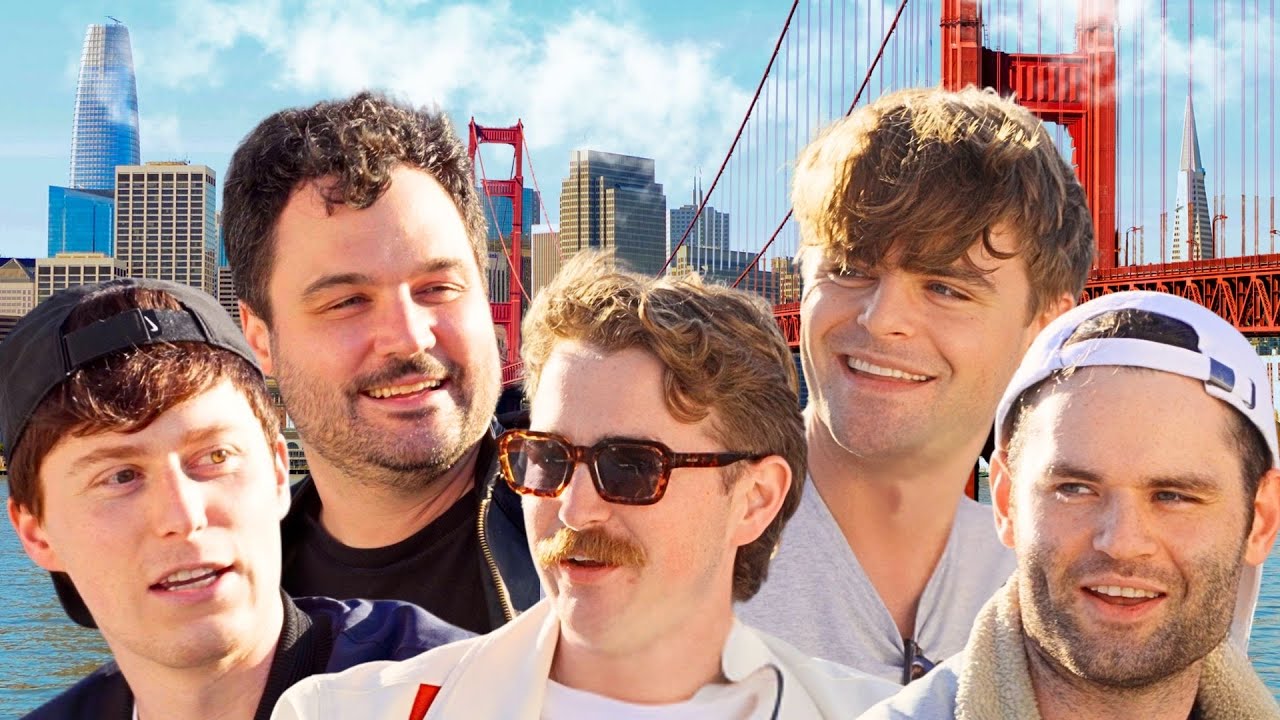
A roundtable of five hard-tech founders — Will O’Brien (Ulyses, autonomous underwater vehicles), Michael LaFramboise (Aurelia Systems, laser weapons), Jason Carman (Story Company, sci-fi films tied to real engineering), Sam D’Amico (Impulse Labs, battery-integrated appliances), and Laurence Allen (Teranova, terraforming robots for flood-zone land) — recorded on a ferry in San Francisco. They discuss why they built their companies in SF, the city’s frontier history, the cultural shift from SaaS back to atoms, the manufacturing gap with China, AI hype versus hardware leverage, SF’s housing and culture problems, and how they would deploy future wealth.
Why they started their companies in San Francisco
Each founder traced their mission to a personal origin story that maps onto a physical frontier: Will grew up on the Irish coast and saw subsea tools stuck in the 1980s; Michael grew up near Detroit watching industrial collapse and saw drone swarms making kinetic defense obsolete; Jason grew up in a flood-zone town north of SF and wanted to lift land instead of building seawalls; Sam wanted a stove that could cook pizza fast and realized every medium-sized appliance has a peak-vs-average power mismatch solvable with embedded batteries; Laurence grew up in a California flood zone and asked why land can’t just be raised.
They share a view that SF’s “frontier spirit” — from the Gold Rush through the hippie era to the Homebrew Computer Club — never left; it just went dormant during the SaaS boom. The current hardware renaissance feels like a return to form, powered by the same westward-selected, contrarian energy that built the city.
All five chose SF deliberately for talent density: a deep, underserved pool of hardware engineers who were ignored during the 15-year SaaS glut, plus proximity to the Bay’s industrial heritage (Pier 70, Mare Island) and a one-flight hop to Shenzhen for production-scale manufacturing.
Building a future they actually want to live in
The through-line across companies is “stewarding a realm for human flourishing”: Will frames Ulyses as giving humanity command over the oceans (3B people rely on seafood protein, 1B on ocean income); Michael sees directed energy as the only way to make air defense affordable (electrons vs. kinetics, 10M× cost advantage); Jason wants narrative “air cover” so the public sees hard-tech builders as protagonists, not villains; Sam wants to reinvent the grid by putting batteries in every corded device, starting with the stove; Laurence wants to terraform flood zones so cities don’t retreat.
They reject the transhumanist “upload consciousness” strand of AI culture, arguing that 8B people live in the material world and want abundance here — cheaper energy, secure borders, fertile oceans, habitable coasts — not escape.
Storytelling is treated as infrastructure: Jason’s films and Will’s documentation exist to translate “freaky” hard-tech projects (robots in the ocean, lasers in the sky, raised land) into shared cultural stories that recruit talent, calm public fear, and align capital with physical progress.
Future of appliances and the electric technology stack
Sam’s Impulse stove ships today; the roadmap includes ovens, kettles, water heaters, laundry, and dishwashers — any device where peak power ≫ average power. Embedding batteries lets the device draw steady low current from the wall while delivering 3–10× peak power, making appliances faster, quieter (no AC line hum), and grid-stabilizing.
The appliance market is roughly the size of the smartphone market but has no “Apple” — no brand that owns the high end through vertical integration of hardware, firmware, and thermal/mechanical design. Impulse aims to be that brand.
The broader thesis: the “electric technology stack” (batteries, power electronics, motor control, embedded ML) is now mature enough to reinvent every medium-sized machine, and the incumbents are asking for the tech rather than resisting it.
Building in China vs. America: the manufacturing gap
Prototyping in the US is feasible (shared lasers, pick-and-place, McMaster-Carr next-day), but production-scale tooling requires integer numbers of expensive machines that startups can’t amortize. China’s ecosystem offers fractional access to that tooling plus deep process expertise — not cheap labor anymore, but the world’s best electric-stack manufacturing.
Founders cite Jim Bellingham (Jim Belos) as a counterexample: he built a US job-shop from a single garage laser cutter to China-speed/quality parts with almost no VC, proving the model works if you solve the utilization problem.
The group agrees the US needs “optionality” — domestic capacity plus allied partners (Canada, Mexico) — not autarky. Key leverage points: reforming permitting (NEPA, CEQA), rebuilding the defense industrial base, and creating demand signals large enough to justify domestic tooling investment (the “Elon threshold”).
AI talent costs, the AGI bubble, and where AI actually adds value
Software/AI compensation has detached from value added: median SaaS engineers earn 4–5× what factory technicians earn, yet the latter keep physical production running. AI researchers command $200M+ acquihires without proven secrets; John Coogan (TVPN) predicts 90% revenue haircuts for pure-play AI SaaS.
The bull case: AI infrastructure (optical switches, storage, data-center power gear, Mitsubishi Heavy Industries, SanDisk) is where public-market value is accruing. The bear case: frontier labs and data-center builds are the first to pull capital if AGI timelines slip, leaving downstream supply chains exposed.
Founders distinguish “vibe-coded demos” from production-grade, software-defined hardware. Sam shipped AI-written temperature-control code for the Impulse stove last weekend — but inside a mature, validated firmware framework. The moat is the hardware platform that constrains the problem so AI can be reliable.
AI cult houses and Silicon Valley’s cultural rebalancing
SF’s “AI cult houses” are described as gang wars for nerds: elite researchers co-living, screening for ideological alignment on AI safety/acceleration, sometimes fracturing into rival startups or, in extreme cases (Zizians), violence. The archetype: “we’ll build a god, our friends become high priests, we get rich and immortal.”
Will maps SV’s cultural waves: 1) pure nerds (mind), 2) nerds + hippies/spirituality (Jobs/Brand), 3) current rebalancing — nerds + body (Bezos/Zuck training MMA, TRT, church-going hardware founders). The “jock” energy is returning, and it correlates with the hard-tech renaissance: people who lift also want to move atoms.
Brian Armstrong’s “mission-first, politics-at-home” memo at Coinbase is cited as a seminal moment that legitimized focus over ideological capture inside tech companies.
What’s wrong with SF: housing, nightlife, and cultural monoculture
Artificially induced scarcity: 1970s downzoning + CEQA/NEPA + local blockers (e.g., Aaron Peskin) keep housing supply frozen. Rents for two-bedrooms jumped from $4.5K to $6.5K in months during the AI boom. Austin proved supply works (months of rent declines after reform), but SF’s new rezoning (six-story by-right) is still pending.
Cultural monoculture: transplants in SaaS towers don’t know city history, don’t reinvest wealth into nightlife/arts, and create a “tech-only” social scene. Jason half-jokes that “50,000 art hoes” (non-tech creatives) would fix the vibe; Will suggests importing IB analyst “jock bros” for balance.
Wild ideas floated: tear down Alcatraz for a new dense district; turn the Presidio golf course (federal land) into a Kowloon Walled City–style hyper-dense neighborhood to shock the NIMBY equilibrium.
Resetting regulations so we can actually build
The regulatory stack (NEPA, CEQA, local zoning, coastal commissions) was built by the “degrowth coalition” — Ralph Nader’s consumer-law infrastructure, Reagan-signed CEQA, Soviet-influenced anti-nuclear movement — and cemented in the 1980s. It makes rebuilding the Golden Gate Bridge today impossible (original: 5 years, $300M).
Founders are becoming politically literate: multiple share lobbyists, make frequent DC trips, and back groups like Grow SF (Gary Tan) and California Forever (new city in Solano County with shipbuilding/hardware foundry). The goal: a generation of hardware founders who have both capital and the playbook to reform permitting, defense procurement, and industrial policy.
The “abundance institute” model — technologists moving to DC to translate builder mindset into policy — is seen as the next frontier after the current hardware wave.
Capital allocation: building companies vs. philanthropy
Michael argues the highest-ROI philanthropy is a profitable factory in a hollowed-out town (Detroit): 2,000 direct jobs → 6,000+ supported lives, wage pressure, tax base, community revival. SpaceX turned Brownsville, TX from near-ghost town to vibrant city with the same logic.
Contrast with “giving pledge” style: Mackenzie Bezos-style rapid nonprofit grants often disappear into NGO overhead and perverse incentives (SF homeless nonprofits displacing working-class housing to fill units with their own clientele).
Founders prefer second- and third-order effects of industrial capital: build the thing, employ the people, spin out supply chains, create the abundance that makes philanthropy less necessary.