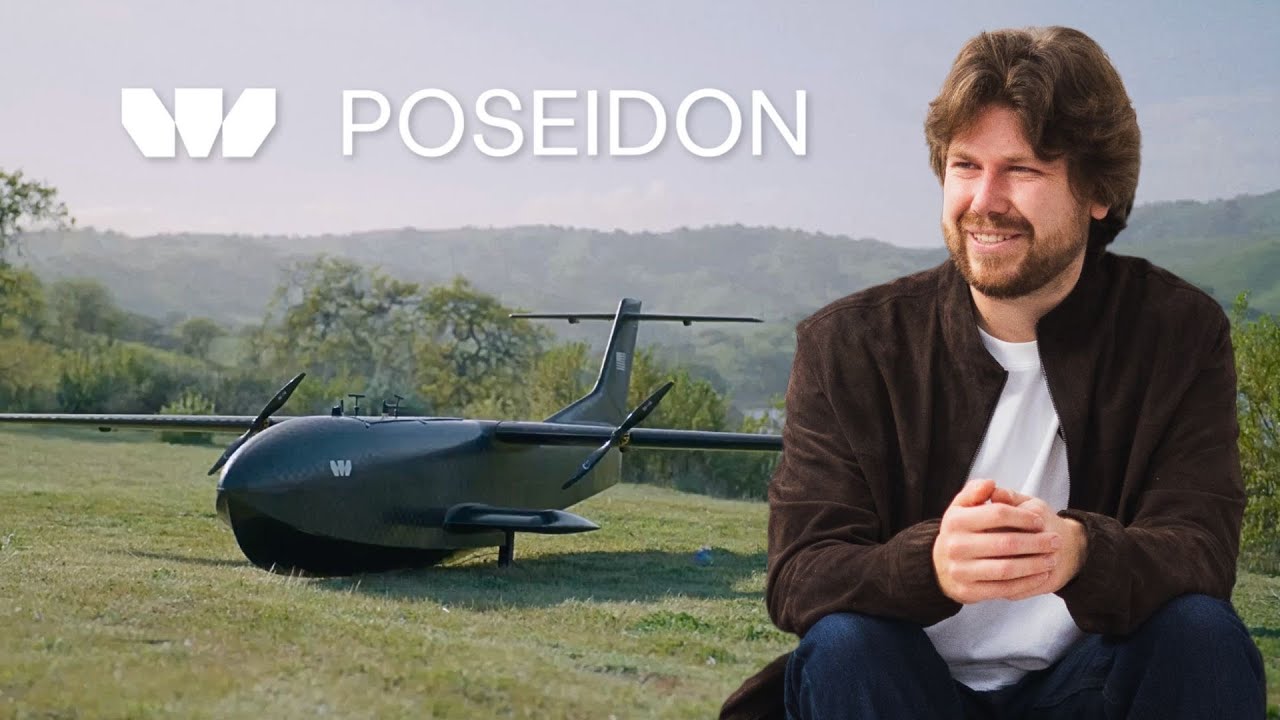
David Zagaynov, co-founder and CEO of Poseidon, is building unmanned cargo aircraft to dramatically lower the cost per flight ton-mile by removing the pilot, using composite construction, and certifying under new FAA drone rules; the company aims to fly its first full-scale prototypes (Heron seaplane and Egret land plane) by mid-2026 and begin commercial operations soon after.
The cargo market and why it matters
Logistics is the backbone of the modern economy and military; if it stopped, daily life would change radically.
Amazon and others have hyper-optimized ground distribution and last-mile delivery, but the aircraft moving goods between hubs are largely 1970s–1980s designs (e.g., Cessna Caravan, average fleet age 35–40 years).
Regional air cargo operators (Part 135 carriers) fly these aging fleets for FedEx, UPS, Amazon, DHL; they face rising pilot costs, pilot shortages, mandatory retirement at age 65, and fleets hitting legal hour limits with no approved repair path.
Starting with a ground-effect vehicle
Poseidon began by studying Soviet ekranoplans (ground-effect vehicles) that fly close to water for increased lift and reduced drag.
The mission has always been reducing cost per flight ton-mile; ground effect works only in narrow operational envelopes (calm water, no overland flight).
They pivoted to conventional unmanned cargo aircraft (seaplane and land-plane variants) to serve the entire air cargo spectrum, not just niche maritime routes.
Why aviation certification is so difficult and how Poseidon bypasses it
Clean-sheet certification costs hundreds of millions to billions of dollars; airlines buy aircraft and run them for decades, creating no pressure for step-change innovation.
Most certification cost and complexity exists to protect people on board and on the ground; removing the pilot eliminates the cockpit, windows, life-support systems, and associated weight/space.
Unmanned aircraft face a simpler certification path: lower design standards, smaller engines, lighter structure, and a clearer regulatory framework under upcoming FAA Part 108 (effective early 2026) for large BVLOS drones.
Flying a plane by mid-2026: the sprint
Poseidon is in full manufacturing sprint on Heron (seaplane) and Egret (land plane), targeting first test flights summer 2026.
Initial flights in low-population areas to accumulate hours; certification follows a clear path as flight data builds.
Team of ~3.5 engineers took Seagull (quarter-scale prototype) from clean-sheet design to first flight in ~6 months, proving rapid iteration capability.
Vertical integration and composite manufacturing
Poseidon does nearly all manufacturing in-house (carbon-fiber layup, wing/fuselage build) in a 25,000 sq ft San Francisco facility, expanding by taking over neighboring leases.
Composites are light, strong, corrosion-proof (critical for seaplanes), and allow mathematically optimal aerodynamic shapes via molds.
Part count reduced by ~10× versus traditional aircraft (e.g., Boeing 747 has ~120k suppliers); manufacturing resembles composite boat building more than exquisite aerospace assembly.
Early prototypes: crashing into a lake and learning fast
First prototype (box-wing ground-effect design) lost controllability outside a narrow envelope; tested at 1 a.m. on a Golden Gate Park RC boat lake.
Vehicle flipped, sank in “a foot of duck poop”; David swam 100 m to recover it.
Returned to clean-sheet design → Seagull, which flew successfully in March and now serves as avionics/controls testbed for Heron/Egret.
Test pilot Rick (found on an RC forum) flew the first RC-controlled flights flawlessly.
Key learnings: design for manufacturability (avoid one-off techniques), and hire specialists (David is not the best avionics engineer).
Heron & Egret: shared architecture, different fuselages
Heron (seaplane) and Egret (land plane) share wing, tail, avionics, engines; only fuselage differs.
Design philosophy: “if a box with wings was cheapest, we’d build a box with wings” — platforms optimized purely for lowest cost per flight ton-mile.
Fuselage sized for standard cargo density (~5–6 lb/ft³, matching Amazon/FedEx/UPS package mix); avoids “voluming out” before maxing weight like retrofitted passenger planes.
Lower operating cost unlocks point-to-point routes (bypassing hub-and-spoke), competes with trucks on shorter routes, and can replace underutilized narrow-body jets on short-haul legs (e.g., Miami–Bahamas).
Warehouse space: the hard-tech scaling journey
Garage (Foster City) → 400 sq ft warehouse (Belmont, mold forced move) → back to garage (full) → 3,500 sq ft (Potrero, SF, shared wall with Ulysses) → 15,000 sq ft (Dec 2024) → current 25,000 sq ft (took neighbor’s lease early).
Planes (50 ft wingspan) don’t fit through doors; wings detach for transport in standard containers — a deliberate design requirement.
Expect to keep expanding until taking the whole block, then hunt for a dedicated factory for rate production.
Aviation startup dynamics: operate, don’t just sell
Most aviation startups fail or struggle; SpaceX model: full-stack, capture the entire value chain (build + operate), margins grow as costs drop.
Poseidon will operate its own aircraft (likely sell later), disrupting cargo operations, not just manufacturing.
Many recent startups (eVTOL, hydrogen, electric) built around a technology first, then sought a business case; Poseidon starts from cost-per-ton-mile and derives every design choice from it.
Drone regulation: Part 108 changes everything
FAA Part 107 (2016) regulated small drones (<55 lb); large BVLOS drones lacked clear rules for years.
Trump executive order pushed FAA to publish Part 108 (large drone BVLOS framework), becoming law early 2026.
Provides a clear certification path for Group 5 UAS (Poseidon’s class); previously startups struggled for years with waivers/exemptions.
Poseidon plans to operate commercially in the US; no need to go offshore (unlike Zipline in Africa).
What won’t change in 10 years (Bezos framework)
Humanity will always need to move goods; trade/logistics have been existentially important for millennia (Silk Road, Napoleon’s failed supply lines, Union rail advantage in Civil War).
E-commerce and industrial production growing; demand for faster, cheaper, more flexible transport only increases.
Poseidon unlocks air cargo for regions currently served only by slow boats (e.g., remote coastal/island communities, offshore oil — currently $40k/hr helicopters or slow boats).
Building airports: rethinking infrastructure from first principles
Traditional airports: runways, hangars, ATC, terminals/TSA for people.
Unmanned cargo airports: short/degraded runways (gravel in Alaska), warehouse-adjacent, trucks drive in/out, no terminals.
Poseidon may build/own its own airport network (like Amazon); a few airports puts you in top 10 owners.
Humanoid robots (e.g., 1X Neo, pre-ordered) could load/unload planes autonomously at remote/nighttime stops; one tele-operator could manage a fleet of robots across multiple airports.
Team and the emotional arc
First Seagull flight brought the team to tears — seeing an idea become a flying machine.
Team has grown rapidly; David emphasizes hiring excellent engineers who are also excellent people.
After each milestone: celebrate, then back to the grind — “now we got to make a lot of planes.”