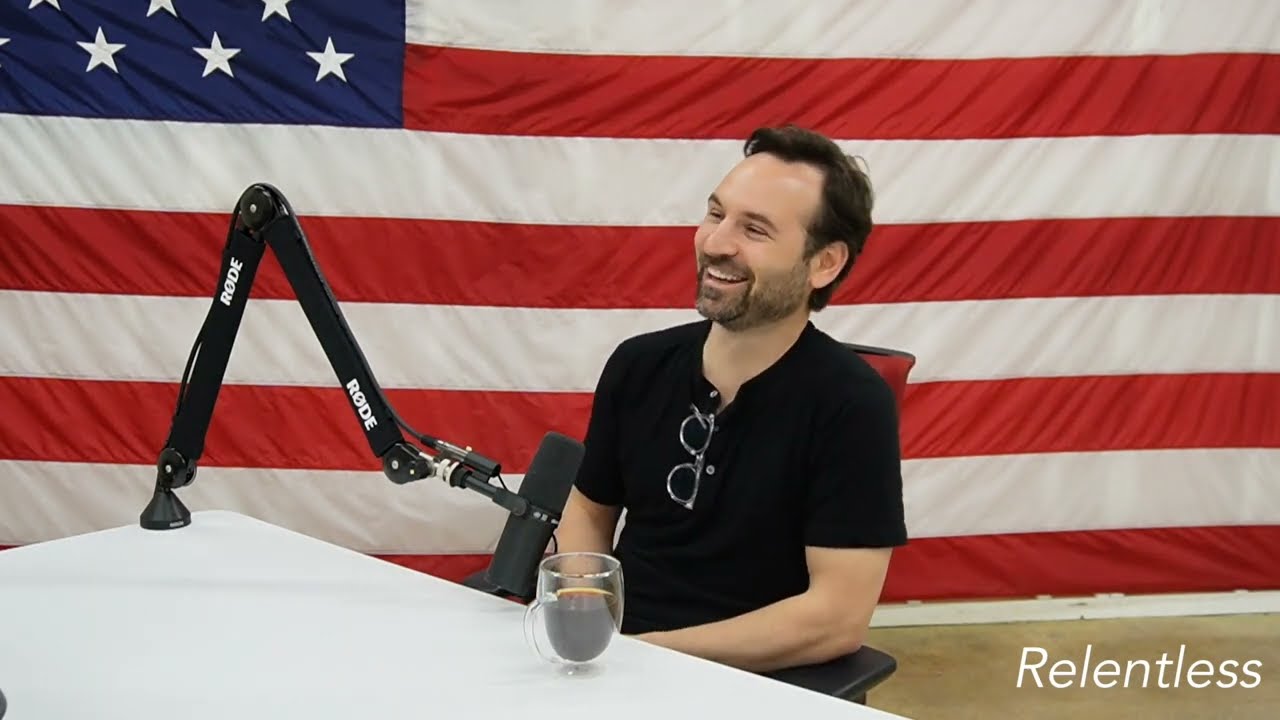
Aaron Slodov, CEO of Atomic Industries, recounts his path from a troubled high school student in Cleveland to a physics PhD candidate, Google engineer, founder of Remesh (a real-time mass-conversation platform), and ultimately founder of Atomic Industries, which aims to build an “AWS for manufacturing” by automating tool and die making through software.
Growing Up in Cleveland and Early Entrepreneurial Instincts
Slodov grew up in Cleveland in a “bubble” with four seasons, family, and friends, describing it as a happy childhood with strong nostalgia.
From a young age he found money conceptually bizarre; he once tried to establish leaves as currency among siblings, collecting pristine beech leaves to use for chores.
In high school (pre-2000) he attempted to launch an internet cafe, drafting a legal agreement with his lawyer father, raising $50,000 from family and friends, and negotiating a revenue-share with a local coffee-shop owner who ultimately backed out when confronted with a teenager presenting a contract.
The failure taught him that selling a future vision (the internet in 1998–99) could rally capital even without a track record.
Menial Jobs as Deliberate Exposure
After the cafe fell through, he intentionally took “menial jobs” — landscaping, pizza delivery, data entry at his father’s law firm, furniture delivery to wealthy clients — to observe how different businesses operate and think.
The landscaping owner fired him saying, “You remind me too much of myself; you got to go.”
Furniture delivery exposed him to high-net-worth individuals (doctors, lawyers, bankers) in their homes, providing informal mentorship and insight into wealth creation.
Programming and the Pull Toward Physics
He taught himself C++ and Java in the mid-1990s, building basic game engines and physics simulations, and ran a small web-development business using platforms like Tripod.
A spiritual quest — raised in a mixed Jewish/Christian household, exploring Buddhism — led him to seek the “meaning of the universe physically,” prompting a return to school at age 22–23 to study physics.
High School Struggles and the Long Road to Undergrad
He describes himself as a “trouble student” who acted out from boredom, accumulating detentions, Saturday schools, in-school suspensions, and eventually jumping out a window to escape in-school suspension.
Family support was minimal; he had to “hit rock bottom” and crawl back via community college, remedial math, and a state-school physics program, taking 5.5 years while working 40–60 hours/week to support himself.
SETI Internship and the Google Pivot
A summer internship at SETI (NASA Ames, 2007–08) placed him next to Google’s campus; he lived in former military barracks and watched Googlers on bikes, sparking curiosity.
He spent six months grinding for the Physics GRE (“the hardest standardized test”), endured subconscious panic attacks about life direction, and accepted a Google residency program over PhD offers.
Google: Renewable Energy and Self-Driving Cars
First rotation: RE<C (Renewable Energy Cheaper Than Coal), building a low-cost heliostat field for concentrated solar; project was killed when Larry Page and Sergey Brin returned and deprioritized non-CS projects.
Second rotation: Self-driving car team (Chauffeur) under Sebastian Thrun and Anthony Levandowski; he instrumented a Lexus SUV with mechanical transducers to map vibration profiles for sensor placement.
Intellectual heroes were scientists (Feynman, von Neumann, Shannon), not business figures.
Meetup, PhD, and the Birth of Remesh
After Google, he spent ~6 months at Meetup in NYC to experience a small startup before reapplying to PhD programs.
Entered a physics PhD but simultaneously co-founded Remesh with a longtime friend during the 2012 Gaza–Israel flare-up; the vision: a platform where millions could converse in real time (e.g., a million Americans talking to the president).
The tech — real-time aggregation of massive groups into coherent signal — was extremely hard; they “hacked” their way into the White House via public contacts and switchboard calls but were rejected as “too small, not Twitter.”
Pivot to Market Research, Techstars, and Landing P&G
After the White House rejection, they pivoted to market research, joined a Barclays-backed Techstars fintech accelerator (despite not being fintech), and hit $1M ARR quickly.
Techstars provided mentor matching, a biz-dev week (including a Cincinnati Reds stadium event), and investor density (20 meetings/day).
At the stadium event, Slodov “sniped” the P&G CMO by sitting next to him, pitching in 15 seconds, and securing a meeting that became a flagship account.
Leaving Remesh: Geography, Role, and Board Conflict
As CTO, he commuted weekly from Cleveland to Brooklyn (5 a.m. Monday flights, Friday returns) for nearly a year pre-COVID.
At Series A, the board and new investors demanded everyone relocate to NYC; Slodov refused, wanting to build an engineering team rather than code as an IC.
The discontinuity forced a separation; he describes it as losing a “baby,” not feeling lost but feeling loss.
Warhammer Figurines: A Hardware Reality Check
During a buffer period, he tried a subscription box for D&D/Warhammer figurines (high-mix, quick-turn).
Discovered injection molding’s brutal economics: expensive molds, long lead times, minimum orders, iterative retooling costs, and quality risk; Alibaba suppliers required 50k–100k unit MOQs and still delivered bad samples.
3D printing lacked the quality/volume/price triad he needed; the project collapsed.
Founding Atomic Industries: The “AWS for Manufacturing” Thesis
The figurine nightmare revealed the core problem: tool and die making (design → simulate → machine → test → iterate) is the hidden, labor-intensive layer behind every physical product.
He spent a year interviewing tool-and-die shops, posing as a business student, learning the trade’s macro dynamics.
Thesis: Technology and manufacturing have been “oil and water” for decades; Atomic will build the software layer that makes spinning up physical production as easy as spinning up an AWS instance — enabling everything from toys to F-35 parts to submarines.
Strategic framing: A weak industrial base makes the U.S. a “sitting target”; adversaries should fear America’s ability to manufacture at will.
Co-founders and Y Combinator (2021)
Entered YC solo, then brought on two co-founders during the batch: a 15-year friend (tech/finance) and a tool-shop owner from Michigan met during research (manufacturing domain).
YC’s second remote batch retained high accountability (shame-driven progress at group meetings) and exposed him to hard-tech peers (Stoke, Moxon, satellite imagery) — a shift from YC’s traditional SaaS focus.
He views YC’s new “reshoring U.S. manufacturing” RFS as a critical Overton window shift.
Co-founder Lessons: Conflict Resolution Over Success
No one-size-fits-all answer; co-founding is marriage without a prenup.
Conflict resolution mechanisms matter more than success: 75% of failed startups cite founder breakups.
His approach: set expectations openly, work with people known over years, avoid snap decisions (<1 month), and ensure alignment on hard decisions and success division.
Hardest Thing Overcome
A deeply personal, pre-18 traumatic event that he keeps private; it catalyzed his spiritual/physics quest and permanently shaped him.
He acknowledges such transformational experiences “mold and sculpt you for the rest of time.”