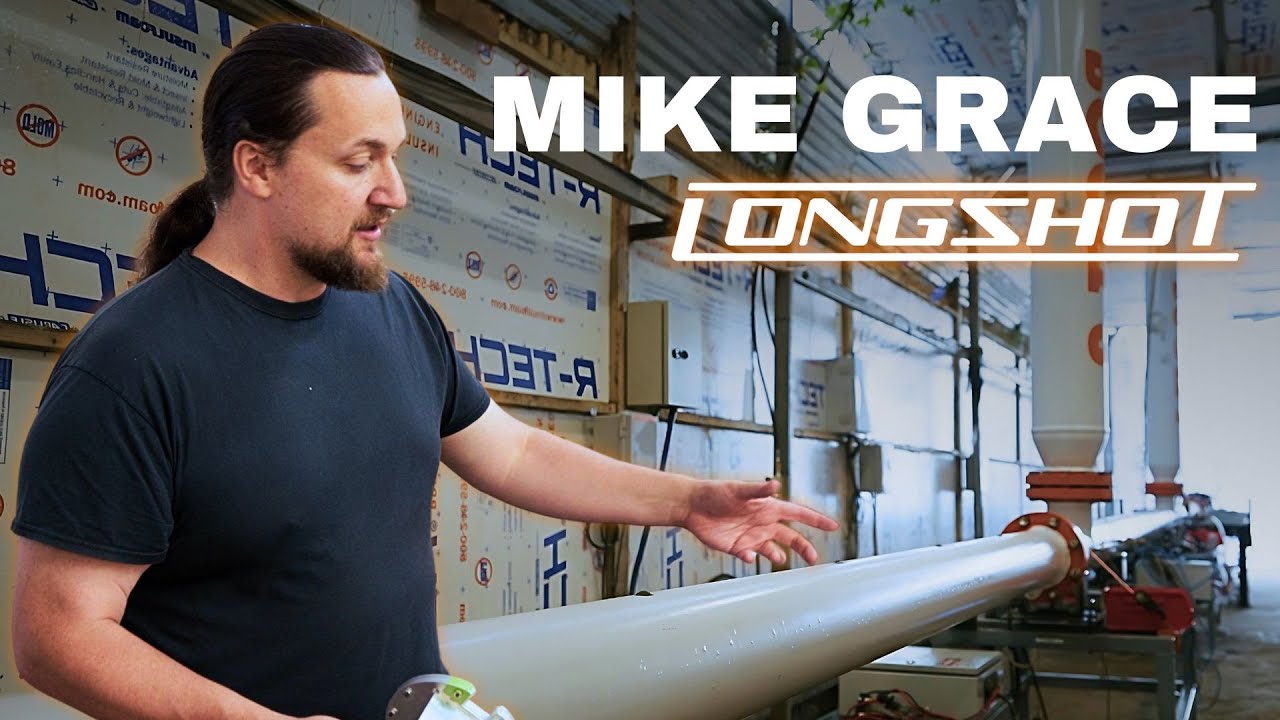
Mike Grace, co-founder and CEO of Longshot, is building a kinetic launch system — a massive “space gun” in the desert — to put payloads into orbit at a fraction of rocket costs by keeping all launch energy on the ground instead of carrying it aloft.
The core concept: kinetic launch vs. rockets
A rocket carries all its energy (fuel, tanks, engines) and only ~1% of its mass reaches orbit as payload; the rest is infrastructure for lifting fuel.
With kinetic launch, the accelerator stays on the ground (built from concrete and mild steel pipe), and only the projectile goes to space, dramatically lowering marginal cost.
The idea dates to Jules Verne and Newton; Grace frames it as “stealing 1930s–1960s German engineering” — if you want to succeed in aerospace, find what a German worked on then and adapt it.
Historical lineage: German superguns and the V-3
WWI Paris Guns fired 1-ton projectiles 120+ km but eroded barrels in ~60 shots from combustion heat.
WWII V-3 (Hochdruckpumpe) used a distributed-injection “pipeline” on a hillside: multiple side chambers fired sequentially down the bore, halving peak pressure, temperature, and acceleration per doubling of injections.
This let the Germans build from ordinary sewer pipe (mild steel, ~1,000 psi peak pressure) instead of exotic gun barrels.
The V-3 was immobile and vulnerable to bombers; post-war, the US/USSR prioritized rockets (V-2 lineage) for nuclear deterrence where marginal cost and reliability mattered less.
Gerald Bull and Project HARP
Canadian ballistician Gerald Bull built HARP (High Altitude Research Project) in the 1960s: two 16-inch battleship guns welded end-to-end in Barbados, firing projectiles to 200+ km altitude (suborbital).
He aimed to add a small solid upper stage to put ~1 kg in orbit by 1964–65, but the Army/Air Force killed it — fixed infrastructure duplicating missile silos wasn’t strategically compelling when 1 kg payloads had no market (cubesats didn’t exist).
Bull later worked for South Africa (CIA-backed), went to prison, then built a supergun for Saddam Hussein; assassinated in Belgium in 1990. Grace’s takeaway: “Don’t build death stars for dictators.”
Why SpaceX isn’t pursuing kinetic launch
US + USSR spent ~$4 trillion on rockets since WWII; rockets exist primarily for suborbital nuclear delivery — orbital launch is a “happy accident.”
Elon Musk has tens of billions sunk into Starship; Grace argues first-principles from 150 years ago (marginal cost focus) point to guns, not rockets, but Musk won’t pivot.
Grace wants Starship to succeed (he’ll ride a rocket; humans can’t survive gun G-loads), but believes rockets hit a physics floor: they’re flying bombs requiring extreme safety overhead, limiting how low marginal cost can go.
Cost per kg to orbit: historical and projected
Shuttle era: ~$72,000/kg (Grace calls it a Nixon-era boondoggle).
Falcon 9: ~$3,000–$5,000/kg today; SpaceX aspirational $1,100/kg go-to-market, but Grace suspects floor ~$250/kg at cost.
Starship aspiration: $100/kg; Grace skeptical — thinks $250/kg is more realistic floor even at massive scale.
Longshot’s cost target with a space gun
MVP (“Baby Bear”): ~$150/kg go-to-market, ~500 kg payload (2–3 small commsats), 10–20 km tube, 150–250 g acceleration.
“Mama Bear”: 20-ton payload, direct Falcon 9 competitor.
“Papa Bear”: 100-ton payload (full Starship as bullet), 7–8 m bore, ~70 km long, multi-billion-dollar concrete structure.
Long-term marginal cost dominated by electricity; could drop below $10/kg as solar/SMR nuclear cheapens power.
Current prototype: reaching Mach 4.2
70 cm (29 in) bore, mild steel pipe, ~$40k bill of materials; per-shot cost ~$5k (not optimized for turnover).
Uses helium (safe in Oakland); hydrogen would reach Mach 6 but too hazardous for urban test site.
Key technical risk retired: precise, repeatable, microsecond-level timing of high-pressure side injection valves at hypersonic speeds.
Achieved Mach 4.2 with intact projectiles; bits at Mach 4.5; Mach 6 possible with H₂.
Scaling from Mach 5 to Mach 15: the DoD wedge
Gap between garage prototype and orbital gun too wide for VC appetite; DoD hypersonic test market bridges it.
Current DoD hypersonic flight tests cost ~$15M (sounding rockets); Longshot offers same for ~$150k (2 orders of magnitude cheaper).
A 1-km, 1-m bore desert system doing Mach 15 creates a “meteor” on exit; Grace sees the jump from Mach 15 to Mach 25 as “a little crack of light” once the test infrastructure exists.
Heat shielding and the ballistic coefficient imperative
Aerodynamic heating scales with velocity³; drag and ablation scale with surface area (²), but mass and thermal capacity scale with volume (³).
Small projectiles burn up or slow down; must go big and dense. Threshold: ~2 m diameter, multi-ton vehicle.
2-ton vehicle sacrifices ~50% mass to ablation (vs. 3% for Apollo, which decelerated high in atmosphere).
20-ton vehicle: ~2 tons ablation, far more efficient. Vehicle must be cheap — “wood chips and phenolic resin,” solved by Soviet-style brutal scale.
Finding a 20 km stretch of land: real estate > engineering
Ideal site: where you could detonate a nuke and no one would notice — remote, sparse population, cooperative government.
US lower-48 airspace too dense; shutting down corridors for daily launches impractical.
Australia (Outback, Northern Territory): twice Texas land area, <1% population, no indigenous launch access — strategic win for them.
Alaska has land but cold; Grace prefers Australia.
Community buy-in is critical: Tonopah, NV (pop. ~1,500) welcomed Longshot for hypersonic test site; town council lobbied county/state. “You can’t cram a project down a town’s throat; they have to want you.”
Rapid reusability via low pressure/temperature
Distributed injection + long tube = lower peak pressure (~1,000 psi, ⅓ scuba tank) and temperature (a few hundred °C vs. mantle-of-sun in artillery).
Energy invested over length/time; no violent single event. Barrel is essentially a concrete vacuum hallway (atmosphere pumped out before firing).
No fundamental physics barrier; 2D gas dynamics are well-understood. Risk concentrates in atmospheric transit (Mach 15–25), not the accelerator.
Early iterations: garage PVC potato guns
Started in Grace’s garage with Home Depot PVC, multi-injection “potato gun,” Mach 1.8 at 40 ft.
Grace (economist/molecular biologist) and COO Brendan (9 ft tall) — neither are engineers — built it with no salary for 1.5 years.
PVC fails catastrophically, softens in sun; vessels exploded behind steel plates. “Scary as hell.”
Mach 1.8 on PVC for ~$13k total spend; SpinLaunch spent ~$140M for Mach 1.6.
Unique test facility: abandoned Navy gun range
Alameda Point (former Naval Air Station): 300-ft × 20-ft × 20-ft hallway, used for Phalanx CIWS testing, bullet spray marks on walls.
Closed since 1990s; city permits raves occasionally. Perfect for Longshot — modern enough to avoid asbestos, insane acoustics.
Grace regrets not finding it 4 years earlier.
Building the desert test site: political economy, not just tech
Critical path is community → county → state → federal buy-in, not engineering.
SpinLaunch’s Hawaii town hall disaster: locals feared property values, cat cancer, sonic booms.
Technologists underestimate this; extractive industries (mining, oil) know the game.
Longshot is an infrastructure project (Panama Canal for space), with infrastructure problems and benefits.
Competitors in kinetic launch
SpinLaunch: centrifuge approach, ~$140M spent, Mach ~1.6, now pivoting to DoD non-orbital work.
RIA (LA): electromagnetic/railgun approach; Grace jokes “Insane Clown Posse fundamentally recapitulates my thesis on magnets.”
Green Launch: John Hunter (light-gas gun pioneer); Grace credits Hunter’s 2010 talk for sparking his interest. Green Launch winding down.
Hiring advantage: cool problems attract talent
Aerospace engineers take 50% pay cuts vs. chemical engineering to work on rockets; they care about mission.
SpaceX exploits this (grueling culture); Longshot offers similarly cool, hard problems without the abuse.
Grace: “Give these people something cool to work on and they’ll break themselves for you.”
Vision: open the solar system, drive launch price to zero
Earth is homogenizing (languages, cultures, travel, AI translation); diversity requires separation + different conditions.
No elbow room left on Earth; need new frontiers for weirdos (Mormons on Enceladus, Trotskyites on asteroids) to run societal experiments.
Target: launch cost → $0 (like airmail to Europe). Business model: own the railroad, monetize downstream (in-space solar, asteroid mining, ads on the Moon).
Cheap bulk launch enables orbital refueling (15 Starships → 1 Mars ship becomes trivial), heavy industry off-Earth, Earth as a garden.
Near-death experiences: three near-bankruptcies
First: $4k in bank, wife paying rent, sleeping at build site; saved by Air Force Direct-to-Phase-II SBIR.
Founder psychology: must spend as if money will arrive, shortening runway; if it doesn’t, you cut team pay or fold.
Latest raise: Grace, COO, biz team went to $0 salary; engineering took 25% cut (CTO 50%); only paternity-leave staff spared.
“You put faith in me and I failed you” — recurring founder burden on hard tech; not the hardest thing Grace has done, but hard.