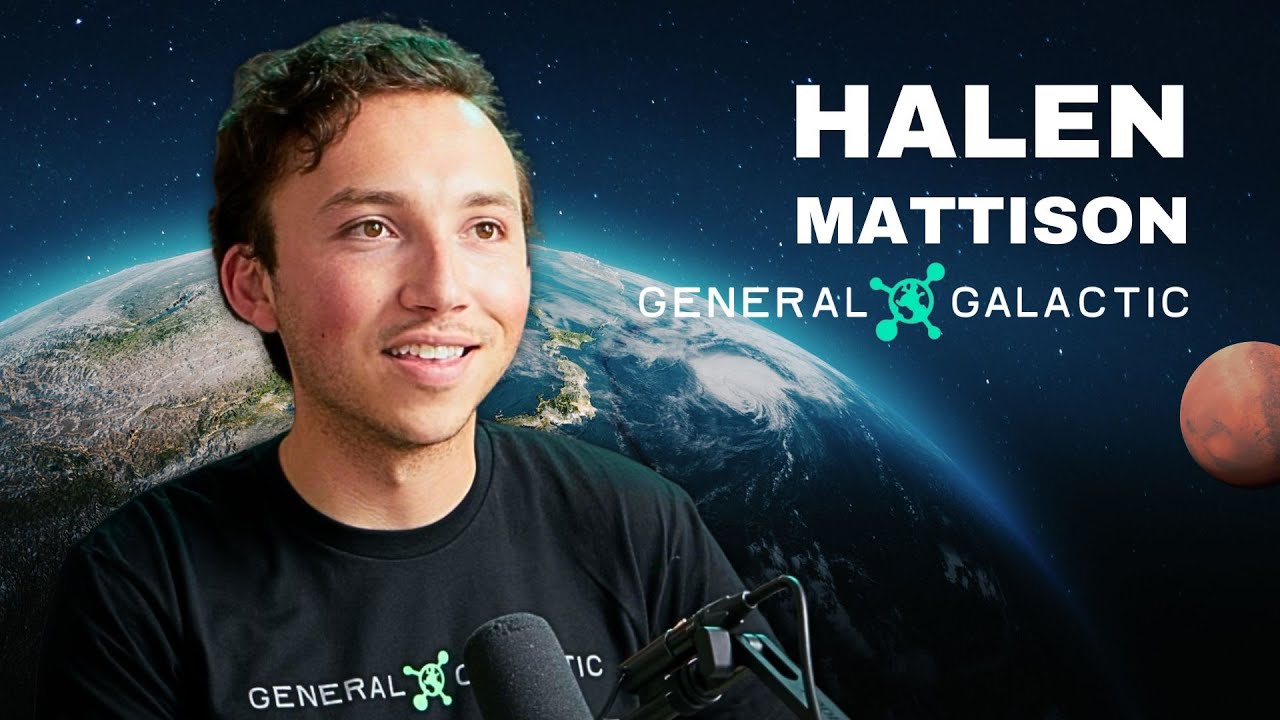
Halen Mattison, a former SpaceX propulsion engineer who grew up poor in North Carolina, now runs General Galactic, a startup building hydrogen–oxygen thrusters to become the in-space mobility layer that lets Starship-scale transport refuel on the Moon and Mars — effectively the first “gas station on Mars.”
The defining ethos is “move fast and break things” borrowed from Silicon Valley; new hardware fails often, but each failure triggers an immediate, locked-down investigation that extracts maximum learning.
Example: the Crew Dragon capsule exploded during a ground test firing after Demo-1; the team spent months reconstructing the failure, a process Mattison says SpaceX does better than anyone.
Unknown unknowns — complex interactions between systems — are what keep engineers awake; known unknowns are manageable with margins.
“The factory is the product”: Starship’s production line is evolving toward automotive-style automation to eliminate the thousands of human touch-points that each represent a failure risk.
Elon’s algorithm (challenge every requirement, delete parts, simplify, accelerate, automate) is lived daily; engineers are “responsible engineers” who own a component from napkin sketch through flight.
Concrete win: Mattison challenged gold-plated case seals ($400–1,000 each, hundreds per vehicle, single-use); by proving leak paths were over-specified, he deleted many, saving cost and enabling reuse.
Starship scale and the Mars logistics chain
Starship carries so much methane and oxygen that a worst-case pad mixing event would create the largest non-nuclear explosion in history — by a factor of five.
Refueling is the bottleneck: the lunar mission architecture needs ~14 tanker flights per landing ship; Mars needs a similar or larger multiplier.
A surface fuel depot on Mars (the “gas station”) closes the loop: it lets crews return, turning one-way shots into round trips.
Mattison’s last year at SpaceX was on the propellant-generation team; he saw the ISRU tech as outdated and not built for the scale Starship demands.
Industry landscape: primes, China, and the mobility gap
Legacy primes (Lockheed, Boeing, etc.) are effectively jobs programs; their incentive is survival and congressional distribution, not innovation.
China has demonstrated capture and rendezvous with non-cooperative objects and on-orbit refueling — capabilities the U.S. currently lacks — creating a “Sputnik moment” for space mobility.
U.S. Space Command’s top priority is now novel propulsion; current options are hydrazine (toxic, carcinogenic, single-source, 1960s tech) or xenon (expensive, low thrust).
Launch cadence and cost are dropping fast: SpaceX Transporter rideshare slots are ~1.5 years out and filling quickly; demand from constellations (“Starlink for X”) will grow exponentially.
General Galactic: hydrogen–oxygen thrusters for the new mobility layer
The GT Thruster burns H₂/O₂ (high thrust, high ISP, non-toxic, producible from water ice on Moon/Mars) — a step-change over hydrazine/xenon.
First engine (Mark 1) melted after 1.2 s on the stand; thermocouples showed 1,400 °C on the outer wall. Team redesigned the cooling architecture in three weeks, retested, and ran 10+ successful firings.
Development cadence: design → test → fail → redesign in weeks, not years; test stand is reusable, only the article under test is expended.
Pivoted from an initial “save Earth with synthetic fuels + go to Mars” vision after realizing energy markets are binary: if you aren’t the cheapest BTU, you have zero product. Space mobility has a defensible, high-margin wedge.
Targeting first flight demo as early as next year; seed-stage team of ~a dozen willing to bet double-digit percentages of company resources on each demo because flight heritage is the only thing legacy buyers trust.
Personal arc: from food stamps to flight hardware
First in family to college; 4.0 GPA for a decade to keep scholarships; Harvard interviewer asked for national chess/tennis rankings — a class barrier he couldn’t clear.
Self-taught fabrication: fixed a 1990s CNC in high school, built an e-bike, apprenticed under a 82-year-old race engineer from the Ford v. Ferrari era.
At NC State, got into the space lab by being the only undergrad who could mill and bend metal; built a CubeSat in an un-air-conditioned Airbnb living room during COVID lockdown — it flew to ISS.
SpaceX internship offer came days after watching Falcon Heavy launch; one week later he was in California; one week after that Elon announced 10% layoffs — Mattison thought he was fired instantly.
Stood outside mission control for Demo-1 docking; didn’t recognize Grimes standing next to him; later told astronaut Victor Glover to get out of his chair.
Founder philosophy: risk is mispriced, resilience is the skill
“You don’t need to be a billionaire to do a space company.” Most engineers overestimate startup risk and underestimate the upside of ownership and speed.
Willing to risk 100% of the company on a technical bet if success rewrites the category; the real binary risks are economic (energy) not physical (rocketry).
Chewing glass: the pivot from energy to space was the hardest engineering reorientation; supplier delays, cash-flow crunches, and “no playbook” moments become calluses.
Leadership model from Elon: shoulder the anxiety and drama so the team can execute; say “we’re catching the booster, here’s why, come talk if you’re scared.”
Goal: seed a wave of hard-tech startups in El Segundo and beyond — “the world is not as fixed as it seems.”