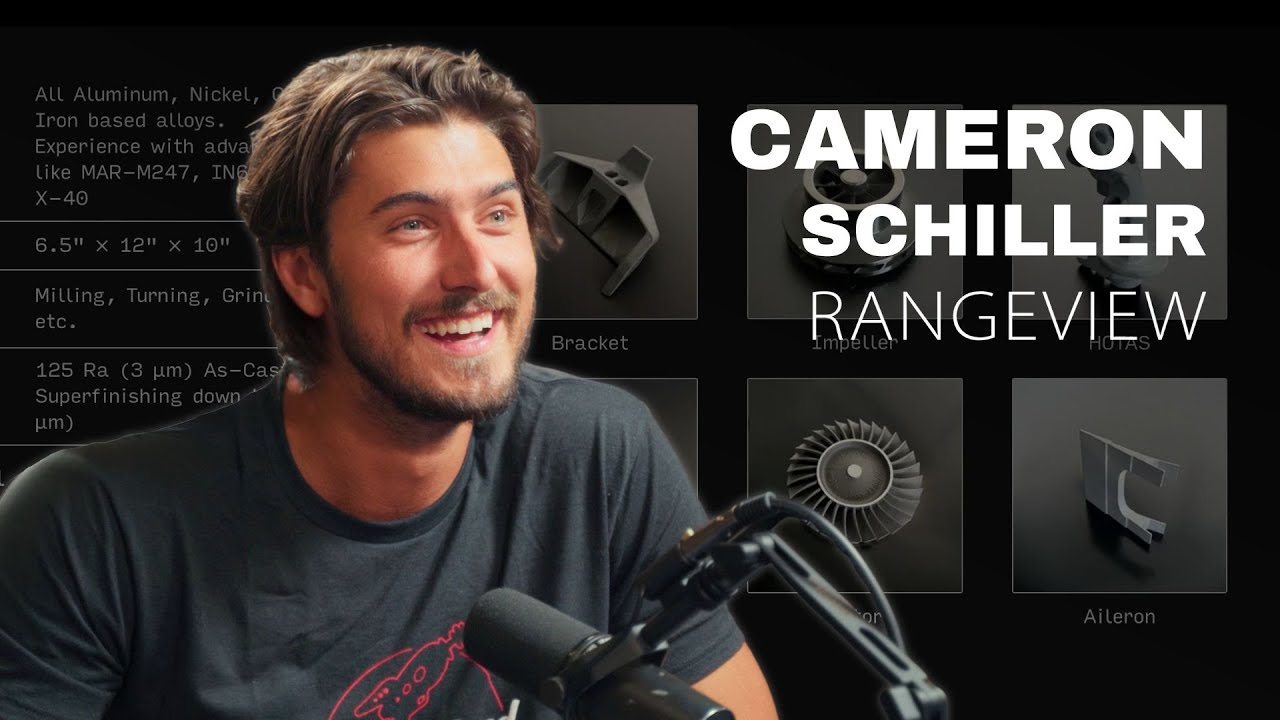
Cameron Schiller, co-founder and CEO of Rangeview, is building “cyber foundries” to re-industrialize American metal casting — a critical but neglected manufacturing capability that China has weaponized through state subsidies and technology transfer, leaving the U.S. dependent on foreign supply chains for everything from jet engines to rare-earth magnets.
Casting as the overlooked backbone of industrial power
Casting is one of the oldest metal-forming methods, relying on sand’s ability to hold molten metal, and it produces critical components across aerospace, defense, energy, and transportation.
Despite its importance, U.S. casting capability was “left for dead” after Xi Jinping weaponized manufacturing: China subsidized the entire supply chain while the U.S. focused only on final ITAR-controlled components, losing the innovative foundry ecosystem, workforce, and equipment base in the process.
Casting has not had its “CNC moment” — it remains largely manual and uninstrumented, unlike machining where motors and software optimized uptime; Rangeview aims to bring sensors, compute, and process control to foundries to make casting more reliable, faster, and cheaper at scale.
The American dream found in China
Cameron grew up traveling to China with his father, who was part of the offshoring wave, and later went alone as a teenager; he observed a society where people worked extremely hard (996 culture) for a tangible future in special economic zones like Shenzhen.
That drive — “the American dream felt very real in China” — contrasted with what he saw in the U.S., where manufacturing had hollowed out and fewer people felt responsible for building real things.
He also witnessed sweatshop conditions (factory suicide nets at 14), which convinced him that automation and technology, not cheap labor, are the only humane and sustainable path forward — especially for off-world manufacturing.
From robotics to casting: the Rangeview pivot
Rangeview began as Range Robotics, building cheap harmonic-drive actuators to lower robot-arm costs, following McKinsey/BCG/Bain analyses that said cheaper robots would revive U.S. manufacturing.
Selling robots to factories failed: factories didn’t want robots; they needed someone to actually build and run factories — and no one was doing that at scale.
A systematic review of every manufacturing process led them to casting as the most “down bad” and highest-leverage opportunity: a wide-open field where modern tech (lithography, sensors, compute) could create a step-change.
Building America’s first cyber foundry
Rangeview operates from a former Space Shuttle/Titan IV rocket engine hangar in El Segundo — 15× larger than their prior facility — retrofitting it with environmental controls, clean rooms for sand lithography, and worker-centric design to make manufacturing inspiring again.
The facility targets multi-decade production contracts worth tens of millions each, producing turnkey cast superalloy components (jet fighter parts, drone engines) from raw ingots, capturing far more of the value chain than “screwdriver factories” that merely assemble imported subassemblies.
They aim to build tools (software, process IP) that lower the barrier for others to start factories, but each factory’s economics differ (e.g., work-in-progress duration, inventory turnover, financing structure), so one-size-fits-all software doesn’t exist yet — most U.S. manufacturing software serves assembly, not primary production.
Manufacturing vs. assembly: the screwdriver factory trap
Most U.S. “factories” are assembly operations bolting together components sourced globally; if one link breaks (e.g., Chinese neodymium magnets), the whole chain stops — a DoorDash burrito depends on a magnet in the driver’s phone and the car’s motor.
WWII mobilization worked because car factories made parts; today they couldn’t switch to bombers because they don’t make the windshield wiper module, let alone the engine.
Defense startups today are almost all assembly shops; nobody is making the underlying castings, forgings, or extrusions — Rangeview targets that gap.
China’s manufacturing dominance is deeper than labor costs
China leads in advanced machine shops and factories across nearly every category except leading-edge semiconductors, built partly on “Made in China 2025” programs that forced technology transfer from foreign partners.
DJI is the proof: it didn’t just copy — it out-designed GoPro and now leads drones by an order of magnitude; Unitree’s humanoids are far cheaper and more capable than U.S. equivalents.
The U.S. lost “design for manufacturability” — the art of designing parts that can be made efficiently at scale — while China optimized entire industrial ecosystems (e.g., a textile factory in an 11-story building with thread, button, and clip suppliers on each floor).
Cameron’s robotics background (VEX/FIRST world champion, solo team) taught him that automation must match the task: a dishwasher is a better robot than a humanoid for washing dishes; a conveyor belt beats a humanoid for moving blocks point-to-point.
Humanoids are “flapping wings” — biologically inspired but inefficient for most industrial tasks; the cost function will always favor specialized automation (100–1000× cheaper, higher throughput) for the vast majority of operations.
Rangeview’s factory uses minimal robot arms; instead, it embeds intelligence into purpose-built processes (e.g., light-based sand shaping) with humans handling edge cases.
Robotics education as a national strategic asset
U.S. programs (FIRST, VEX, BattleBots) produce great engineers, but China’s DJI RoboMasters — state-sponsored, celebrity-status for builders — aligns youth talent with national manufacturing priorities at scale.
Cameron argues the U.S. must invest heavily in manufacturing-adjacent education now or fall further behind in the next generation of builders.
Engineering emotion: beautiful spaces as leverage
Cameron treats design as “engineering emotions” (like Disney Imagineering): beautiful, intentional spaces subconsciously boost team efficiency and pride, countering the soul-crushing aesthetic of traditional factories.
The new facility includes an employee car lift in the lounge — many at Rangeview are car people — because caring about mechanical things translates to caring about manufacturing excellence.
Cars as societal mirrors
Cars reflect a society’s values, constraints, and aspirations: the F-150’s shift to aluminum, BMW’s carbon-fiber chassis (using Boeing 787 tech), the Dodge Viper as a “parts-bin” proof of corporate vitality.
Cameron champions the VW GTI as the “perfect people’s car” — practical, engaging, well-packaged — and criticizes the U.S. SUV craze as ego-driven waste; Europe’s manual wagons represent a healthier car culture.
Dropping out: loneliness, conviction, and the gym
Leaving college was the hardest decision: the path was safe and expected, but he felt higher urgency to build impact now; the initial loneliness of “world disagrees, but I know I’m right” was acute.
Two to three hours daily in the gym (plus strict nutrition) provided the clarity and discipline to endure; founding the company cut that in half, but the habit remains foundational.