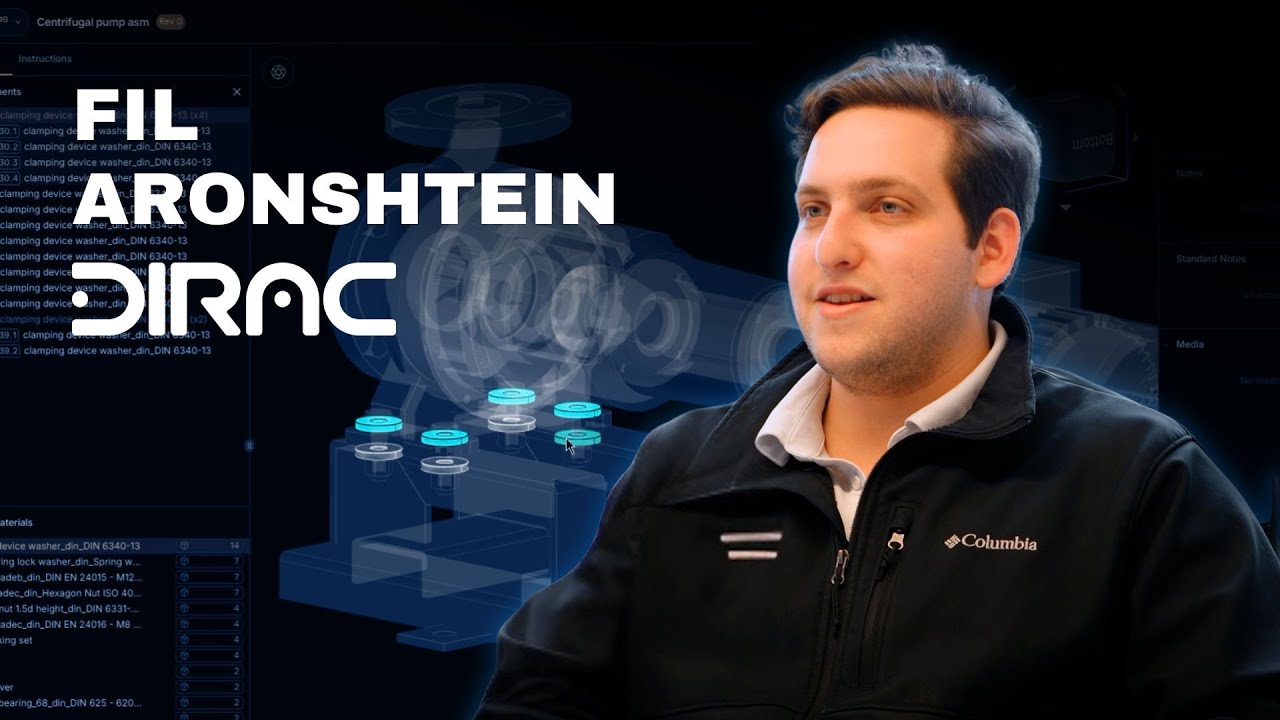
Dirac, co-founded by Fil Aronshtein, builds Build OS — the first automated work instruction platform for manufacturing engineers — and is expanding into a context-aware production planning platform that unifies design, production, and sustainment feedback loops across the factory.
Moving from El Segundo to the Empire State Building
Dirac previously ran two in-person offices (El Segundo and New York) but realized that two in-person offices with strong culture effectively create two remote offices, which fractures communication and context.
Communication breakdowns occurred because smart, opinionated people whiteboarding in person didn’t write things down; context was lost, decisions were made without full information, and the company became fractured across coasts.
On January 30th, Dirac executed a reorg in one day: parted ways with the LA engineering team, tripled down on the in-person New York team, and moved into the Empire State Building.
Fil remains in El Segundo frequently for friends and customers, but the conscious decision was to build a single, cohesive in-person culture to win.
Build OS — the automated work instruction platform
Build OS automates the creation of animated, model-based, interactive 3D work instructions from CAD data, replacing weeks of manual PowerPoint/Word doc creation with a process that is ~1,000x faster.
The product name “Build OS” was a placeholder from 2–3 years ago that stuck; it is currently a point solution for manufacturing engineers, but the roadmap expands it into a platform for context-aware production planning.
The platform vision uses the “three blind men and an elephant” analogy: manufacturing engineers (bottom-up work instructions), industrial engineers (top-down factory layout), maintenance/repair teams, and others each see only a piece; Dirac becomes the central source of truth that connects them.
Example: an industrial engineer consolidating 15 bolts across 20 stations into two stations automatically propagates to the work instruction, which kicks context to a mechanical engineer for DFM review — all automatically.
Future modules include factory layout planning, DFM, automated MRO/disassembly instructions (changing ~6 lines of code from assembly logic), and design for sustainability/assemblability.
Designing a product for manufacturing engineers
Unlike typical manufacturing software bought by C-suite but hated by shop-floor users, Build OS radically improves quality of life for the manufacturing engineer doing the work; 99% of manufacturing engineers immediately “get it” when they see it.
The sales challenge is bottom-up: engineers love it, but management often blocks adoption because they don’t see immediate ROI or use case.
To solve this, Dirac is building a “Commander Console” (working name) for VPs of Manufacturing/COOs — analogous to what Ramp is for CFOs — aggregating cross-functional context (error-prone parts, fastest operators, most-executed instructions, non-conformances) from shop-floor data.
Operator Plus, recently announced, lets operators instance runs, trigger automatic time studies, and give feedback on instructions (error codes, non-conformances, improvement ideas), all tied to specific components for cross-analytics.
This top-down visibility makes enterprise adoption straightforward; several large enterprises are already design partners for the platform expansion.
Building strong customer relationships
Dirac’s two core strengths: (1) exceptionally close customer relationships — everyone on the team comes from hardware (Fil: EE/roboticist, Northrop Grumman; Jared: manufacturing engineer at Hubble Power Systems, senior nuclear engineer at General Dynamics Electric Boat on Virginia-class subs), and (2) deeply context-aware software that solves the problem 1,000x better than alternatives.
Key customer: Ancra (tier-one supplier to Airbus, Boeing, Gulfstream), making 60% of cargo loading mechanisms worldwide; live on their lines with a very close relationship.
Mid-market manufacturers are “incredible to work with”; enterprises are design partners for the platform transition, betting that Dirac will be the platform the future of American production is built on.
Bringing production planning context back to the US
Post-election, a clear trend: companies are reshoring/nearshoring, but the tribal knowledge of how to build things stayed abroad; they need to digitize and standardize production planning to bring it back.
Major challenges: training new, less-skilled labor at scale; managing higher mix/variance production plans; ensuring quality and consistency across hundreds of global facilities (e.g., data-center cooling supply chains with 20–30% commonality across 200+ facilities).
Build OS acts as a “rubber band around variance” via automated, model-based instructions that standardize across facilities and variants.
Ripple effects: data-center boom drives demand for cooling systems, heat exchangers, sub-assemblies — second- and third-order growth across the supply chain in US and Europe.
Animated, interactive instructions drastically lower the skill floor for operators, enabling hiring of younger/untrained talent; easier-to-follow instructions reduce scrap rates and error, making companies more competitive.
One tier-one supplier’s OEM saw Dirac instructions on screens, mandated Dirac as a line-item requirement in all future bids — turning the software into a competitive differentiator for suppliers.
Biggest challenge in the past year: rebuilding the product from scratch
In August, Dirac realized the legacy app’s core architecture was unstable: two 20,000-line files (parts and steps) 95% similar but out of sync; every change required dual edits; pre-draft/drafting separation forced round-trips via a slow batch simulation.
ITAR/GovCloud compliance for an aerospace customer required rebuilding ~50% of the backend.
Decision: start a new repo, rebuild from scratch. Estimated 3 months; took 6 (Oct–March), with testing through April; Build OS V1 launched publicly in early April.
New stack: enterprise-grade, ITAR-compliant, GovCloud-integrable, single pane of glass (model + instructions unified), dynamic synchronous simulation (reordering regenerates animations on the fly), handles massive CAD files competitively with cloud CAD tools.
During the rebuild: morale was bleak but team was locked in; Fil was “freaked out” burning cash with no sellable product (customers need to see it to believe it); sold the old app lightly while building relationships for the new one.
The legacy app served as a beta that revealed the shape of the real product; V1 is now a “very sturdy, very sophisticated” piece of software with no close competitor.
Understanding your customers: call your customer, call your shot
Fil blends Paul Graham (“call your customer”) and Peter Thiel (“call your shot”) via horseshoe theory: listen deeply to customers, but understand the first derivative — the unspoken sentiment and platonic problem beneath their words.
Customers often ask for “faster horses” (e.g., PDF/Word/GIF exports of animated 3D instructions); Dirac provides exports (before/after screenshots, silhouette overlays) to meet them where they are, while pulling them toward the browser-based operator viewer.
99.9% of manufacturers still use paper binders with scribbled corrections; Dirac’s on-ramp lets them start with PDF exports, then naturally migrate to the live viewer once they see how easy it is.
The leapfrog: skipping 2–3 tech generations for many customers; the job is to give an on-ramp, not just leapfrog.
Advantages of being in the Empire State Building
Employee interest: “coolest place to work” helps recruiting.
Customer signal: the building houses established companies (LinkedIn: 10 floors; FBI, SEC), not startups — signals longevity and seriousness to enterprise buyers.
Fil’s identity shift: “I am no longer the founder of a startup. I am the CEO of a small business.” Shed silliness, be present, never miss emails, show up on time — the mission (American production cannot fall behind) demands the most serious version of himself.
Working with a great co-founder (Peter, CTO)
Met freshman year in EE class; Peter did all four final project options instead of one — instant signal of execution horsepower.
Peter: “engineer’s engineer,” highest GPA in EE dept, did homework for friends at MIT/Hopkins, loves teaching (tutored weekly even in early Dirac days).
Youngest on the 10-person engineering team but most respected; has grown from shy engineer to “leader of men” running a team that executes relentlessly and consistently.
Fil: “Every day he grows. Every day he comes in and he’s a better version of himself and he makes me very proud.”
Chewing glass: the 6-month rebuild
August realization → early September rally (“It’s wartime”) → 6-month grind building novel architecture (dynamic simulation, synchronous updates) that didn’t exist before.
Team was dedicated but morale was bleak; Fil burning money, unable to sell (customers need to see it), selling legacy app lightly while building pipeline for V1.
Since April launch: pipeline “blowing up,” inundated with calls; Fil and Trevor (partnerships) double-booked, scheduling customers weeks out; hiring aggressively — “very good problem to have.”
Focus over the next 12 months
Primary focus: customers — pipeline is exploding, all-in on driving value.
Roadmap: complex enterprise integrations (Teamcenter, Windchill, 3D Experience); platform expansion via new modules (factory layout planning, DFM, MRO); partnership-driven integrations (some announcements bottled up).
Shipbuilding vertical: working with Fairlead (massive supplier/shipbuilder at Norfolk); they see the design→production→sustainment vision and want to guide roadmap; announcement triggered heavy inbound from shipbuilders — natural fit for New York/Hudson River location.
Having friends you can lean on during hard times
Support system: Augustus (shared office early on, started companies same time), Josh Steinman, Isaiah Taylor — mission-aligned peers in similar life stage who “get it.”
Critical for a founder/CEO to have people to call anytime, not just for advice but to ask “what’s going on with you?” — mutual understanding.
Evolving as a leader
Clear from day zero that automated work instructions were the right problem; early articulation was frustrating (“skill issue on my part”), now refined to: “Ever build IKEA furniture? Imagine that for planes, cars, engines, missiles — but animated, 3D, auto-generated.”
Leadership shift: realized he cannot be “one of the guys” — if he’s late/sloppy/silly, the team will be too. Since moving to Empire State Building and launching V1, consciously became more serious, set the standard.
“Pressure makes diamonds” — not there yet, but transforming into the leader the mission requires.
Sacrificed gaming (CS:GO, Factorio) — played Factorio 30 hours straight one weekend to study factory-layout mechanics, then wrote PRD for factory layout planner module; video games inspire UI/UX mechanics (macros, click reduction, intuitive flows) that Dirac incorporates.
Taking design inspiration from video games
Games excel at making repetitive screen-time pleasant; Dirac aims to make production planning not just gamified but enjoyable — today it’s awful.
Customer anecdote: head of manufacturing at a German conglomerate (50s) uses the software on weekends because “it’s actually fun… incentivizing to use.”
Lead manufacturing engineer: “I don’t want to make work instructions any other way.” NPS for traditional tools: 1–2/10; Dirac is a step-function change — what CAD did for mechanical engineers, Build OS does for manufacturing engineers.
Pride at legacy incumbents (Boeing example)
If Fil could pick one company: Boeing — they have severe work instruction issues but suffer from “not invented here” pride and fear of admitting failure; management doesn’t listen to manufacturing engineers.
Ex-Dirac employee #1 (Keenan) was a Boeing manufacturing engineer; coworkers applauded his departure as a “hero’s journey to slay the demon of awful work instructions.”
Near-peer competitors are already working with Dirac; every industry has a stubborn incumbent oligopolist, but mindset shifts take time.
Fil isn’t worried — plenty of other aerospace/auto/construction OEMs and suppliers — but wants Boeing to win: “I would like to be proud to take a Boeing.”