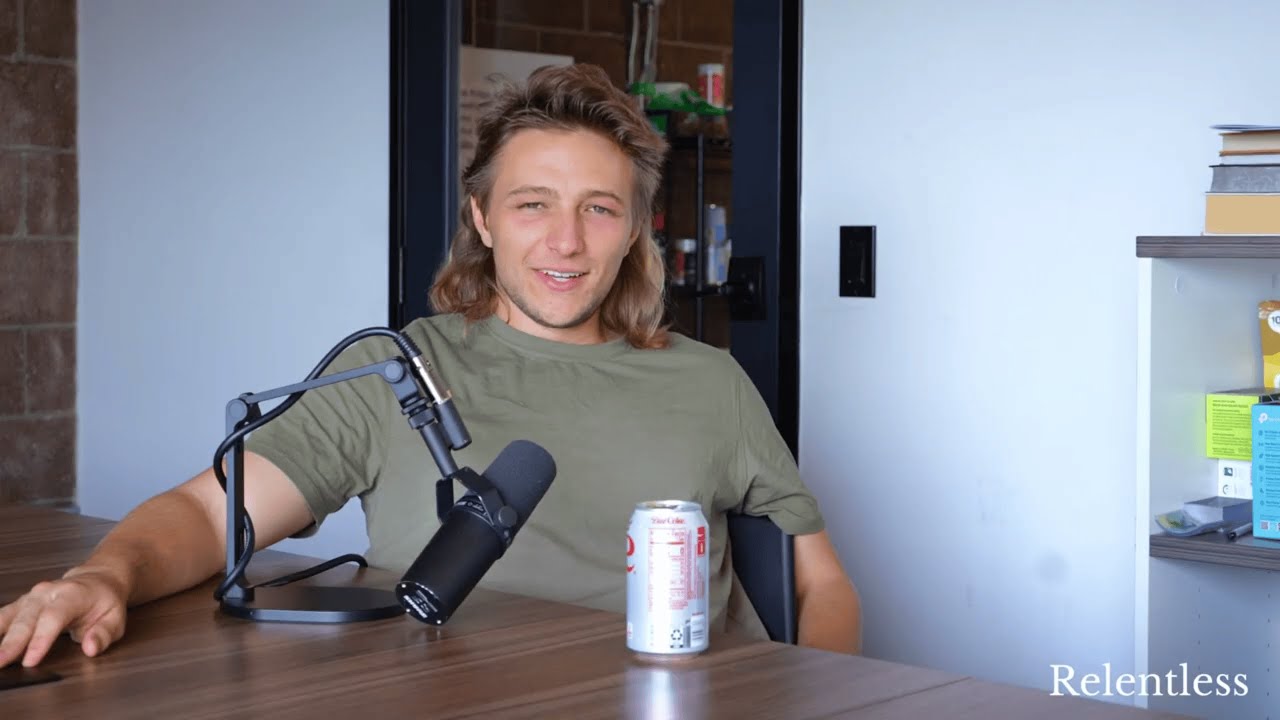
This episode is a follow-up interview with Augustus Doricko, founder of Rainmaker, a weather modification company that seeds clouds with silver iodide to produce rain and snow. Since the last interview roughly a year prior, Rainmaker has grown from about eight employees to over 50, vertically integrated its entire technology stack (drones, radar, particle design), and expanded operations across multiple U.S. states and internationally (Argentina, a Middle Eastern country). The conversation covers the brutal “Pendleton experience” that forced vertical integration, hiring for extreme field conditions, creative financing to avoid dilution, legislative battles over weather modification bans, and the personal toll of building a hard-tech company at warp speed.
The Pendleton experience forced vertical integration
In September–October 2024, Rainmaker was blocked from testing in California and moved the entire company (about a dozen people) to Pendleton, Oregon, a town of 16,000 on the Idaho border, to find permissible airspace and frequent test conditions.
Off-the-shelf hardware providers either lied about capabilities, had year-long lead times, or lacked required specs; nothing on the market worked for their needs.
From October onward, Rainmaker decided to build its own drones, radar, and particle-dispersion aerosols — a “harrowing” period of living in a freezing warehouse with converted offices, barely functioning heat, and intense iteration cycles.
By end of November 2024 they had their own drones flying; by April 2025 they had their own radar deployed; first evidence of anthropogenic precipitation enhancement arrived in December 2024.
The team iterated drone versions weekly (V0 → V0.1 → V0.2 → V0.5 → V0.75 → V0.9 → V0.99 → V0.999), crashing several units in severe icing conditions and recovering them by walking miles through mud at night, often digging trucks out by hand.
Doricko compares the experience to Elon Musk’s “Russia trip” moment: realizing everything costs too much and takes too long unless you build it yourself.
Everyone who lived through Pendleton came out with “different neurologies” — a shared culture of extreme grit and speed that now defines the company.
Hiring for the Forward Operations Corps: adventure and grit
Rainmaker is hiring ~50 “Forward Operating Specialists” to deploy to remote mountain sites for six-month stints starting October 2025; ~30% filled as of the interview, with a target of full onboarding by August 1.
The role attracts former oil roughnecks, national parks workers, Marine Corps veterans, and even financial analysts from firms like Blackstone who want to trade desk jobs for real adventure.
Doricko filters explicitly for “desire for adventure” and “grit”; he asks candidates directly: “Are you prepared to go live on a mountain for six months?” and clarifies: “You can’t come back to see your family now and then. You have to stay until the job is done.”
Retention is extremely high: people who visit for a week often refuse to leave; the culture self-selects — those who can’t handle the intensity are “terrified and run away.”
Doricko compares it to the “don’t work at Anduril” ad: Rainmaker doesn’t need to tell people not to apply; the reality of the work does the filtering.
Typical week for Augustus in 2025
Roughly 50% of time in El Segundo (LA), 50% split between Saudi Arabia, Washington DC, and U.S. program sites (Utah, Colorado, Texas, Oregon, California).
When traveling, works late nights to sync with LA-time team; focuses on regulatory issues (e.g., Florida), resource allocation, and thinking sessions for engineering programs.
Reads a high volume of emails; currently in off-season (May–September) doing logistics setup for Texas and Argentina programs that restart in earnest in October.
Flight tracking app shows he circumnavigated the globe 14 times in the prior year — weeks of cumulative flight time, which he uses for deep thinking and email triage.
Pushing to physical limits: the spider-eyes episode
During the October 2024 acquisition of a legacy cloud-seeding company (while seed-stage, taking on debt and doubling headcount), Doricko slept almost nothing for weeks.
Chronic sleep deprivation caused Demodex mites (microscopic arachnids normally harmless on human skin) to burrow into the sebaceous glands of his eyeballs, eating his eyes; cured only by ivermectin after extensive medical investigation.
He views this as a predictable cost of being a man in his 20s building a hard-tech company: “you should be on the verge of death at all times and live a very vital life.”
Jokes that Neuralink will solve the long-term damage; keeps a “lifetime supply of horse dewormer” on hand.
Did not change behavior post-recovery — just took the medication and kept grinding.
Acquiring a legacy cloud-seeding company to unlock market access
The cloud-seeding market barely exists because legacy tech could never prove efficacy; only a few desperate watersheds (Utah, Nevada) bought in, at small scale.
Rainmaker’s thesis from day one: buy one of the four remaining U.S. legacy operators (Texas, California, Utah, North Dakota; five including Colorado), inject Rainmaker’s superior tech, improve operations, and upsell.
Investors initially thought the acquisition was crazy — seed-stage company taking on debt, doubling headcount with people in another state, before having commercial contracts.
Doricko argues this “roll-up” model makes sense for deep tech: legacy industries with better products can’t scale fast enough through long B2G sales cycles; buying operations + injecting tech + using project finance/debt yields 10× scale 10× faster while preserving software-like margins.
The acquired company gave immediate operational footprint, existing government relationships, and revenue while Rainmaker’s tech matured.
Creative financial structures to minimize dilution
Doricko emphasizes that founders rarely take practical steps to mitigate dilution despite claiming to hate it; growth should be asymptotic (worth multiples more each year).
Strategy 1: Finance equipment and even sales teams with debt/project finance rather than venture equity. Example: set up a subsidiary LLC to own a factory, bring in outside equity + debt, pay down debt, buy back equity over time — avoids spending venture dollars on capex.
Strategy 2 (Rainmaker-specific): Land fund. Rainmaker produces water in arid regions with high-quality soil (e.g., parts of Arizona comparable to Central Valley pre-irrigation). Instead of just selling water, buy the land, terraform it via weather modification, then flip or operate the agricultural assets — capturing the full value stack.
Central Valley is cited as proof: it was desert/swamp until engineered water delivery made it the most productive agricultural region in the U.S. — “not playing God, just engineering.”
Origin of loving pain and exhaustion: high school spaceflight program
Junior year of high school, Doricko participated in the Student Spaceflight Experiment Program (designing a yeast-cell replication experiment for the ISS).
To juggle school, competitive sports, debate, and the program, he routinely stayed up until 2–4 a.m.; it was the most satisfying period of his life because the work was meaningful and he loved space.
He associated joint aches, headaches, and exhaustion with deep meaning and success — “learned to love the taste of blood in my mouth.”
This Pavlovian link lets him tolerate the constant “punches in the face” of aggressive startup building; if you don’t care deeply about the mission, you burn out.
Focus for the next 12 months: largest weather modification program outside China
Rainmaker will run the largest weather modification program in the world outside of China starting in the 2025–2026 season (October–April in Northern Hemisphere).
Goal: reach parity with the largest U.S. desalination plant (~10 billion gallons in 6 months) to prove cloud seeding is viable water infrastructure at scale.
Technical priorities: qualify drones in severe conditions, accumulate massive flight hours, validate radar phase-detection and precipitation-rate measurement.
Argentina deployment is for testing in glaciogenic (snowpack-enhancement) conditions to derisk the full system across diverse cloud regimes.
Logistics priority: hire and train the 50 Forward Operating Specialists by August 1.
If successful, Rainmaker can replicate in every target watershed and become the largest water utility in the western U.S. by 2026–2027 season.
Long-term: within two years, develop particle designs that work in warm-cloud conditions (fall/spring/summer), making the atmosphere “engineerable” globally, year-round.
Throwing new hires into the deep end
New hires arrive at the El Segundo office to a machine shop humming, people running around, palpable intensity — “you kind of know what you’re in for as soon as you arrive.”
Example: engineer Chris was hired in Pendleton, never saw El Segundo until 2025; his first experience was living in the freezing warehouse.
Culture remains “pandemonium” but more organized than nine months prior; autonomy is mandatory because too many distinct scientific, engineering, regulatory, and BD threads exist for Doricko to micromanage.
Hiring pipeline relies on referrals from existing high-agency engineers who attract similar friends; candidates are either “electrified” or “terrified.”
Finding the right mission: don’t tinker, join an impressive organization
Doricko advises against “tinkering on side projects” or searching for ideas in isolation — you won’t find consequential problems that way (learning Arduino doesn’t change the world).
Instead: join an impressive organization whose mission resonates, even if it’s not your life’s work; you’ll encounter real problem sets at scale that reveal what you can build.
He stumbled into Rainmaker — never imagined running a cloud-seeding company until 2.5 years ago; mission emerged from doing the work, not from a childhood dream.
“Move in any direction to get more information; don’t start a company until you’re sure where to run, but at least run.”
Selling to governments: boots on the ground, not cold calls
Deep tech has a demand advantage: people are desperate for water, energy, hardware — the hard part is building the tech, not finding buyers.
B2G sales require physical presence: state capitals, small towns, regular barbers and sandwich shops in places like Tallahassee; legislators must know and trust you.
Doricko spends weeks per year on planes; face time keeps you top of mind; you can’t do it via Zoom or cold email.
Florida legislative battle: separating cloud seeding from chemtrail conspiracies
In 2023, Doricko’s public advocacy for weather modification coincided with RFK Jr. and QAnon-adjacent figures calling chemtrails real and demanding bans; multiple states (Florida, Tennessee) proposed blanket bans on all weather modification and geoengineering.
Public confusion: most people conflate cloud seeding, solar radiation management (SRM), and chemtrails; many think silver iodide is colloidal silver.
Rainmaker’s lobbying strategy: acknowledge concerns, offer to ban SRM and chemtrails (which Doricko doesn’t believe are real — contrails are just engine condensation), but carve out cloud seeding as a proven, non-polluting, ecologically benign water-supply tool.
Montana used this model: proposed wholesale ban, then carved out cloud seeding for agriculture.
Florida has real need: 30,000 acres burned in April wildfires (hundreds of millions in damage in Miami-Dade alone), cattle and citrus operations need water.
Lesson learned: a lone LA tech startup is “default untrustworthy” in red states; need local stakeholders (farmers, ranchers) advocating for the tech, not just the company.
Unclear whether fundraising publicity helps or hurts credibility with legislators; “we’ll see.”
Most difficult thing: the relationship tradeoffs of extreme aggression
Doricko cites two answers: (1) the personal cost — struggling to be a good son, brother, and Christian because work is the overriding priority; deep friendships and family time are a real tradeoff that “grates on you” but he believes is worth making.
(2) Most difficulty is self-imposed by pace: moving the company to Oregon for six months, living in a freezing warehouse, vertically integrating the whole stack — didn’t have to do it, but it was the optimal move.
Rainmaker’s core value (“we like the taste of blood in our mouth”) exists because sufficient aggression means reality punches you constantly; you must Pavlov yourself to love the pain.
Decision to move to Pendleton took two weeks; the whole team agreed instantly — “drop of a hat, that’s what we have to do.”