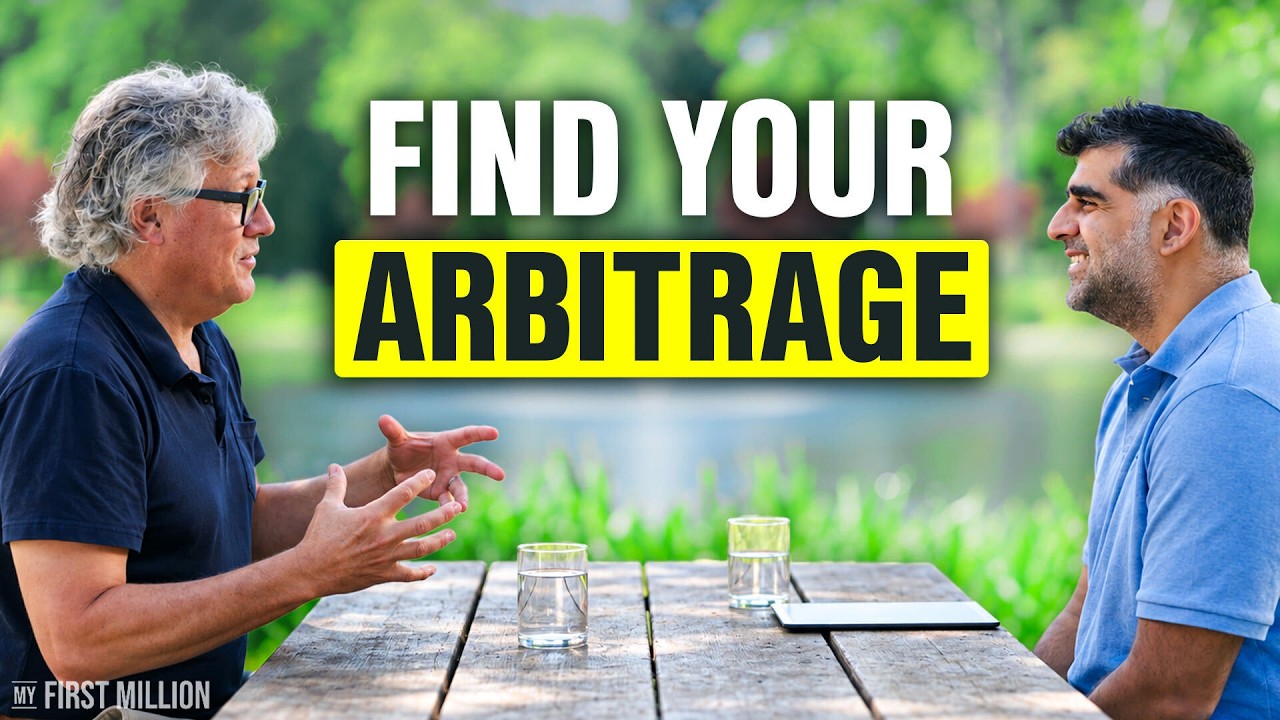
Nick Kakonis is a serial entrepreneur who has repeatedly entered unfamiliar industries — options trading, fine dining, restaurant software, and now immersive theater — and found arbitrage opportunities by applying first-principles thinking, intensity, and a willingness to be uncomfortable. He started with $60k on the Chicago trading floor, built Alinea into a three-Michelin-star restaurant widely considered the best in America, founded and sold Tock (restaurant reservation software) for hundreds of millions, and is now developing a vineyard and “Strange House,” an immersive magic experience under Wall Street. The through-line: every arbitrage is fundamentally about time scale, and the signal to pursue something is a “tingle of uncomfortableness” — not panic, not comfort.
Trading: the first arbitrage and the “smallest, highest hoops”
Kakonis wanted to be a floor trader but had no finance background (philosophy major). He faked his resume downward — removing college — to get a $5.25/hr runner job at the CME, because that was the only way onto the floor.
Goal: be trading within a year. He achieved it in a year and a week.
He sought a mentor who understood the “smallest, highest hoops” — difficult, niche knowledge with high barriers and low competition. Found a quant-trained trader rejected by firms for being too geeky; offered to pay him to work for him. Got hired at $250/week.
Within six months, had a rudimentary grasp of options market-making. Put up $20k (partner put up $40k), started trading Swiss franc options.
The core arbitrage: ETFs (e.g., QQQs) in New York vs. futures in Chicago. The physical paper handoff took ~30 seconds. Kakonis read the CFTC rulebook cover to cover, found no prohibition on same-firm communication between pits, and ran a dedicated T1 line (bribing union workers with Jameson to lay fiber).
First day live: made hundreds of thousands instantly, zero risk. Reaction: terror — the edge was so good the establishment would kill it. Shut it down voluntarily, reapplied for a pilot program to legitimize it.
At peak: doing a couple percent of AMEX daily volume, ~$100M/year profit (early 2000s dollars). Firm grew to ~35 traders, mostly “corporate refugees” (lawyers, etc.) he recruited and trained.
Merger with a NY firm for capital led to overexpansion, culture clash, and declining returns. 9/11, father’s death, and personal burnout prompted exit. He quit abruptly, paid out partners/employees, walked away at 31.
Alinea: building the best restaurant in America with no experience
After trading, Kakonis felt the “world was slow” and became unpleasant. Wife’s intervention led to a sabbatical. He didn’t want to become the retired athlete gambling on golf with no edge.
Met Grant Achatz, a young chef who reminded him of himself: obsessive, showed up at 6am, made 25 sauce variations to find the right one. “Knowing what great is is making mostly 99% of the time.”
Alinea concept: open-source the business plan on eGullet forum (2004-05). Published menu development, naming, philosophy — hundreds of thousands of views, press attention, built-in customer base before opening.
Declared goal: “best restaurant in America” — before Michelin even came to the US. Framed it as: “It will look bad for Michelin if they’re not here.”
Experience design borrowed from theater (David Byrne’s Stop Making Sense: empty stage that builds) and magic (misdirection, positioning, callbacks). No tablecloths, no 18 forks, no host stand — start empty, reveal courses as narrative arcs.
Service philosophy: stand beside the guest, not across. “Team diner.” Learned from magicians: control attention, assess environment (e.g., reading shoes/watches to upsell wine without embarrassing the buyer).
First year: $5M revenue, 7-8% margin. Peak: ~$20M revenue, 18-20% margin. Achieved by eliminating phone lines (built Tock), scientific food costing (Marimekko charts from CFO), and treating hospitality as a flywheel: great experience → profit → reinvest in experience.
Investors got quarterly distributions from 2005 to 2023 sale, then 8x initial capital — ~27-28x total. Kakonis: “Restaurants aren’t a bad business. I was bad at the restaurant business — until I wasn’t.”
Tock: the software arbitrage (reservations as dynamic pricing)
Core insight: the host stand answering phones is the “30-second piece of paper” of restaurants. OpenTable intermediated the relationship and didn’t allow dynamic pricing.
Tock built: ticketing (pre-paid reservations), dynamic pricing by time slot (Tuesday 9pm ≠ Saturday 7pm), direct customer relationship (KYC).
Friction: restaurants print menus quarterly; dynamic pricing requires menu changes daily/hourly. Kakonis: “You need a big dumb button that says ‘make more money.’”
Elizabeth Warren later tweeted against dynamic pricing; Kakonis: everything is dynamically priced, just slowly. Uber’s “surge pricing” was the right idea with the worst possible name.
Believes “geoence” — localized, dynamic, variable pricing for time-slotted businesses — is a hundreds-of-billions-dollar opportunity. Got tired of convincing people; AI may finally enable the “big dumb button.”
Sold Tock to Squarespace during COVID (200% growth year). Took control of diligence: converted 896-question Excel list to Google Docs, color-coded, assigned, completed in 3 days (bankers/lawyers estimated 4-6 weeks). Fired investment bankers, ran process themselves for 2% fee. Closed before Squarespace’s S-1 lockup deadline.
Strange House: the next boulder (immersive magic theater)
Origin: late-night YouTube rabbit hole → Nate Stanforth’s lottery trick. Kakonis reverse-engineered the method (working backward from the effect), noticed the numbers weren’t in ordinal order (lottery tickets always are), emailed Stanforth with a fix.
Stanforth called in 5 minutes. They bonded over the business of magic: great art, terrible monetization. Next-gen David Blaine won’t come from TV; YouTube doesn’t pay.
Kakonis had a 15-year-old idea: restaurant with narrative arc like Disney’s Haunted House (small groups moving through rooms, high throughput). Economics never worked for food (variable costs, staffing). But for magic? Close-up magic in intimate rooms = high wonder, scalable throughput.
Stanforth spent 8 months building a full proposal: scale models, QR-coded videos, spreadsheets, insurance, technical guide (hundreds of pages). Kakonis read it three times. “This is the last thing I need. But there’s no way we can’t do this.”
3-year search for real estate. Found 90,000 sq ft under Wall Street. REITs balk: no comparables, “what does a magician know about real estate?” Building a purpose-built theater = “smallest, highest hoop.”
Team: Stanforth (magic), Alon Lee (Exploding Kittens, game design), Kakonis (business/ops). Goal: human connection through awe. “Take any two people who hate each other politically; put them in this environment; make them love each other by the end.”
In-person experiences will become more valuable as AI replaces digital interaction. Not a concert, not theater — its own category. Hard to reproduce, high barrier, right time.
Recurring principles across careers
Arbitrages are time-scale differences. Trading: 30-second paper handoff. Restaurants: phone vs. digital. Software: static menus vs. dynamic pricing. Theater: passive watching vs. immersive participation.
Intensity is the strategy. Not a secret formula — visible strategy executed with greater intensity, which eventually becomes the strategy. Edit out stupidity daily (Market Wizards: “a successful trader will figure that out”).
Seek the “tingle of uncomfortableness.” Wake up feeling great → not enough risk. Wake up vomiting → too much. The nausea is the signal you’re at the edge. Every ~10 years, quit before expertise becomes a trap; build a new “prison of your own choosing.”
Show up prepared — or show up unprepared and admit it. Both count. Don’t show up late, cancel, or ghost. Responsiveness compounds.
Learn from adjacencies, not peers. Restaurants ← theater, magic. Software ← trading floor. Podcasts ← Hot Ones (put trouble in the way), interrogators (get honesty), golf (4-hour filter).
Build in public / open source the plan. Creates engagement, feedback, future customers. Authenticity wins — even the cringey parts.
Align incentives. Alinea manager held back covers to avoid burnout; Kakonis opened 110 seats/night, forced the system to adapt. Manager left. Incentives must make “every day Saturday” beneficial for staff.
Read the rules. CFTC rulebook, lease terms, M&A docs. Most people don’t. The edge is in the fine print.
First principles > convention. Universal restaurant calculator (80 cells). Magic books start with effect, then method, then craft. Apply to any domain.
M&A: control the process. Lawyers/bankers bill hourly; their incentive is delay. Convert diligence to shared docs, assign, execute fast. Be the counterparty who knows the answers.
Current mindset
At 58, still building. Vineyard (grapes won’t be good until 70), wine bar, Strange House. “The work is the win” — Sisyphus happy.
Fear of not finding the next quest > fear of failure. “I’m fearful of not finding more quests, side quests.”
Still emails people directly when media narratives feel wrong. Unfiltered information (X, Reddit, boards) vs. filtered lag.
Strange House: “It deserves to exist.” The question “will it happen?” is self-referential — the choice to make it happen is the answer.