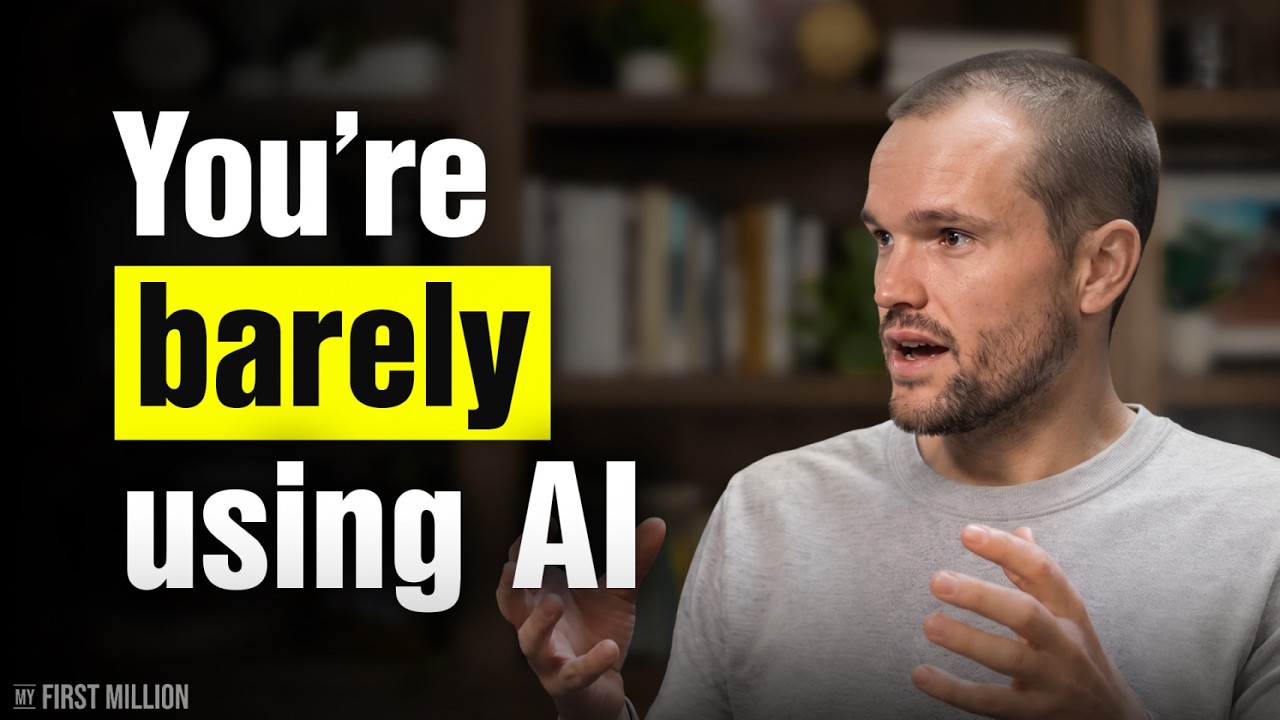
Wade Foster, co-founder and CEO of Zapier (valued at ~$5B, seed-strapped with only $1M raised), shares how he personally uses AI as a CEO to run his company and his life, demonstrating a suite of custom AI agents he calls his “robot executive staff” that handle briefings, decision support, hiring audits, and customer outreach.
Zapier’s AI pivot: from integration layer to agent infrastructure
Zapier’s original value prop was connecting apps via “universal plugs” so data flows between unrelated tools (e.g., form submissions → CRM).
The new pitch: AI chatbots (Claude, ChatGPT, Cursor) are generally smart but lack your business context; Zapier becomes the connective tissue that feeds your CRM, help desk, email, and chat into the AI so answers become hyper-specific.
The real unlock is deploying automations/agents that run while you sleep — not just chat — and Zapier differentiates by making those run deterministically (code/workflow logic) rather than purely agentically (guessing, token-heavy, expensive).
Zapier writes the workflow code for you, uses AI only where judgment is needed, hosts it in the cloud (no laptop open), and adds self-healing: if an API fails, an AI troubleshoots and retries automatically.
Wade uses Cursor (an AI coding agent) as his daily driver for building these workflows via natural language, not writing code himself; he prefers voice-to-text (Monologue app) for input.
The “Robot Executive Staff”: morning and evening briefs
Morning brief (6 AM): pulls calendar, email, meeting notes, and to-do list → sends a Slack digest (“waking up like the president”) with the day’s schedule, context on each meeting, and a pump-up speech from an AI persona named “Ari.”
Evening brief / Scribe (end of day): loops over Granola meeting notes, outstanding to-dos, and inbox emails → asks “How did the day go?” → logs the reflection to learn what drives good vs. bad days → takes action: drafts follow-up emails, makes intros, clears administrative debris.
Result: Wade’s end-of-day admin dropped from ~2 hours to ~15 minutes; the reflection data later summarized patterns (e.g., “good days = no meetings before 11 AM”) which he gave to his human assistant to protect.
AI that argues back: system prompts and the War Council
Default AI behavior is sycophantic; Wade adds a system prompt (in Cursor’s AGENTS.md or Claude’s CLAUDE.md) demanding: “Be direct and honest. I need the truth my coworkers are afraid to tell me. Challenge my assumptions. Poke holes. Disagree when you genuinely disagree.”
Example: prompted “Kill the free tier because a competitor raised prices” → AI pushed back: “Big move off thin signal. Bring data. Define the real problem. Run a smaller experiment first.”
War Council skill: spins up 7 sub-agents with personas — 3 standing members (Wartime COO, Ruthless CFO, Contrarian Board Member) + 4 dynamic personas generated per prompt (e.g., hiring expert, security lead) — each debates the decision; output is a synthesized, multi-angle analysis.
Personas are generated by describing traits (e.g., “wartime COO = ruthless, execution-obsessed”); Wade tweaks the generated descriptions to match the “Mamba mentality” he wants as a counterweight to his own collaborative default.
AI in hiring: replacing gut feel with structured audit
Pre-AI: Wade (thousands of interview reps) could “smell” bad hires but couldn’t articulate why; pushing hiring managers created friction (“Are you making the decision or am I?”).
Post-AI: runs candidates through War Council / hiring committee skill → AI articulates specific gaps (“Panel didn’t scrutinize X; here’s how this candidate compares to historical Zapier hires”) → hiring managers engage substantively (“AI got X right but missed Y context”) → decision quality improved.
Wade’s own hiring filter: 1) Evidence of exceptional ability (story of something exceptional done personally, not team-adjacent) → 2) Creative chemistry (do they elevate the room when problem-solving together). No formal personality tests (Myers-Briggs, DiSC, Burkeman) used company-wide, though Wade finds complementary traits in his EA (3/4 Myers-Briggs letters differ) valuable.
AI as the “brain” — shifting the CEO role
If all institutional knowledge (code commits, customer convos, Reddit/X mentions) is hooked to AI, it reasons over more data than any human CEO → plausible that AI becomes the primary decision-maker for certain classes of decisions, with human as context-provider and final judgment call.
Wade: “Any high-stakes decision, AI weighs in now” — it has a seat in exec/board meetings.
Counterpoint: roles requiring human trust (sales, relationships) still need humans talking to humans; AI augments but doesn’t replace the relationship layer.
Life philosophy: defining your own winning, money as a non-driver
Wade turned 40; paper wealth ~$5B but illiquid. Psychology: “Once you hit a certain wealth level, more doesn’t change the equation.” Family is #1–3. In central Missouri, $1M liquid would suffice; his post-college dream was $100K/year.
No bucket-list purchases unlocked by a billion-dollar exit: “Nothing I couldn’t already do.” Took family on safari (grandpa’s dream) before liquid billions.
Grandfather (WWII vet, died at 98.5) as north star: tight family, professional respect, deep community ties — “didn’t have it all, didn’t need it all.” Winning = nailing the things you care about.
Rejects “one-dimensional winners” (e.g., Michael Jordan on-court greatness, off-court flaws). Define your own game; decisions become easy when the scoreboard is yours.
Odd-for-Silicon-Valley choices: fully remote from day one (2011), only one funding round, optimizing for customer value over valuation headlines. “The work itself” is the point; money follows if you do that well.
Consumption: Acquired podcast (NFL episode, retail trilogy: Costco/Walmart/Amazon); book Make Something Wonderful (Steve Jobs in his own words, chronological); Sean recommends The Score (Taiwin) on life as game selection; Sam recommends Mark Hoppus memoir (Fahrenheit 182).