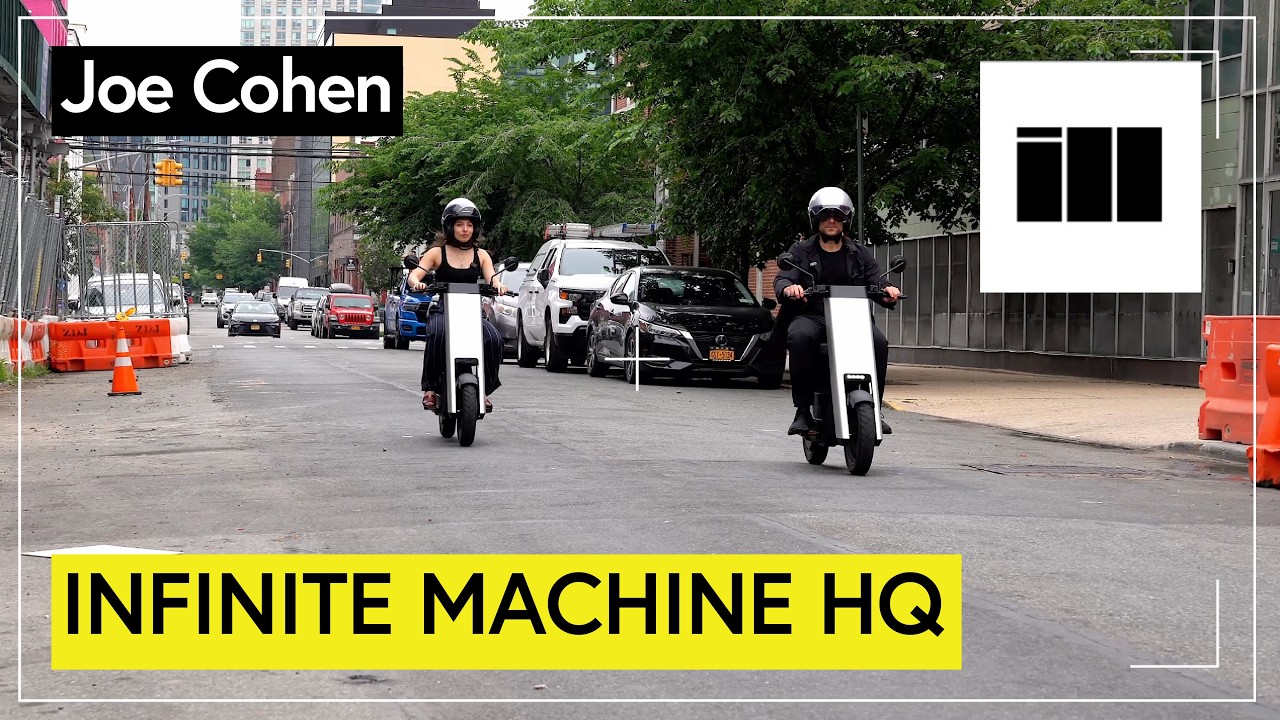
Infinite Machine is a New York–based electric vehicle startup founded by two brothers (Joe and Eddie) and a third co-founder, Zach, that designs and manufactures compact urban electric vehicles — the P1 (a 65-mph street-legal electric scooter/motorcycle) and the Alto (a class 2 e-bike). The company operates out of a single New York facility that houses its showroom, prototyping factory, warehouse, design studio, and back office. Both vehicles are fully electric, feature removable batteries, connect to a smartphone app, and are designed to be durable, simple, and beautiful. The company is backed by Andreessen Horowitz (a16z) and is currently shipping Alto at scale this summer after a beta run last winter, while P1 remains a flagship statement product.
Origins and founding story
The company began as a nights-and-weekends project during COVID after Joe’s Vespa was stolen and he found the existing electric vehicle market uninspired.
Joe had ridden a Vespa for 10 years and, after it was stolen, went looking for an electric replacement but was “super uninspired by everything that was out there.”
He brought the idea to his brother Eddie, and the two started building a better vehicle during COVID, self-funding the effort.
The three co-founders are Joe (software background, previously running his own company), Eddie (hardware/meditation-related business), and Zach (vehicle engineer, machinist, and fabricator).
Zach was found fortuitously: the brothers rented a small garage in Red Hook, New York, and their neighbor — a custom motorcycle builder named Carlos — introduced them to Zach after deciding the project wasn’t quite his fit.
Zach had studied vehicle engineering and had experience in both mechanical/electrical systems and architectural metalwork, making him ideal for building a vehicle that is “not only a mechanical and electrical system but also sculpture.”
The first prototype, called P0, was built by the three of them in that Red Hook garage on nights and weekends.
The vehicles
P1 — flagship electric scooter/motorcycle
65 mph top speed, street-legal, license-plated, fully electric.
6,000 W motor with a removable battery.
Can be ridden up to 30 mph without a motorcycle license (classified as a moped by software limiting); with a motorcycle license, it goes up to 60+ mph.
The legal distinction used to be based on engine size (under 50 cc = moped), but since P1 has no engine, it’s regulated by software.
Designed to “make a statement” — looks nothing else on the road, with a prominent front light element called “the grill” as its iconic fascia.
Features anodized aluminum construction with powder coating (more industrial than auto body paint).
Has a helmet hook, under-seat storage, NFC key card, and smartphone connectivity.
Includes a mounting system on the sides for attaching accessory boxes.
Alto — class 2 e-bike
Class 2 e-bike: no license required, can be ridden in bike lanes.
Ships at 20 mph out of the box; app allows switching to class 3 mode (25 mph) or off-road mode (up to 35 mph).
Removable 48-V battery (20 lb) that can be charged via an included charger plugged into a standard wall outlet (no dock needed, unlike P1 which has a charging dock option).
Also has a charge port on the vehicle itself for plugging in without removing the battery.
Seats two people — uncommon for e-bikes.
Front and rear suspension for smooth rides on rough surfaces like cobblestones.
Tons of storage: center storage area, optional front sidewall inserts that create a basket, and an optional rear basket.
Security features: self-locking, alarm system, GPS tracking — the company reports zero thefts. If someone tries to move the vehicle, it locks, triggers an alarm, and notifies the owner’s phone.
Smartphone app for remote unlocking, sharing access with friends, and viewing ride history.
Designed to be more “soft-spoken” than P1 — less visually dominant since it shares space with bikes and cars in the bike lane.
Positioned as a car replacement for city dwellers going 5–10 miles a day: better than the train, better than an Uber, better than a city bike.
Design philosophy
Infinite Machine’s consistent design principles across both vehicles: durable, honestly constructed, pushing manufacturing techniques, exciting and inspiring, simple and beautiful.
Both vehicles use anodized aluminum construction with powder coating rather than traditional auto body paint.
The company aspires to create a “New York design language” — they want their vehicles to be recognizable as products of New York’s culture and diversity, distinct from San Francisco startup aesthetics.
The team is intentionally diverse in background: machinists with 25 years of experience, mechanics, warehouse builders, creative directors from the fashion world — “not cookie-cutter San Francisco startup.”
Manufacturing and operations
Everything is designed, engineered, and prototyped in-house at their New York facility, which includes a full machine shop for electronics, metalwork, and paint.
Once a design is locked in, mass production is outsourced to specialized global manufacturers — a vehicle comprises about ~300 components, each sourced from different specialist manufacturers (e.g., one factory for anodized aluminum panels, another for electrical components).
The company’s role is to choreograph and integrate all components coherently.
Manufacturers were eager to work with them because “great manufacturers want to work with inspiring products” — the excitement of the design attracted top-tier partners and talent.
For the first few hundred units, all vehicles are shipped to the New York facility first for a final quality check before going to customers.
Each vehicle has multiple chips running firmware; the QC process verifies every component’s firmware is up to date.
The packaging is designed as a user-disassemblable container — the vehicle arrives fully built with zero setup required.
Within the next couple of months, they plan to ship directly from the manufacturer to customers.
Headquarters and New York identity
The company is headquartered in New York because the founders are from New York and the vehicles are designed “first for New York, then shareable to the rest of the world.”
New York’s diversity and culture are imprinted in how they think — they build for many different kinds of people.
There are very few vehicle companies in New York (one mentioned: Tarform, which makes electric motorcycles), making Infinite Machine unusual in the city’s industrial landscape.
The team is approximately 20 people — remarkably small for a company designing and producing two vehicles from the ground up.
Marketing and public presence
Ran a marketing campaign called “Eclectic Vehicle” featuring 100 New Yorkers riding Alto — including rappers, NYC Ballet dancers, designers, founders, everyday New Yorkers, and the founders’ mother.
Celebrities were recruited through the founders’ personal and professional networks.
The vehicles were spotted on the streets of SoHo (near the Andreessen Horowitz office) as a kind of showroom display, which generated public curiosity — some observers noted a Cybertruck-inspired aesthetic.
The connection to a16z is real: Andreessen let the Infinite Machine team work out of their office during an event, and the team showed up on P1s.
Colors and customization
Alto ships in two base finishes: anodized black aluminum or clear anodized (silver).
Five standard wrap colors are offered: forest (green), blush (pink), crimson (red), and two others.
Custom wraps in any color are also available.
Wraps are durable and changeable — customers can switch colors at any time and the company handles it.
Pricing and availability
Alto is currently in mass production and back-ordered, with orders being fulfilled as quickly as possible.
Shipping began last winter (beta run in New York and San Francisco); this summer is the scale launch.
The showroom is open to the public — anyone can walk in, test ride, purchase, and customize a vehicle with accessories.