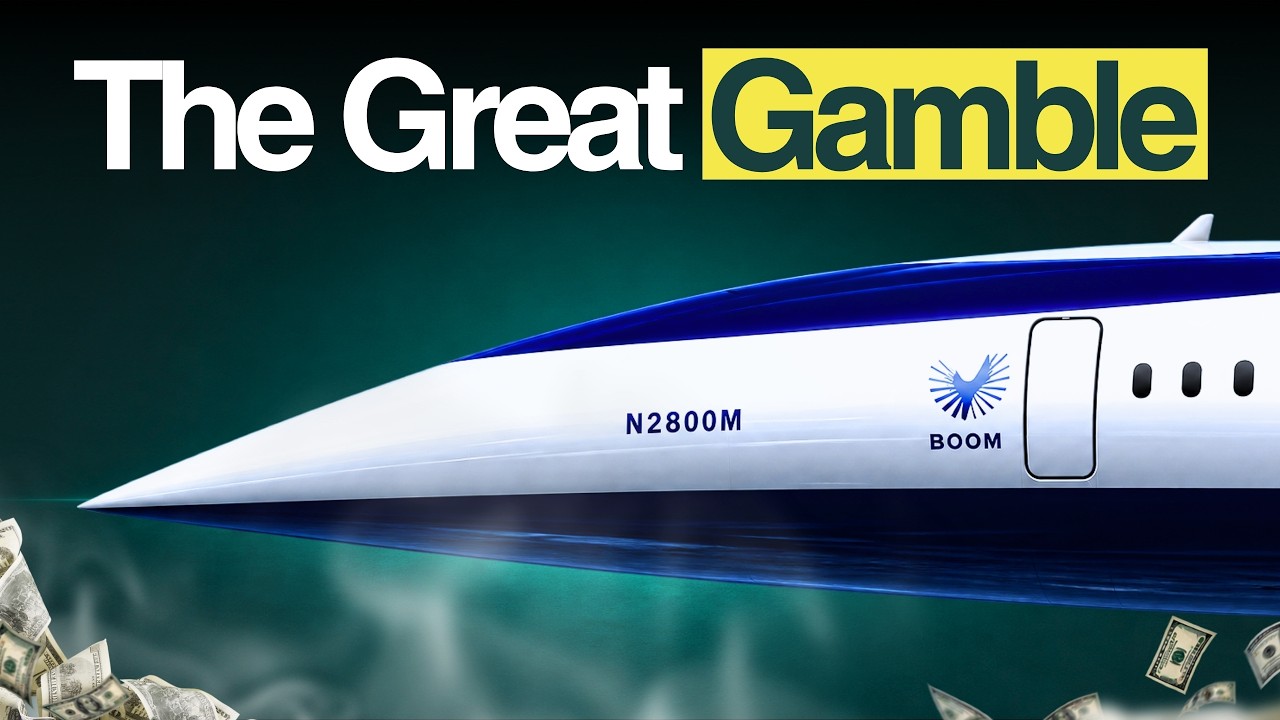
Blake Scholl, founder and CEO of Boom Supersonic, walks through the journey of building the first independently developed supersonic jet (XB-1), the near-death experiences that shaped the company, and the philosophy that drives him to tackle seemingly impossible problems.
The XB-1 supersonic breakthrough
Boom flew XB-1 supersonic in early 2024, the first civil supersonic jet built outside a government or military program.
The supersonic flight was the 12th test flight, following a methodical envelope-expansion process: step up in speed, step up in altitude, analyze data, repeat.
First flight to first supersonic flight took about nine months, with a long gap between flights 1 and 2 for modifications, then a faster cadence.
On the morning of the supersonic flight, weather looked marginal; the test team made the go/no-go decision behind closed doors per safety culture, and their excited body language signaled a go.
A live air-to-air stream via Starlink showed the Mach 1 callout on a giant screen; ~300 people (media, friends, investors) watched and celebrated.
Scholl felt the barrier had already been broken hours earlier when the crew chief hooked up the tow bar — the flight itself felt like confirmation of an inevitable outcome.
Target for passenger service on the production airliner (Overture) is ~2030, though schedules in aerospace tend to stretch; all “hardness problems” are solved, remaining work is scale-up and safety testing.
Near-death experiences and the 2,000 lb overweight crisis
The first ~10 years brought a near-death experience roughly every year: running out of money, technical crises, existential doubt.
At one point XB-1 was 2,000 lb overweight on a 12,000 lb design — a 17% margin that felt potentially fatal.
Press and skeptics labeled Boom “the Theranos of aviation”; Scholl’s personal fear was being branded a fraud if the airplane never went supersonic.
Breaking the sound barrier felt like reaching base camp on Everest: not the summit (mainstream supersonic travel), but proof the climb is possible and a positive contribution to history is already made.
The last acute crisis was ~18 months ago; Scholl jokes they may be “due” for another.
Philosophy: making a dent in the universe and the dark matter entrepreneur
Scholl frames his drive as: “How big a dent can we make in the universe?” — inspired by Steve Jobs but determined to swing harder.
He didn’t always see himself as a dent-maker; for a long time he admired Gates, Jobs, Edison but felt arrogance in claiming that role for himself.
The turning point: reading about Bill Gates in the 1970s aiming to put a PC on every desk running Microsoft software when neither PCs nor a software industry really existed.
Scholl realized there are two kinds of entrepreneurs who take on huge challenges: those who succeed (visible in history) and those who give everything and fail — the “dark matter of entrepreneurship.”
He decided he would rather be a dark matter entrepreneur than a “what if” entrepreneur; the only way to find your limit is to push until you hit it.
Courage is not fearlessness; it is acting despite fear. Once he framed the decision as a courage choice, it became easy.
Origin story: the aviation bug and starting Boom with three kids under two
Early imprint: at 6 months old, taken to Cincinnati airport, connected a toy airplane to real ones taking off.
First flying lesson at 19 (San Carlos airport, summer 2000): pulling back on the stick, feeling “I’ve got my life in my own hands” — both literal control and a metaphor for agency.
Flying forces 100% mental presence; Scholl finds one hour in the air more relaxing than a week of vacation because nothing else intrudes.
Holds private pilot license with instrument rating; flies ~once a month to maintain currency (muscle memory for safety-critical shortcuts).
Started Boom with three children under two (twins involved); rejects the trade-off narrative between “life” and “work” — meaningful work is part of life, and lessons transfer both ways (parenting → CEO, CEO → parenting).
Recent cultural practice from parenting: “mistake dinner” — family shares a mistake and the lesson; adopted at Boom staff meetings to normalize candor and transparency.
Culture at Boom: mission focus and resilience
Hiring filter: vast majority of employees must be passionate about the mission (mainstream supersonic travel).
When the equivalent of a stage-4 cancer diagnosis hits (technical/financial crisis), only people who deeply believe the goal is worth enormous pain will stay; sane people who don’t love it will quit.
Resilience is built into culture; setbacks are expected and treated as problems to solve, not reasons to stop.
The Rolls-Royce breakup: best gift Boom ever got
Spent six years trying to get Rolls-Royce to build a custom engine; early employee argued Rolls engines were most modifiable — sounded like a breakthrough, turned out to be a mistake.
The program reached a Rolls board meeting for approval; outcome was the CEO got fired, and the engine program died.
Scholl realized betting the company on a 100-year-old incumbent’s willingness to play ball was fragile; bad luck reveals fragile plans.
Decided to bring engine development in-house (Symphony engine) — a scary leap because the team didn’t believe they could do it and the people didn’t exist yet.
Brian Chesky (Airbnb) gave a talk on leading through crisis: “don’t compromise, become your truest best self” — Scholl heard “Boom should build its own engine” and got permission to make the big swing.
In-house engine unlocked a second revenue stream: ground power generation, pulling scaled revenue forward by years and billions in capital, making the whole business financially viable in a new way.
Lessons from Amazon (engineer ~200, 2000–2001)
Joined two weeks before a hiring freeze; got to work on projects Jeff Bezos cared about — “nothing like being early in your career and working on something the world’s greatest entrepreneur won’t let you fail at.”
Built the first automated customer acquisition system at scale: automated search-ad buying and optimization before Google had an API, at age 22.
Advice for young people: if you have a startup you can’t shake, go start it; otherwise, go work with the best people on the most important problem at a company — that’s where the best mentors and exposure live.
Big ideas hiding in plain sight: congestion pricing and the supersonic prize
Traffic wastes ~one working month per year per American; autonomous vehicles will worsen it (people tolerate longer commutes if not driving).
Solution: congestion-price the entire road network — variable pricing by time/route, replace gas/vehicle taxes, rebate proceeds to taxpayers; smartphones enable tracking.
Political hurdle: societal entitlement to free road access; Scholl thinks it’s solvable with the right framing (rebates + priority pricing).
Supersonic RC prize: inspired by historical aviation prizes (Orteig, XPRIZE); saw a kid build a 500 mph RC plane, tweeted a $50k prize; community grew it to $750k with >100 teams registered — someone will break Mach 1 with an RC plane.
Personal philosophy: courage, fear, and giving it all
Scholl’s current fear: not giving everything his all, leaving something on the table at the end of life.
His daughter at 10, when asked how she’d feel if Boom went bust: “I’d be proud of you for trying.”
Wish for every entrepreneur: do the thing you’d be proud to fail at. Honest failure is forgiven (especially in tech/America); ambitious goals make failure psychologically easier because expectations are lower.
Courage = acting despite fear, not absence of fear. Exposure therapy from repeated crises has raised his threshold; bad news no longer phases him the way it once did.