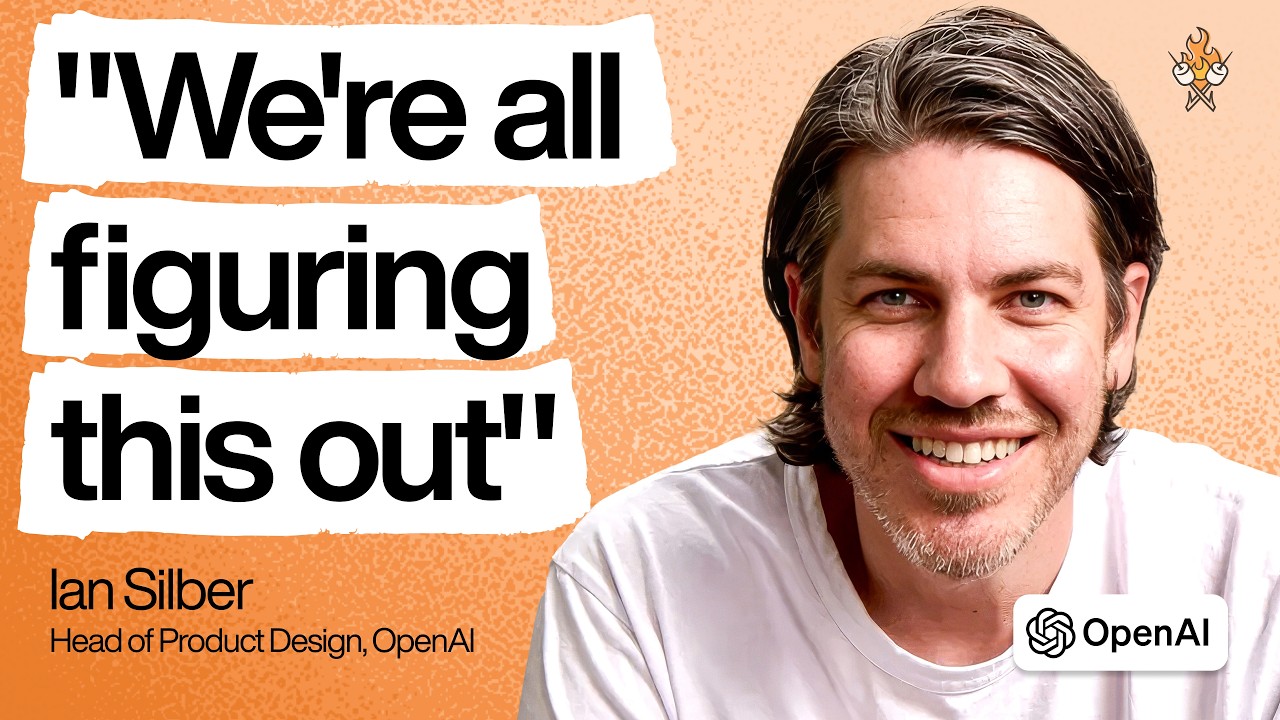
Ian Silber, Head of Product Design at OpenAI, shares his perspective on why this is the best time in history to be a designer despite widespread anxiety in the design community, how AI is transforming the design process, and what skills and mindsets will help designers thrive in the AI era.
Why designers feel anxious about AI
Designers and user researchers report the highest levels of anxiety, overwhelm, and pessimism across the tech workforce, driven by uncertainty about changing role expectations.
The core tension: engineers have seen 10-100x productivity gains from AI coding agents, while the design process remains messy, fluid, and time-consuming — trying many ideas, throwing most out, and relying on human feedback loops that haven’t compressed the same way.
Classically trained designers feel pressure to completely change their workflow (e.g., “do I need to ship code every day?”), but lack clarity on what the new expectations actually are.
Organizational alignment overhead in larger companies adds friction that AI hasn’t yet solved.
What makes designers thrive in the AI era
The strongest correlate of designer happiness and success: feeling amplified by AI — it makes them better, not replaced.
Thriving designers share key traits: high curiosity, adaptability, willingness to explore, and using AI at every step of the process (ideation, prototyping, thinking partner).
They treat AI as a collaborator: “throw an idea into Codex/Claude to help think about it, prototype it, try a different way of working.”
Crucial mindset: nobody has it figured out — we’re all in early innings. What works today will change in months. Starting today puts you ahead of most.
OpenAI’s culture encourages exploration over pressure: designers who embrace the tools report more creativity, ability to try bad ideas quickly, stronger thinking, and higher impact.
Why Ian says it’s the best time in history to be a designer
Unprecedented speed from idea to working artifact: minutes instead of weeks, enabling massive expressive range and rapid iteration.
Democratization: anyone can be a designer; the barrier to entry has collapsed.
Human-centered design becomes the key differentiator: as anyone can build anything, products that deeply understand users and deliver delight will stand out most — that’s the designer’s core job.
Shifting ratios: startups may hire 2 designers per engineer (vs. 1:15 historically) because creative direction and product thinking become the bottleneck, not implementation.
Designers are more empowered: at OpenAI, designers take early research concepts and package them into products people want — that’s the job, and it’s expanding.
How product roles are converging (and where they stay distinct)
PM, design, and engineering roles have always had blurry boundaries (designers with PM skills, designers who code), but AI is making them blurrier.
However, distinct responsibilities remain valuable at scale: a PM rallying multiple teams, aligning strategy, handling resourcing; an engineer ensuring system soundness; a designer driving craft and user understanding.
One person doing all three well is rare; the “hats” (strategy, craft, execution) still need wearing, even if individuals fluidly switch between them.
At startups: hire the best generalists who can move fluidly. At larger companies: specialized excellence with collaborative overlap works better.
Can AI design great products?
Ian’s view: AI is already an incredible product designer — accessible to everyone, great at generating options, prototyping, and reasoning through interactions.
But it’s not necessarily the best at visual design, typography, information hierarchy, or novel interaction paradigms — yet.
The trajectory: rapid improvement, but the goal is tools that enable human creativity, not replace it.
Where human judgment still matters
Truly understanding what people need: the human feedback loop of watching users, inventing novel solutions for unmet needs.
Point of view: “somebody made this, somebody had a point of view” — human intentionality and taste become more distinctive as AI output commoditizes.
Zero-to-one invention: designing for new paradigms (multi-touch, ephemeral messaging, voice agents) where no training data exists — humans evaluate “what good is” and iterate with real people.
Systems thinking: understanding underlying primitives and composable building blocks so products feel cohesive as capabilities explode (e.g., Notion’s block model).
What Ian looks for when hiring designers
Curiosity and aptitude over AI background: the field moves too fast for prior experience to matter; they want people who jump in, learn, and build with the tools.
Prototyping ability: more accessible than ever, and a strong signal of hands-on exploration.
Strategic thinking / point of view: on where tools are going, or deep thinking on past work.
Systems thinking: designing composable primitives that build on each other, not one-off siloed features.
Team composition: well-rounded teams with varied strengths (generalists, visual/brand experts, prototypers, strategic thinkers) — no single designer checks every box.
Balancing speed and craft
Pick your battles: some features get deep obsession (try 100 things, ship 1, AB test, user research, iterate over weeks); others embrace “building in public” — big swings, fast feedback, ship in hours.
Durability heuristic: invest craft where the technology has stabilized (e.g., core ChatGPT app experience); move fast where capabilities shift weekly (Codex, new model behaviors).
Don’t be precious until it hardens: if latency, intelligence, or interaction paradigms change monthly, over-investing in polish is waste.
Do less: reuse existing systems/components; extend rather than invent; question whether a feature is needed at all.
Designing for vastly different audiences
ChatGPT serves a staggering spectrum: from “what’s this rash?” to automating Japanese farms to building Salesforce competitors — billions of users with wildly divergent needs.
Strategy: capability overhang — most users get a sliver of potential value. Design an extremely simple, streamlined default experience for the masses; put cutting-edge power tools (Codex, desktop app, ChatGPT Work) where power users find them.
Long-term vision: distill advanced capabilities into the main experience so users never think about modes, switches, or models — it just works.
Solving the blank-box problem
The “glorified terminal” critique is real: a blank chat box doesn’t teach users what’s possible.
Adaptive, shapeshifting interface: the UI should morph based on intent — writing blocks for documents, specialized image tools, data viz for analysts, home automation controls.
We’re genuinely early: don’t be intimidated; everyone is figuring it out together. The “impostor syndrome” is universal — even seasoned leaders feel it daily in this pace.
Find your community: talk to peers in similar transitions; shared struggles normalize the experience and provide impartial perspective.
Humility beats theater: the “AI confidence theater” (performative mastery) is fake; admitting “I don’t know, this changes weekly, I’m exploring” is the real superpower.
Kevin Weil’s mantra: “The model we have today is the worst it will ever be” — design for the trajectory, not the current snapshot.
Advice for overwhelmed designers
Validate the feeling: it’s rational. You’re not behind.
Just explore: try prototyping with AI tools, rethink your process, have fun with it. Start small.
Focus on outcomes, not process: we’re here to make great products people love. If AI helps, use it; if not, don’t. You’re still the one steering.
How Ian uses AI in his own work (AI Corner)
Early ideation/prototyping: “idea at night → type into ChatGPT Work/Codex → get a visualized artifact to discuss with team by morning.”
Cloud-based, accessible anywhere: ChatGPT Work runs in the cloud; he can riff from phone without a computer.
Operational augmentation: summarizing Slack, prepping meeting context, recruiting support — every part of the workflow.
Failure corner: lessons from flops
IGTV → Reels: IGTV flopped due to baked-in wrong assumptions and rigid constraints. The team learned fast, dropped constraints, rebuilt as Reels → massive success.
Career pattern: “mostly failure along the way” — shipped plenty of things that didn’t work. The key is fixing forward: how you react, iterate, listen to users, and keep moving.
Culture DNA matters: Groupon taught him brand personality and not taking yourself seriously; Instagram taught “do the simple thing first” and design-led craft; OpenAI teaches research-lab speed and systems thinking. You can’t change a company’s founder-driven DNA — you lean into it and round it out.
Lightning round highlights
Book: The Design of Everyday Things (classic, foundational).
Inspiration: Broadway’s Maybe Happy Ending (robots, humanity, stunning set design) and The Invitation (simple, intense, brilliant writing).
Product: Rivian EV — removed legacy car assumptions (walk up, it unlocks, no on/off); Waymo as the “most magical experience.”
Vibe/motto: “Have fun with it, try stuff, be fluid, don’t fit a box, build great stuff.”
Groupon lesson: brand character matters (comedian writers, funny emails); every company has unique DNA — embrace it, don’t fight it.