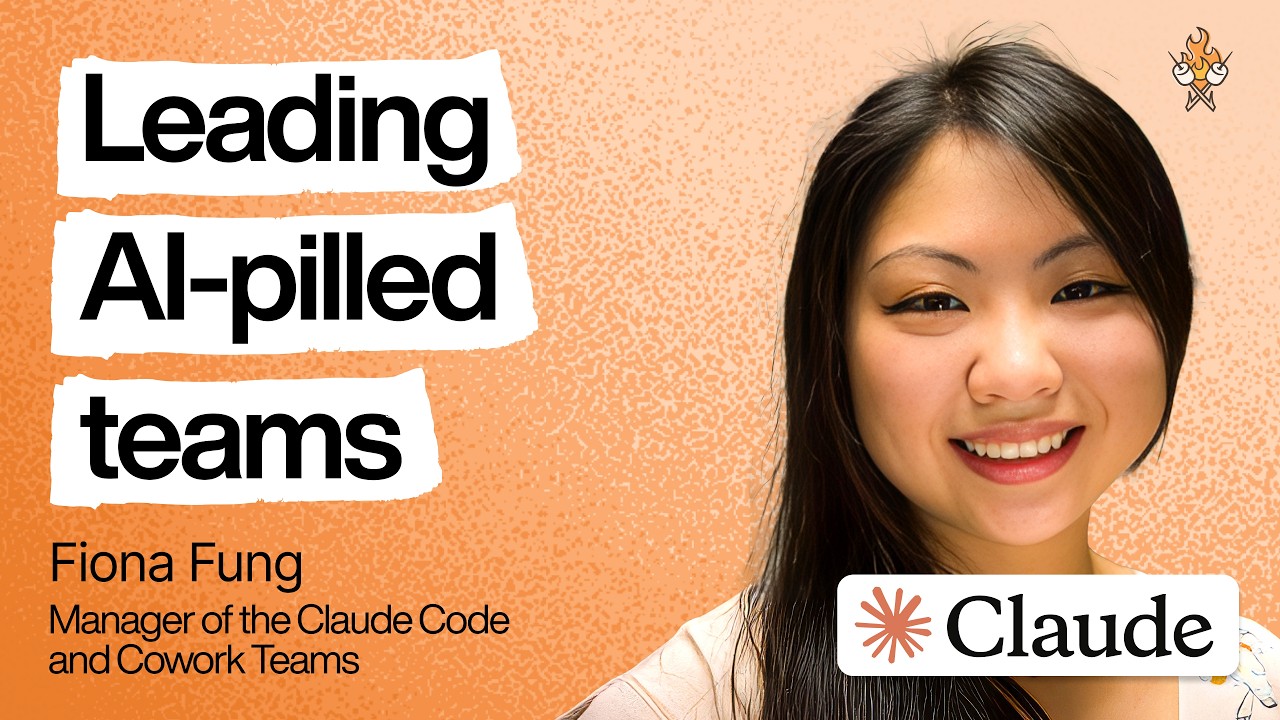
Fiona Fung leads the teams behind Claude Code and Cowork at Anthropic, and has spent 25+ years as an engineer and engineering leader — at Microsoft (TypeScript, Visual Studio), Meta (Facebook Marketplace, AR/VR smart glasses), and Instagram. She now operates at the frontier of how AI is transforming software engineering, and her teams are among the most “AI-pilled” in the world.
The central shift: Coding is no longer the bottleneck. Anthropic engineers now ship 8x more code per quarter than in 2021–2025. The constraint has moved from writing code to verification, quality, and ambition — how big can you think?
This episode covers how Fiona’s teams operate, how she manages at the edge of this transformation, what’s being lost and gained, and practical frameworks other teams can adopt.
How Fiona’s teams operate differently
Everyone is a builder now — not just engineers. Designers, PMs, and managers all check in code. The role boundaries are blurring.
Claude Code as management tool: Fiona runs a Claude Code remote session enrolled in all her repos, with access to Slack channels and metrics dashboards. She uses it to do monthly reviews with engineers — looking at what shipped, what the feedback themes are, and where the bugs are — turning what used to be a manual process into an AI-assisted conversation.
Routines replace synchronous prompting: Instead of manually checking feedback channels every morning, Fiona uses Claude Code Routines — scheduled agents that run on her behalf, scan feedback, identify themes, and even generate PRs overnight. She wakes up to a summary and reviewable PRs. This represents a level of abstraction above prompt-writing: routines that spawn and manage other agents.
JIT (Just-in-Time) planning: The team abandoned 6-month roadmaps. They now do monthly planning on a lightweight spreadsheet, with weekly check-ins to confirm priorities still hold. The explicit permission to kill processes that no longer serve the team is a core cultural value.
High agency + high accountability: Engineers are given freedom to build and ship, but are expected to have a clear hypothesis for what problem they’re solving and to own the outcome. “Make new mistakes” — it’s fine to fail, just don’t repeat the same ones.
Hiring for two profiles
Creative builders with product sense: People who are passionate about a product, have ideas, build them end-to-end, and iterate based on feedback. They own the delight of the experience.
Deep systems experts: People with distributed systems or domain expertise who can verify what the models produce. The models are strong, but verification still requires deep subject matter knowledge — especially for “double-clicking” into dependencies and architecture.
Fiona notes that when she joined Claude Code, the team had great product generalists but was missing systems expertise, which she had to intentionally hire for.
Code review and quality at scale
Claude Code Reviews didn’t exist a year ago and have become a critical bottleneck-reliever. Human reviewers are still essential for areas requiring deep expertise, but automated reviews handle the bulk.
Specs as the framework for quality: The team checks specs and definitions of “what good looks like” into repos. Claude Code Review then validates code against those specs. This is a modern evolution of test-driven development — but now the model writes the tests.
“Bad vs. Sad” quality framework:
Bad = irrecoverable errors (e.g., crashes, lost work)
Sad = recoverable pain points (e.g., flickering, slow responses)
Each team defines what constitutes “bad” and “sad” for their surface area, giving them agency while maintaining a shared quality vocabulary. Stacking up “sads” can become “bad.”
Swear word dashboard: The team tracks profanity in user feedback as a signal of frustration — a creative, human-centric quality metric.
Invest in tests and monitoring over manual review: At 8x throughput, human review alone can’t scale. The answer is better evals, automated checks, and monitoring — closing the loop so agents can self-correct.
The human side: loneliness, connection, and culture
Loneliness is emerging: Engineers now spend most of their time working with agents rather than teammates. The social fabric of engineering teams is at risk.
Pair programming lunches: The Claude Code team started these so engineers can watch each other work. Everyone uses Claude Code and Cowork differently, and observing each other is a major source of learning — like “parallel play” for adults.
Hackathons: Used to maintain team interaction and shared energy.
Culture is what keeps Fiona up at night: As the team grows rapidly, maintaining the “one team mentality” — diverse perspectives, open debate, honesty about what’s not going well — is her biggest concern. She explicitly asks managers to be open about problems, not to pretend everything is fine.
Dogfooding is non-negotiable: Fiona uses every product her team builds, every day. She believes leaders must experience the product firsthand — not just through dashboards — to keep a pulse on quality and user experience. This has been her practice across every product she’s worked on, from Visual Studio to VR headsets to Instagram.
The growth mindset required to thrive
Growth mindset is the #1 trait of engineers who are thriving vs. those who are frustrated or resisting. The willingness to keep learning, even when what made you successful before no longer applies, is essential.
Fear drives much of the frustration: Fiona’s advice is to lean in and ask, “What is within my control?” — shifting from “this is happening to me” to “what can I do about it?”
Revisit what didn’t work before: Models improve exponentially. Something Claude couldn’t do well six months ago may be worth trying again now. Engineers who dismissed AI tooling early based on early mistakes may be missing the step-function improvements.
Personal story: Fiona grew up without a computer, discovered programming through a high school typing class, feared she couldn’t afford engineering school, and worked as a bank teller through high school and college to fund her education. This shaped her belief in taking action against fear.
Helping others adopt AI — especially small businesses
Fiona is passionate about closing the gap between AI power users and those being left behind. She has personally onboarded small business owner friends onto Cowork, helping them with invoicing, expensing, document organization, and even market analysis (e.g., comparing restaurant pricing in their area).
Her advice for listeners: Start with a personal story of how AI meaningfully changed your workflow, and use that as a conversation starter with someone in your community — a small business owner, a family member, a friend. It’s awkward at first, but it works.
She’s concerned about the growing divide and wants help making AI tools more equitable.
What’s lost and what’s gained
What’s lost:
The flow state of deep coding — the “gnarly problem + music + zone + aha moment” experience
Social connection and collaboration among engineers
Some engineers report that the hardest parts of the job used to be the most enjoyable
What’s gained:
Massive throughput and the ability to tackle problems that were previously too complex or cross-disciplinary
Engineers can now work across mobile, backend, and other domains they weren’t trained in
Context switching becomes easier because agents can summarize state — you don’t have to re-learn a codebase to pick up where you left off
The net effect is mixed: Some things got better, some worse. The key is being intentional about preserving what matters (connection, craft, quality) while embracing the new capabilities.
How other roles are transforming
PMs: No longer bottlenecked by engineering bandwidth. PMs on Fiona’s teams roll up sleeves and ship features themselves when engineers are unavailable.
Data science: The role has shifted from doing analysis to reviewing analyses done by non-experts using AI — and frequently correcting them.
The general trend: Every role is becoming “the average of what you do” — role definitions are blurring, and people are increasingly defined by their highest-value activities rather than their job title.
Open questions Fiona is still thinking about
Do we still need separate iOS and Android orgs? Engineers are flexing across platforms, so maybe smaller platform teams suffice — but the right balance of deep expertise is still unclear.
How far do you push fully automated reviews? Verification of the experience (not just correctness) remains hard to automate.
Context switching load: With 20+ agents running async, the cognitive load of tracking and reviewing all of them is increasing. Fiona blocks focus time just to catch up on async work — but hasn’t fully solved this yet.
How do we grow the next generation of engineers? If new engineers never write code from scratch, how do they develop the deep understanding of architecture and systems that enables them to verify and improve what AI produces? Fiona wonders if apprenticeship/fellowship models may replace traditional internships.
Lightning round
Books: Margaret Atwood and Haruki Murakami (fiction); The Little Prince (re-read yearly)
Movies: Amélie, Spirited Away, Nausicaä of the Valley of the Wind (the heroine Nausicaä shaped Fiona’s leadership principles)
Product pick: Sweet Sisters Bodycare — an organic hair and skin care line from a small business on Whidbey Island that solved a chronic skin reaction Fiona had from chemical shampoos
Life mottos: “Keep it simple” (at work); “In a world where you can be anything, be kind” (in life)
Knitting: Fiona knits during meetings (the click-clack is audible on calls). She learned from her grandmother at age 8. She recently knitted the top she was wearing on the podcast. Her dream is to open a yarn store in her grandmother’s name.