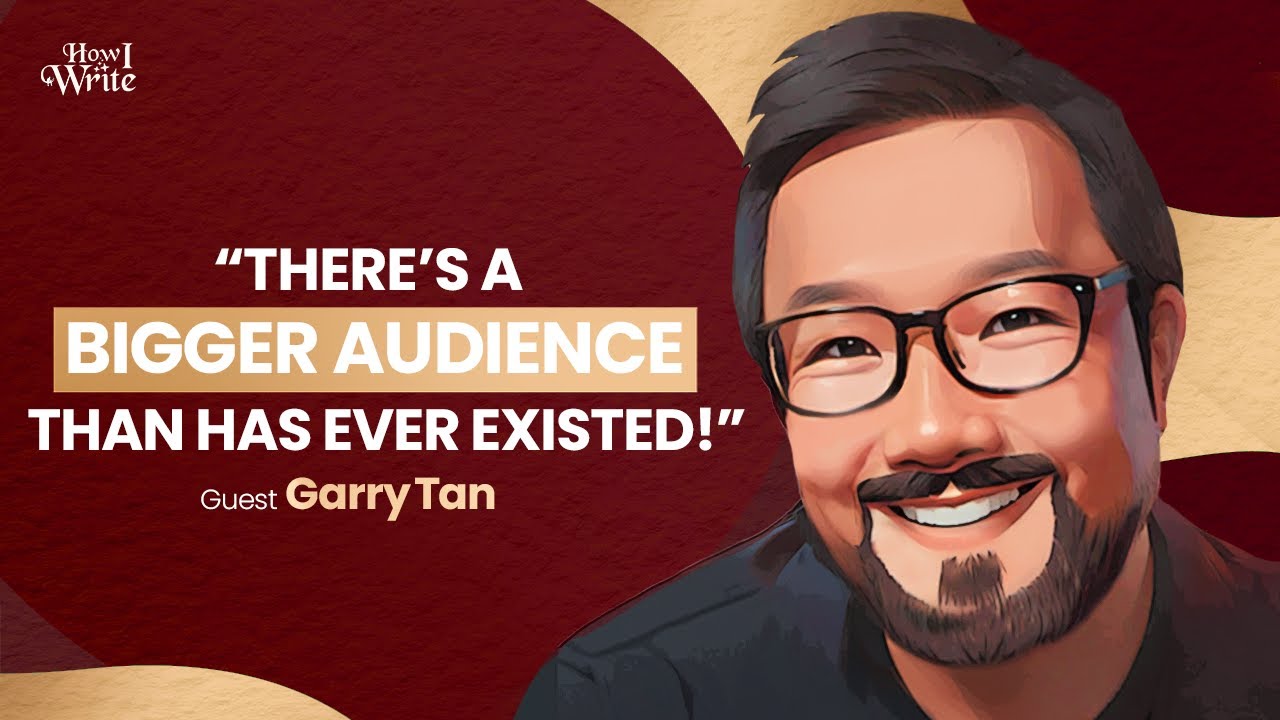
Garry Tan, CEO of Y Combinator, traces how writing has been the through-line of his life — from a seventh-grade underground newspaper that gave him social standing, to blogging through personal crisis, to leading an organization where writing is the primary tool for thinking, recruiting, and scaling culture across 10,000+ founders.
Writing as identity formation from childhood
Writing gave Tan a felt sense of agency when he had little control over his circumstances; putting experience into words made it indelible and shareable, allowing him to “exist” as an individual in a collectivist Chinese-American household that emphasized the group over the self.
His seventh-grade underground newspaper (created with Aldus PageMaker) turned him from a “nobody who’d get shoved into lockers” into someone with influence; classmates wrote about criminal justice reform at age 12, and the teacher photocopied 150 copies for the whole class.
In high school he became editor-in-chief of the school paper, continuing the pattern of curating others’ voices — a dynamic he now sees mirrored in his Twitter/X feed, which feels like “a distributed newsroom.”
Reading Kerouac, Kundera, and even Rand during a rough childhood (father’s alcoholism, religious crisis, suicidal ideation) was a desperate search for wisdom; The Fountainhead “made me an asshole” and tanked his college essays — he got waitlisted/rejected everywhere except Stanford.
Writing helped him develop an individual identity over 20–30 years; “how do you know who you are until you sort of put it on a page?” — the act of writing is the construction of self.
Early internet conviction and the blog as liberation
Tan was obsessed with the internet from the BBS era (1991–92); forums let him be treated as an adult regardless of age, and he saw early that media technology shapes consciousness at societal scale (newspapers → national identity; social media → mimesis at scale).
He cites David Bowie’s 1999 BBC interview: the internet isn’t just a tool, it’s “a shift in consciousness… an alien life form”; Peter Thiel invested in Facebook because Girardian mimesis is amplified by networked media.
Personal blogs were the hyper-democratized medium: no printing press, no editorial board, “nobody knows you’re a dog” — a 12-year-old’s zine could sit alongside CNN.
He still believes we’re in early innings; most workplaces still run on phone calls and steak dinners, and software/media haven’t yet transformed those domains.
Design and web development as writing’s match pair
Design and writing both “float back up to social experiences”; great interaction design is a good party — onboarding = greeting at the door, taking coats, introducing friends, handing champagne.
At Adjacency (1996), he learned to push the medium: full-page image bleeds, JPEG compression for 28.8 modems — the craft of making webpages feel like magazines, not “under construction” signs.
The web is adversarial: you have 5–10 seconds to prove value against Reddit, X, every other tab; “perfect competition for human attention” forces clarity and immediacy.
Writing is the most important part of interaction design; software codifies the conversation you’d have 10,000 times with 10,000 users — evaluate it socially: “Are you being rude? Is it the right amount of information?”
Vulnerability and novelty as the two elements of effective writing
Vulnerability is a hack: sharing the scary, potentially alienating truth makes it okay for others to do the same; but there’s a strange inversion — early oversharing (college emails to his provost) landed awkwardly because he had no “power armor”; now, with status, the same vulnerability resonates and builds connection.
He did therapy then went on Justin Kan’s podcast to publicly discuss his father’s abuse and adverse childhood experiences — “being vulnerable allows people to see not just my humanity, but the humanity in themselves.”
Novelty is misunderstood: beginners write to impress themselves and their heroes, but the most helpful writing covers the obvious, commonplace things founders struggle with daily — “the stuff that comes up all the time but is almost too obvious.”
Chasing Velvet Underground-level novelty is exhausting and unsustainable; the real novelty is articulating the fundamentals clearly.
“Being incredibly weird and unique and yourself and having the courage to do that is really, really important” — conformity is what school teaches (aim for the middle of the bell curve), but the internet rewards the one person who can be you.
YC application writing: plain speech and immediate learning
Tan reads thousands of applications; he wants “very plain spoken” prose where he “can learn something immediately.”
Common failure: derivative ideas (e.g., 15 apps in a row for “travel with friends”) — the trick to good writing is being good, i.e., having distinct, differentiated ideas rooted in your own weirdness.
Magnetic north should point toward distinctiveness, not conformity; “Auntie Sue not getting it at Thanksgiving” is the price of authenticity.
Documentation and technical writing as user testing
Good documentation is tested like an essay: send it to people, ask “do you understand?” and “did I get anything wrong?”
For dev tools, sit next to users and don’t speak — let them struggle, then their questions become the exact lines that need to go back into the docs.
Great writing hits the 80–90% comprehension threshold; you shouldn’t explain everything, just what most people need to hear.
Writing at YC scale: media, not memo
YC’s community is 10,000+ founders/alumni, hundreds of thousands including employees — internal communications are media.
Weekly letters, batch updates, and reunion events (2,700 people recently) function as cultural reinforcement: “everyone had the same set of values… it felt like home.”
Clear thinking and good writing at scale is a YC cultural contribution (Paul Graham, Sam Altman); “solving the money problem” phrasing created instant recognition and self-selection.
What writers can learn from founders: outcome clarity and endurance
The best founders have a clear why far beyond fame/money/vacation — Brian Chesky: “how do I connect people?”
Like great filmmakers: “create until your fingers bleed, and then create some more” — the work is the identity, not a means to an end.
Tan’s own arc: writing was never his “number one thing” (always grinding as founder/engineer), but the river of top-of-mind output built parasocial relationships at scale — people spend 20–30 hours with him, walk up in the street, and he feels obligated to know them back.
Philosophy: memex, LLMs, and graphomania
Vannevar Bush’s memex envisioned human-computer symbiosis: computers do math/memory; humans do reasoning/intuition — LLMs may have surpassed this by exhibiting theory of mind and reasoning (flight isn’t flapping wings).
Milan Kundera’s graphomania (“the desire to write books to a public of unknown readers”) resonated early: putting his zine online and getting comments from strangers who took him seriously felt incredible — the internet’s original promise, now realized at massive scale.
Anonymous writers now influence Congressional staffers; democratized distribution means great writing finds audience regardless of credentials.
Creative pride: the work not yet made
Most proud creation (besides family): Initialized Capital, the seed fund he started and gave up — not YC.
Top YouTube video “How to Get Rich” uses a clicky title to deliver Alan Watts on the nature of money — elevating a base query into philosophy.
He doesn’t have a magnum opus; “the thing I’m most proud of I haven’t created yet” — output is a river, not a monument, and the relationship with audience is the product.
Consistency (recognizable thumbnails, camera close-ups) serves authenticity; if you want to change, just change — second-album syndrome is real, but the answer is to keep creating.