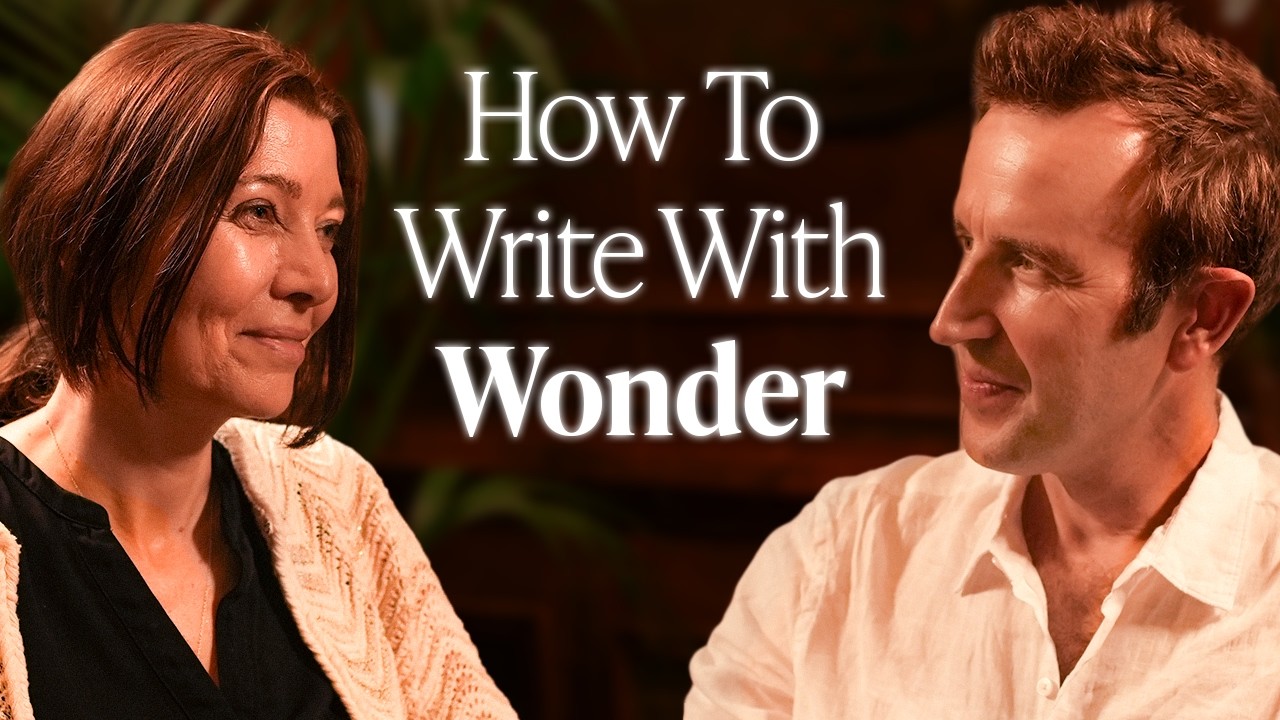
This episode captures a wide-ranging conversation between novelists Elif Shafak and Robert Macfarlane, close friends who discuss the craft of writing, the limits of language, the lessons of nature, and the existential motivations that sustain their work.
Language will always be late for light
Macfarlane argues that language can never fully capture the encounter with a mountain, river, or rock; the moment of awe shatters language, and beauty emerges in how the pieces fall.
Shafak agrees that writing requires listening to something larger, older, and wiser than oneself, which dissolves the hierarchical gaze and becomes a moral act of “unselfing.”
Both reject the capitalist framing of “paying attention” as transactional, preferring “giving attention” as an unselfish, egalitarian practice that dismantles dualities between self and world.
Writing tools shape the work
Macfarlane writes songs and poems in notebooks with a fountain pen carrying ink mixed with water from 110 rivers, but uses screens for complex, kaleidoscopic non-fiction that requires moving pieces fluidly.
Shafak, forced to switch from left to right hand in a Turkish classroom — a practice rooted in religious superstition associating the left hand with sin — finds the keyboard a liberation; she cannot connect with her handwriting.
Both write while traveling; Shafak notes that a nomadic life makes linear writing unnatural, and a library requires rootedness, so writers must memorize passages and carry feelings across borders.
Mosaic versus linear structure
Shafak’s novels are woven like braids — simultaneous, non-linear, jumping across time and geography — reflecting a personality shaped by migration and rupture.
Macfarlane describes a similar kaleidoscopic process: twisting the telescope, recognizing relations between moving pieces, then a final rush where architectonics lock into place with a series of “clicks.”
Both experience valleys of anxiety and mountains of depression regardless of experience; Shafak trusts intuition over cerebral plotting, and respects when characters surprise her.
Boredom, distraction, and the rhythm of movement
Boredom is not the enemy but an opening of possibility; the attention-fracking economy teaches us to fear it, yet the mind wanders into latent details of a painting or landscape.
Macfarlane finds his best ideas while running (six to seven miles an hour), sending himself panting voice notes; Kierkegaard said the mind works best at three miles an hour.
Shafak walks and sends herself notes; she dislikes silence and pristine order, preferring the clatter of trains and her own productive chaos — the “fetish of the desk” can become preparation rather than writing.
The Epic of Gilgamesh as a guide to failure and change
Both love Gilgamesh because it centers a flawed, arrogant king who learns through friendship, grief, and defeat — not achievement.
The turning point: after Enkidu dies, Gilgamesh refuses to accept it until a maggot crawls from Enkidu’s nostril — a brutal memento mori that forces him into the wilderness, where he sheds royal garments and begins to change.
The epic also holds an ecological warning: the felling of the cedar forest and slaughter of the Bull of Heaven (weather/climate) bring divine punishment; a tablet from Slemani reframes Humbaba not as a monster but as the forest’s guardian — an early climate activist.
Wilderness as physical place and imaginative space
Macfarlane rejects the categories “mountains still, birds moving”: mountains are living networks teeming with biological presence (“place is always moving like a sleeping cat”), and birds can be utterly still.
Shafak experiences writing as entering a space — sometimes controlled, sometimes a coracle on a river in spate; language itself is a space she enters and breathes in, and different languages shape thought differently (vocabulary for trees or bees changes how we perceive them).
Both value rhythm, cadence, and sound in prose; Macfarlane argues non-fiction can sing, using internal rhyme, leitmotif, and symphonic patterning to work above propositional language.
Nature as teacher and story as ecological technology
Shafak describes Yazidi grandmothers teaching children to tread gently in April because “the earth is pregnant” — story transmits ecological knowledge intergenerationally.
Macfarlane notes the clay tablets of Gilgamesh (river clay, reed, sun, water, time) are frail yet durable vessels carrying the oldest story with its warnings.
Shafak’s The Island of Missing Trees uses a fig tree to narrate the Cyprus partition, letting nature guide a perspective that avoids replicating political division.
The felling of the Sycamore Gap tree — “it was just a tree” — condenses a worldview that sees nature as inert, rightless, and meaningless, which rationalism and technocracy have invisibleized.
The microcosm and macrocosm: seeing the world in a grain of sand
Macfarlane recounts a glaciologist handing him grains of sand from the bedrock of Antarctica, revealed through an ice core — deep time exploding from tininess.
Van Leeuwenhoek’s microscope revealed “a world teeming with animals” in a drop of pond water; science finesses the real into greater wonder rather than unweaving the rainbow.
Dark matter physics — 27% of the universe’s mass detectable only by its gravitational ghost — is as mysterious as any recess of the human soul.
Both hunger for interdisciplinary conversation: Shafak wants novelists reading neuroscience, water scientists reading film theory; academia’s atomization starves the mind.
Motivation: the existential need for stories and the casket test
Shafak returns to her childhood: an only, lonely child in a conservative, patriarchal neighborhood; books (Dickens, Dostoevsky, Cervantes) showed her other possibilities — literature as transcendental journey, not career.
“Without stories, human beings are just numbers, categories, abstractions.” The core motivation must remain that existential need, not prizes or sales.
Macfarlane proposes the “casket test”: if this book were dug up in a hundred years, would the future reader see that we tried — wrestled with, dreamed of ways out of the planetary crisis? Not whether we solved it, but whether we tried with all we had.