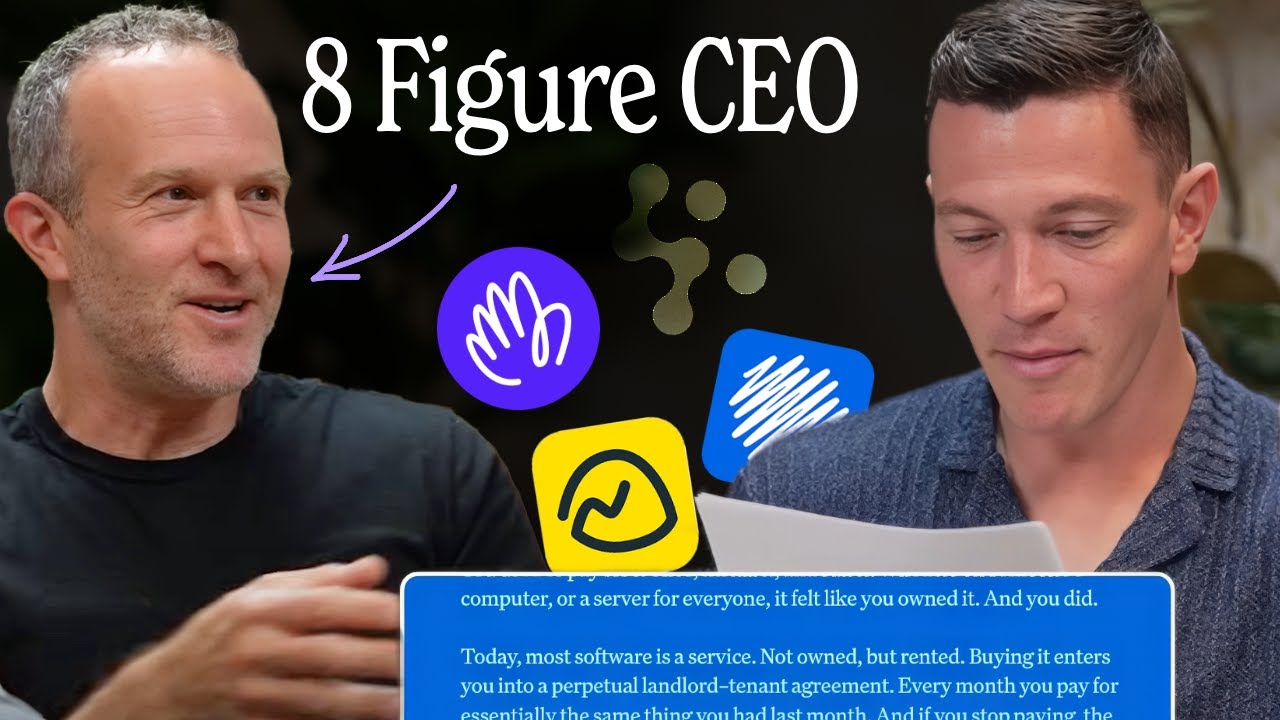
This episode features Jason Fried, co-founder of 37signals (Basecamp, Hey, Once), in conversation about writing as communication, his distinctive writing process, the architecture of his founder launch letters, and why most business writing fails.
Core Philosophy: Writing as Communication, Not Content
Fried’s central rule: “Don’t write, communicate” — the goal is to move an idea from your head into someone else’s brain, not to perform “writing.”
He dislikes the word “content” because it frames output as a commodity for SEO or volume rather than genuine communication.
Writing should feel like talking: natural, human, and imperfect — “what is it about writing it down that makes it have to be more perfect than saying it out loud?”
He values “perfect imperfections” (wabi-sabi): a spelling error or awkward phrasing that carries personality is preferable to sterile, over-edited prose that removes all feeling.
The best writing feels like a lived-in space — warm, human, slightly worn — not a sterile modern museum where you’re afraid to leave a fingerprint.
Writing Process: Flow Over Struggle
Fried writes fast; if he struggles, he stops, throws it away, and starts fresh on a blank page — struggle signals the piece isn’t working, not that he should push through.
He compares flow to a running back finding a hole in the line: you don’t control the hole, but when it opens, you run because it closes in ~12 hours.
The “37signals Guide to Internal Communication” (30+ points) wrote itself in an hour because the hole was open; he barely edited it.
He avoids contrivance: if he catches himself forcing a number (e.g., “37 points for 37signals”), he stops immediately — effort shows in the result.
He writes the way he speaks; when stuck, he goes for a walk and talks it out loud to find the “hook” that restores confidence to return to the page.
Editing: he prefers talking through changes with an editor (phone calls over redlined drafts) because conversation reveals the “why” behind choices.
For his own articles, he publishes without pre-feedback, fixes typos later — “it’s not printed,” and spoken mistakes aren’t retraced either.
Memory as compression tool: rewriting from memory keeps only what matters (the ~250 words you remember from 1,000 are the best parts).
Founder Letters: Once and Hey — Structure and Craft
Both letters follow a problem → resonance → solution arc: establish a shared reality, get the reader nodding (“yeah, this sucks”), then introduce the new thing.
Once letter (once.com — buy-once software):
Opens with a statement that injects a question: “Something happened to business software.” No question mark needed — the reader asks “what?” internally.
Uses “owned vs. rented” framing: SaaS is a “perpetual landlord-tenant agreement”; stop paying, you’re evicted. “Boom, you’re evicted” — short, punchy paragraph ender.
“Payers and prayers to the church of recurring revenue” — playful alliteration that personifies the model; he worried “payers/prayers” might trip readers but kept it for the bounce.
“Add up your SaaS subscriptions last year. You should own that by now.” — revelation moment, transfers the feeling “you’re damn right I should.”
Transition to Once: “Once. Once upon a time you owned what you paid for…” — the brand name emerged from writing “once upon a time” (double meaning: pay once, once upon a time).
Five bullets with parallel bounce: “Pay one time, own forever. We write the code, you get to see it. We give you the software, you get to host it. Simple and straightforward, not enterprisey and bloated. For one fixed price. Once.”
Hey letter (hey.com — email service):
Opens personally: “Hey everyone, I’m Jason, CEO here at 37signals” — feels like a love letter to email, less aggressive than Once.
Reclaims email’s core wonder: “Email’s a treasure… getting an email from someone you care about… that’s how email used to feel all the time.”
Names the villains: “An avalanche of automated emails” — rare multi-syllable words (avalanche, automated) create rhythmic bounce against mostly short words.
“Now email feels like a chore rather than a joy. Something you clear out, not cherish. Rather than delight in it, you deal with it.” — parallel structure, emotional contrast.
Pivot: “And yet and yet email remains a wonder.” — enchanted words (wonder, treasure, magic) fill the positivity bucket after the pain section.
Alliterative cascade: “cultures, continents, countries, cities, communities, seas” — Cs that emerged naturally, not forced.
Closes with “Hey is our love letter to email… sending it to you on the web, Mac, Windows, Linux, iOS, and Android” — platform list signals scope/ambition.
Rhythm and “bounce” are intuitive, not formulaic: short words, occasional multi-syllable clusters, paragraph-ending punches, parallel structures that pull the reader forward.
Playfulness as personality revealer: “when you’re playing, you can’t not be who you really are” — play brings out the voice that sterile “professional” writing suppresses.
Business Writing Critique: Why It’s So Bad
Root causes: MBA-style training (fake business plans = practiced BS), companies without a point of view writing what they think buyers want to hear, conservative herd-following, SEO-driven “content” factories.
“Most companies don’t have anything to say. They have a lot to sell.” — they fill the void with jargon, platitudes, interchangeable logos.
Groupthink and fear: people copy “successful” styles without the underlying ideas, so they don’t know what to do next when the model shifts.
The delete key and grammar checkers enable over-polishing — technical precision replaces human voice.
Editors often sterilize: replacing an awkward-but-feeling word with the “correct” one removes the bacteria that made it alive.
Hiring and Internal Communication at 37signals
Hiring: first filter is the cover letter — generic “dear hiring manager” letters are rejected instantly, even if well-written. They want someone who wrote to them.
Tiebreaker always goes to the better writer — “the majority of our communication is written.”
Heartbeats: every 6 weeks, each team lead writes a long-form summary (800–1,200 words) of their team’s work — no status meetings, no AI summaries.
Good heartbeats have personality, name specific people and struggles (“this was really hard, we couldn’t break through, they nailed it”), and convey how it felt, not just output.
Rosa’s heartbeats are identifiable by voice alone — “I know Rosa wrote that.”
Long-form writing builds institutional knowledge: searchable, transferable, onboards new hires better than 40 hours of meeting recordings.
Most companies write “boring business way” — lots of words, no conveyed information, wasted time, lost productivity.
Coaching Better Writing: Just Say It
If someone writes a sterile heartbeat, Fried says: “Just tell me. Talk it out. Then write that down.”
Talking removes the “I have to write something” pressure — humans are good at communicating verbally.
He tests his own copy: “Would I ever say this out loud to anybody to describe Basecamp?” If no, it’s marketing performance, not communication.
The trap: writing to impress peers (musicians making music for musicians, filmmakers for film festivals) instead of the customer who knows nothing about you.
Website formats fracture narrative into blocks — people browse, don’t read. He prefers long-form, top-down letter style: “Human race has been reading in a certain way… we know how to consume that.”
Books as Byproducts: Getting Real, Rework, Remote, It Doesn’t Have to Be Crazy at Work
Getting Real (2006): “cookbook” for software makers — recipes for how they build, inspired by chefs who publish recipes without fear of competition.
Rework, Remote, It Doesn’t Have to Be Crazy at Work: essay collections compiled from years of blog posts, not written as books from scratch.
Rework was cut in half (40k → 20k words) because the collection felt repetitive; editor was horrified but admitted it was better — they added illustrations, wider margins, larger font to meet physical thickness requirements.
Fried is a “sprinter” (400m max) — short essays are his natural distance; long chapters would be forced and worse.
Derek Sivers’ method: write essays first, compile later — Fried follows this instinctively.
Core ideas haven’t changed: stay small, scrappy, small teams move fast, launch with teasers, bootstrap, ignore Silicon Valley noise.
Books are byproducts of being who they are and sharing openly — “healthy” vs. the paranoid, secretive, patent-everything business culture they entered.
Life/Work Philosophy: Know Your Nature, Relax Your Grip
Fried doesn’t schedule writing time — writes when he has something to say, fits it in (sometimes 20 minutes before a call), protects calendar openness.
No shared calendars, no one can take his time — buffers allow responsiveness to creative calls.
Drum analogy: gripping sticks too hard ruins tone, movement, endurance. Relaxing the grip makes you better.
Business equivalent: people grip too tight — read industry news, copy “7 ways to succeed” lists, inhabit others’ thoughts.
37signals benefited from being in Chicago, outside SV — “island evolution,” finding their own way without party/scene/VC pressure.
“Everything’s held together by duct tape. Every business is kind of a crazy place. People are making everything up as they go.”
The only method: “You can do whatever you want but whatever it is that you do choose you got to be really really really good at what you do and the only way to do that is to have it be aligned with your nature and who you really are.”
Understand the true nature of a thing — yourself, a place, an experience — and roll with it. Going against nature is unnecessary battle.
Some things require pushing through to learn, but then “let up on the grip a little bit and relax a bit more. I think you’ll go further.”