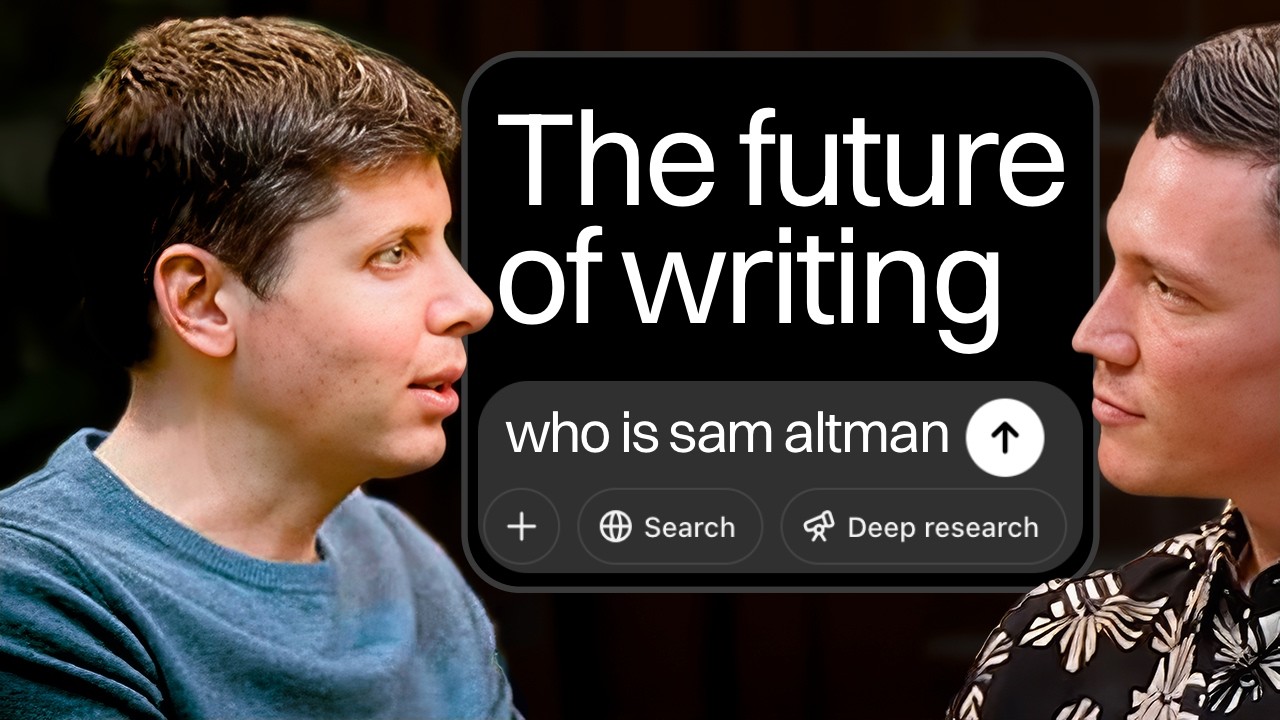
Sam Altman, CEO of OpenAI, discusses his writing process, how LLMs are changing communication, his note-taking system, decision-making frameworks, and the future of writing in an AI world — revealing that he views writing primarily as a tool for thinking rather than a craft, and that his most impactful writing happens in private strategy memos and personal notes rather than public posts.
How LLMs change writing and communication
Altman believes many people will write differently in the future, but not by simply having LLMs expand bullet points into emails that recipients then summarize back to bullet points — a “societal nicety” that misses the point.
The real opportunity is building tools that help writers discover new ideas in the idea space, not just format existing ones — “that’s what computers do at their best… help you do things you otherwise couldn’t do.”
Words will remain central to human-computer interaction because natural language is the interface people want; text is searchable, malleable, and allows rigorous thinking — “you can point to specific words and sentences that you disagree with rather than just the overall vibe.”
Multimodal input/output will exist, but language is deeply evolved and text has a unique rigor that makes it irreplaceable for precise thought.
How Sam uses ChatGPT daily
Uses it as a general-purpose tool that has expanded from a few use cases to “most things I do” — every few months finds new ways to incorporate it.
Most common use case friends report: programming help (“transformed my life” for many).
Personally uses it heavily for summarizing long emails and threads — “super good at effectively summarizing long pieces of content.”
Uses it as a thinking partner: tests ideas by seeing if ChatGPT disagrees (signaling distinctness), then asks it to find examples and stories that amplify the seed idea.
Observed two students using it differently: one pasted prompts to generate a passable but bad essay; the other used it interactively to articulate a half-formed idea and generate new directions — the second produced far better results than either could alone.
The first approach reveals we’re asking the wrong questions in education; the second shows the tool can raise returns on the “Big Bang moment of an idea.”
How Sam shed anxiety and its effect on thinking
References an idea that “most people can’t even let themselves think the interesting thoughts much less say the interesting ideas” — background anxiety makes it harder to think new thoughts and focus.
If you’re constantly self-critical or worried about embarrassment, you can’t explore ideas far enough before social filtering kicks in.
Writing serves as externalized thinking: when confused or facing a hard problem, sitting down to write it out — explaining it to himself or an imagined audience — is the most powerful tool he’s found.
Writes primarily for himself, secondarily for private groups, rarely for public consumption.
Clear thinking leads to clear communication
Clear communication is downstream of clear thinking — “if you know what you’re going to do… and figured out how to reduce that to the essence… then communicating clearly about that is not so hard.”
Unclear communication is usually a symptom of unfocused thinking.
Napoleon’s emphasis on clear directives on the battlefield mirrors business: clarity, speed, and quality of execution are linked.
Proudest writing? “Truly none of it” — writing isn’t his gift, but it’s valuable as a thinking and internal coordination tool.
“How to Be Successful” blog post (which influenced the interviewer) wasn’t about prose quality but idea density — “make every next thing you do be a footnote to what you’ve done before.”
Sam’s writing origins: blog, novel dream, and YC influence
Started personal blog to practice writing after watching Paul Graham — saw how powerful writing was for attracting and evaluating founders at YC.
Never aspired to be a great writer; wanted the romantic novelist lifestyle (café in Paris) but realized he wasn’t gifted at prose.
Still values the experiment: learned to write for himself to clarify thinking, and to write plans for teams instead of just spitballing in meetings.
No rigid format for internal memos — tries to keep them short, but no other constraints.
Lessons from Peter Thiel and Paul Graham
Thiel: master of evocative, sticky short statements — combines truly original thinking with exceptional expression. “Most people you’re lucky to get one or the other.”
Thiel’s biggest investment mistake: not investing in Facebook’s Series B — taught Altman to quadruple down on working ideas (power law dynamics).
“All business books are terrible… three good ideas and 300 pages… what a reader wants is three good ideas on one page.”
Paul Graham: learned by reading essays — clarity, precision, density, no posturing, interesting ideas said clearly without wasting time.
A whole generation of founders copied PG’s style because it resonated so deeply.
Writing in pitching and decision-making
Writing clarifies thinking before pitches — “dramatically different to be on the other side of a pitch if the person has gotten their thinking clear ahead of time.”
Often thinks he’s clear on an idea, then writes a one-page summary and realizes he didn’t understand it.
Used to do extensive Google Doc exchanges with friends for feedback (“tell me where I’m wrong”), but hobbies attenuated after ChatGPT launch.
Conversation is generative; writing is the grinding-down process — “removing rather than untangling” — best done alone at a big monitor.
The book Sam Altman would write (but won’t soon)
Would write the book he wishes existed for people asking what to read about AI: historical context of tech revolutions, how the tech works, current capabilities, near-term impact, 5-year possibilities, 100-year implications.
Biggest thing people miss? “That’s why I’m not going to write the book… I haven’t had time to think about that.”
All-lowercase typing originated from growing up online — stopped using shift key; still capitalizes properly for formal pieces.
Writing strategy memos at OpenAI
Every ~2 years writes a strategy document called “Our Plan” — first was 25 pages, then 15, then 4; believes a half-page version is now possible (sign of progress).
Weekend writing routine: writes something most weekends, shares with ~10 people internally — “here’s a thing I’ve been thinking about that we should do.”
Currently working on a rare public piece about AI-driven abundance.
Document-heavy culture at OpenAI predates Matt MacInnis and YC — likely from academic researcher roots.
YC applications revealed that clarity of expression correlates with clarity of execution — founders who couldn’t write clearly didn’t run companies clearly.
Skills that matter in an AI age
Having great ideas, knowing what you want the AI to do, taste, and expert-level creation become more valuable.
ChatGPT is an “incredible tool for writers” — sparring partner, collaborator, super-thesaurus for phrasing — but not a writer; won’t replace idea generation.
Writing education may need to shift: creative writing teachers often strip overwritten prose to find there’s no story underneath; mass-market hits (e.g., Twilight) have great stories but poor prose — can tools help achieve both?
Storytelling capability in models isn’t great yet but will improve with scale and targeted training (showing good vs. bad story examples).
Sam’s focus workflow and note-taking system
Used to need perfect conditions (coffee shop, noise-canceling headphones); now takes any 11 uninterrupted minutes — back of car, bed, wherever.
Ideal: Saturday morning, coffee, nothing scheduled — but most writing happens in short chunks.
Heavy user of voice mode: speaks ideas, asks ChatGPT to clean up — “much more generative with my mouth than fingertips.”
Weekly rhythm: non-stop in office all week (no thinking time), long quiet blocks on weekends — cycle is essential.
Used to take month-long sabbaticals (alternating social immersion and solitude); doesn’t happen anymore.
Obsessive note-taker: spiral notebooks only (rip pages out, lay flat, fit in pocket), Uni-ball Micro 5 or Muji 0.38/0.37 dark blue pens.
Goes through a notebook every 2–3 weeks; rips out used pages, crumples them when done — no completed notebooks archived.
System evolved through extensive trial and error across many notebooks and pens.
The future of writing in an AI world
Writing as a thinking tool isn’t going away — “I figured out this tool to think more clearly… if there’s a better way… I would switch to that. Definitely not found that yet.”
Competence with written word is rising as text becomes the control interface for video (Sora), music, images — more reason to learn writing, not less.
Analogous to coding: even if traditional coding jobs decline, coding teaches thinking — same for writing.
No evidence AI is killing serious writing — bad AI content floods the internet, but Paul Graham isn’t worried.
Full superintelligence would be needed to replace human writing entirely, at which point “we have much bigger issues.”
Most popular novel of 2027 will still have a human name on it — readers connect to a person’s life story and shared human experience through a book; that connection is a significant percentage of the enjoyment and won’t transfer to AI output.