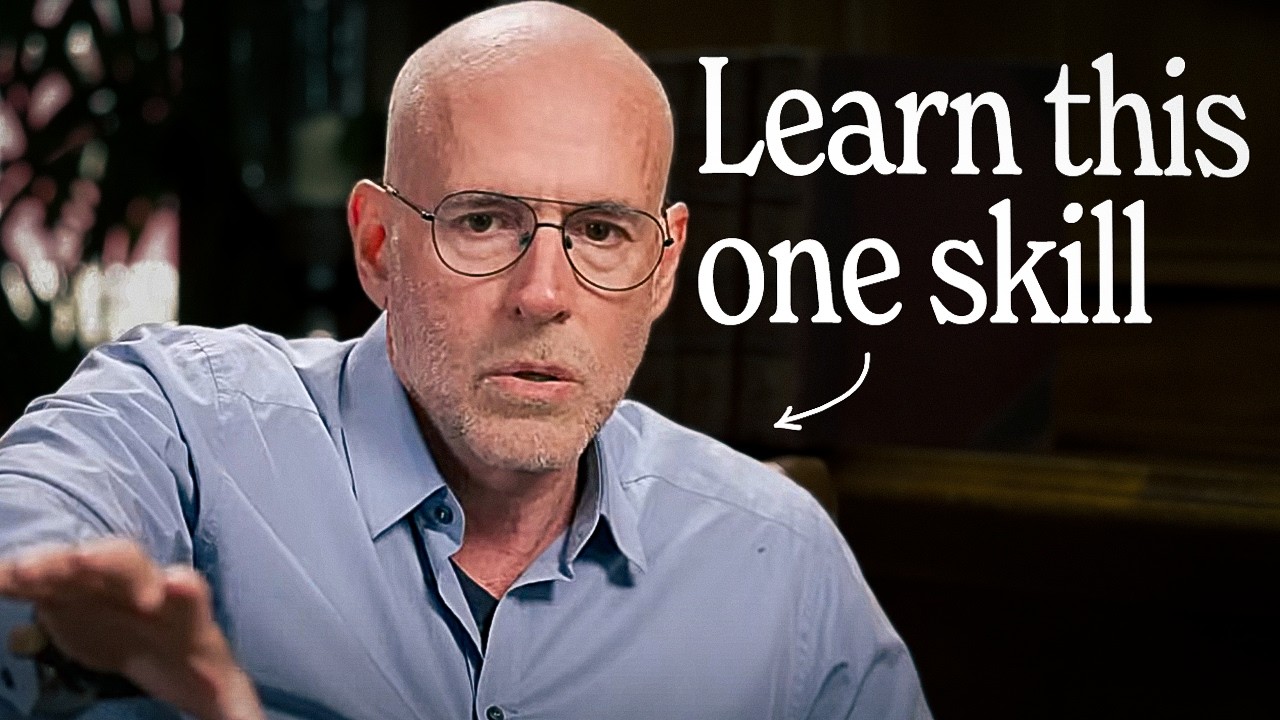
Scott Galloway — NYU professor, entrepreneur, author, and podcaster — shares his masterclass on writing, storytelling, and communication, revealing how he builds high-impact work through a team-driven process, fearless framing, data-grounded narratives, and emotional resonance.
Writing the first book at 52
Galloway wrote his first book, The Four, at age 52 after a decade of thinking about it; he wishes he had started 20 years earlier.
His dean at NYU told him to either publish peer-reviewed research or write a book to be taken seriously as an academic; he dismissed peer-reviewed work as “mutual masturbation” — largely irrelevant citation-trading for tenure.
A talk he gave at the DLD conference (unbeknownst to him, recorded and posted to YouTube) garnered 300–400k views; music-industry writer Bob Lefsetz endorsed it, driving more traffic.
Top literary agent Jim Levine approached him afterward and said, “You should write a book on this talk” — launching his author career.
His process since: test ideas in newsletters (a “petri dish”), develop a talk, and if the talk performs well on YouTube, he knows he has a book — his “minor leagues” for book ideas.
The magic happens in editing, not drafting; he commits to deadlines and structured time, but the real work is rewriting.
Team and production process
Galloway runs a 14-person team handling editing, charts, graphics, research, and drafting; almost nothing he publishes goes out untouched by others.
He estimates 51% of his influence comes from other people’s scale, technology, and platforms; 49% from himself.
Typical workflow: he gives talking points to an analyst, they draft 1,500 words, he edits heavily (“bloodied” drafts), and the next draft improves; he adds voice, metaphors, and personal anecdotes.
Editorial meetings involve 8–10 people — “half a dozen muses,” mostly young, bright staff with different life frames — who push back, surface blind spots, and challenge his views.
They use a shared Google Doc for real-time collaboration: comments like “need more data here,” “chart opportunity,” “Scott, personal anecdote needed here.”
He cannot easily articulate his “voice” to others; AI mimicking him produces anodyne “dick jokes and data” — so he directs by argument and structure, not style imitation.
Mediums and intimacy
The medium shapes the relationship: readers of his writing feel deep, heart-level connection; podcast listeners feel casual friendship (they ask about his dog, Leia).
Podcasting creates the most intimacy — listeners hear him while making breakfast, walking dogs — and is highly profitable for top-200 shows.
A deliberate strategic “white space”: he is a white heterosexual male in his 50s speaking openly about emotions — grief over his mother’s death 20 years ago, vulnerability — which resonates with men who lack safe spaces for emotional expression.
He cites Miles Davis: “Sometimes it takes a long time to be able to play like yourself.”
Fearlessness, authenticity, and the sources of courage
Two blessings enable his fearlessness: economic security (he has all the money he’ll ever need) and people who love him unconditionally.
With those, he has the “privilege and obligation to speak your mind”; he can survive being shamed, canceled, or losing deals (TV shows, book deals, speaking gigs have been canceled).
Atheism is a “huge source of power and courage”: everyone he worries about impressing will be dead, and so will he — so “squeeze the fuck out of this lemon called life.”
He writes for an audience of his two sons at age 40, after he’s gone: he wants them to think “Dad was smart. Dad was fearless.”
Role model: Muhammad Ali — outstanding at his craft, shunned by society, never wavered, artistically communicative, fearless in the most macho sport.
TED Talk preparation and choreography
Chris Anderson (TED curator) invited him; Galloway proposed “the war on the young” — the transfer of wealth from young to old via weaponized government.
Process: Google Doc outline → analysts build slide deck (80–100 slides with titles only) over 8–10 weeks → chunk, reorder, refine titles (e.g., “old vs. young” → “incumbents vs. entrants”) → replace words with visuals (brains process images 30–50x faster than words) → 2 weeks of fact-checking/QA.
He does little formal rehearsal; the night before, he clicks through slides in bed. By showtime, he’s reviewed slides 15–20 times and knows the data cold.
A TED-level talk represents 8–12 weeks of team labor; if charging six figures for a speech, “you’ve got to show up. You’ve got to bring it.”
Slides are his teleprompter and architecture; he cannot speak well without them.
Choreography: 2 weeks of sequencing, pacing, dramatic pauses, reveals, segues — “chunking” the narrative arc.
Storytelling as the premier skill
If his boys could learn one skill: storytelling, 100%. It underpins convincing investors, hiring, getting viewers, landing a coffee meeting.
Curriculum: practice and fearlessness. Rule when they were young: “We can’t go back until you speak to a stranger” — ask a dog’s breed, talk to people in line.
Core mechanics: identify the central narrative (e.g., “purposeful transfer of opportunity from young to old”), backfill with data, choose the medium, find your own rhythm.
He doesn’t believe his process generalizes; Mick Jagger’s storytelling differs from Malcolm Gladwell’s — find your own.
Controlling narratives in business
In financialized markets, the CEO’s core competence is storytelling: a compelling narrative → cheaper capital → pull future forward via investment → establish monopoly → compound shareholder value.
Example: Bezos’s 1997 investor letter (“value, convenience, speed”) made you want to buy stock.
Comm/PR headcount at big tech has grown 6x; earnings-call framing moves stocks: “leveraging AI” → +10–12%; “victim of AI” → decline.
Snap judgments dominate: “Does this CEO know what they’re talking about?”
Humor, comedy, and interrupting cadence
Humor is a weapon: softens the beach so you can invade with ideas; people are more open to challenged ideas when couched in humor.
Technique: interrupt cadence — e.g., put up a mugshot of Bezos and Lauren Sanchez, pause, say “I just like this slide. It has no context or relevance.” Audience laughs, likes him, grants permission to change their mind.
Emotional vulnerability similarly interrupts cadence: a photo of his kids, a pause about missing his mom — “emotionally manipulative” but effective.
He accepts losing some audience/clients (e.g., Walmart in the Bible Belt) — “the key to being a strong brand is not only who you’re for, but who you’re not for.”
Making people feel something
“Making people feel something beats any business insight.”
If you tap a dad in the audience to slow down and feel “all this shit is just a means to the ends — deep relationships with your kids,” you’ve won.
People want sensation: anger (e.g., Sandberg leaning in while Meta depressed teen girls), discovery (“I know something most people don’t”), connection.
Emotions are survival machinery; communication that activates them lands.
Speaking vs. writing
Writing allows deeper, more precise argumentation; readers give license to go deeper because they’re sitting down.
Speaking competes with Netflix/TikTok — must entertain an “ADHD 12-year-old male”; tangents and syntax errors are forgiven.
Writing is the hardest thing he does — “hardest thing I’ve ever done” — but also the most rewarding (metaphor for life).
He’s now on an 18-month book cycle (three-book deal: Algebra of Masculinity, Work, Mating), modeling a franchise approach like Thor or Mission Impossible — sequels beat reinventing the wheel.
Superpower: attracting and retaining talent
His competence is storytelling; his superpower is talent management — building organizations where the whole exceeds the sum of parts.
He can’t draw; two full-time designers create the signature sketches/charts, overseen by Katherine Dillon (Tisch professor, visual language expert).
Resources matter: he makes “well over a million bucks a book” and spends half before publication — e.g., assigns two researchers to study rites of passage across cultures for the masculinity book.
Entrepreneurial experience taught him how to scale his output through people.
Honing interestingness and framing
Jeff Zucker (ex-CNN CEO): “I don’t always agree with him, but he says it in a damn interesting way” — the highest compliment.
He doesn’t know if “interesting” can be trained; it comes from finding an argument and being fearless.
He still craves approval, gets bummed by social-media shaming, but pushes toward “counter-narrative” — saying things regardless of offense, backed by data, not to diminish but to inform.
Jonathan Haidt: “When we all bark up the same tree, we get stupid.”
Framing technique: bookend with a provocative question (“Do we love our children?”), walk through data, then revisit the question — now the audience sees it differently.
Reagan’s rule: “Tell them what you’re going to tell them, tell them, tell them what you told them.”
Catalyzing conversations over being right
Newsletter tagline aspiration: “Our objective isn’t to be right. We’d like to be right, but our objective is to catalyze a conversation.”
Example: Social Security is a “great transfer of wealth from young to old” — a sacred cow. He slays it, admits he’s a beneficiary (class traitor), shows data: cap at $160k means he pays 0.0006% while a $160k earner pays 6%.
Result: invited to Congress to discuss means-testing, raising the age, lifting the cap.
Class traitor credibility: he’s wealthy, has been broke three times, grew up poor — he can say “this is unacceptable” and survive the backlash.
Same with tenure: “2/3 of my tenured NYU colleagues should be put on an ice floe” — universities put $3M in escrow acknowledging they’ll be “economically wildly unproductive.”
TED Talk clip: movement and choreography
39-second clip: 12+ visual moves (charts, data points) — per-capita childcare spending, housing permits — “Things are doable. We have the money, but we decide not to do it.”
Choreography is the hidden work: ordering, pacing, dramatic pauses, reveals, segues.
Core themes: young men struggling (data is overwhelming); America is doing better than peers on almost every dimension (puncturing “shitposting America”); incumbents weaponize “illusion of complexity” (Google can’t age-gate but knows lint on your phone at a Taylor Swift concert).
Facts, data, and proof of work
Data gives arguments “integrity, groundedness, rigor, precision” — receipts for views.
In a post-truth Congress, showing up with volume of data signals “this person did their homework.”
Example: Nvidia added the market cap of the global auto industry + Sweden’s GDP since January; responsible for half of Nasdaq/S&P returns; S&P 499 barely beats inflation without it.
That data point gave him a “brain boner” — greed glands activated — and sparked a 30–60 minute talk on “The Nvidia Economy.”
The Nvidia Economy: blast radius and second-order thinking
Method: find one massive data point → ask “What is the blast radius?” (cultural, economic, second/third-order effects) → go for a walk, generate 28 ideas → team filters to top 4 → lace with humor/narrative → publish into zeitgeist.
Nvidia as a “United Sovereign Empire”: $2T market cap increase, 30k employees → ~$118M value per employee.
Second-order: housing prices in SF rise 4–6% as 15k employees gain $10M+ equity; California budget should be trivial for Newsom with AI tax windfall; Jensen Huang becomes a celebrity signing breasts — “the new Justin Bieber.”
Financialization of everything makes capital allocators the new rock stars.
Brand strategy: “Brand is Latin for irrational margin”
Brands target young people in mating years making irrational decisions to signal fitness; the “third brain” (genitals) void of common sense.
Example: Panerai watch → signals resources → potential mates subconsciously infer “my kids are less likely to die” vs. someone with Android/Kia/Discover card.
Brands turn 20¢ of peanut butter into $3 of maternal love (“Choosy moms choose Jif”); mediocre beer into friendship (Budweiser frogs).
Brands hate old people: they get smart, spend on education/vacations, not status signals. His father at Costco: “These last 2 years… this is the last pair of shoes I will ever own. $48 lifetime shoe budget.”
Fire round: personal principles
Physical fitness: Ratio of sweating to watching others sweat predicts success. 480/500 Fortune 500 CEOs work out 4×/week. We are hunter-gatherers; sweating is the ultimate antidepressant/clarity tool. Watching ESPN nightly → anger, failed relationships. Pilates/CrossFit 4×/week + sports for bonding → success.
Follow talent, not passion: “Anyone who tells you to follow your passion is already rich.” Get ninja-level at something you’re good at; mastery brings economic relevance, camaraderie, prestige, better mates, Aman vacations — then you’re passionate. No 8-year-old dreams of tax law; the best tax lawyers fly private. Be the person who buys great Wimbledon seats, not the 99.9% who fail to become Federer.
Own a niche: Act like an owner. Find a narrow niche you can own completely (e.g., 18th-century London hotels desperate for renovation), dominate it, then broaden. Specific crowds out general; credibility compounds.
“Life is so rich”: His email sign-off and personal mantra. He struggles with anger and depression — lives in past (rumination) and future (planning), rarely in the present. The phrase forces a pause to appreciate nature, friendship, money’s possibilities, art, food — “slow down and really take it in.” Biggest fear: looking into his son’s eyes at the end and realizing “my life didn’t really happen. I was in the past, I was in the future, never really there.”
Bonus: Writing example — John Steinbeck’s East of Eden
Steinbeck’s apple-pie paragraph uses only common language — no fancy words — yet creates vivid, multi-sensory immersion: sight (golden, browned, sugar-crusted), smell (cinnamon wafting), touch (warmth, melting ice cream), taste (tender not mushy, sweet-tart balance).
Pacing: three sentences, roughly equal length, seven commas acting as gentle pauses — equal weighting, unhurried, “like a hammock.”
Sequencing: slow zoom from eye → mouth → mind (memories of lazy autumn afternoons), pulling reader into intimacy.
Lesson: uncommon effect from common language describing a common experience; no need for $100 words.