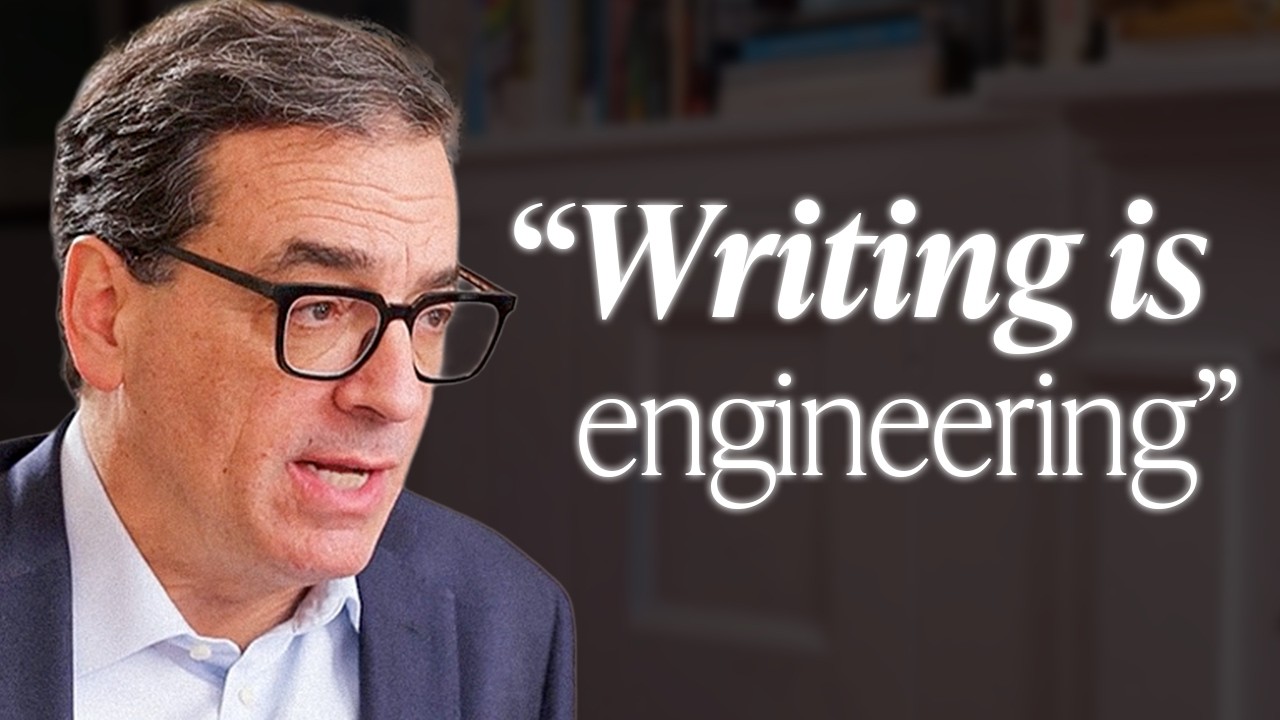
Daniel Pink, bestselling author of Drive, To Sell Is Human, and The Power of Regret, shares his complete writing philosophy — from daily routine and structural discovery to book proposals, research discipline, and the single question he asks before every project: what promise am I making to the reader?
Writing routine as liberation through rigidity
Pink follows a strict daily regimen when drafting: wake up, coffee, newspapers, walk 22 steps to his garage office, no phone, no email, write until he hits a modest word count (500–800 words), then stop.
The routine is deliberately low-intensity but high-consistency; he describes himself as a “tortoise, not a hare” — writing is still hard after decades, so structure makes it possible.
He works chapter by chapter: several weeks drafting, then a week rewriting, then repeat.
The rigidity is freeing because it removes daily decision fatigue; the structure itself is the scaffold that lets the work happen.
Finding a book’s structure through tortured iteration
Pink cannot write until he sees the “skeleton” of the book; he spends months researching and reporting to discover the organizing principle.
He uses whiteboards and large Post-its on the wall behind his desk, swiveling his chair to stare at them until the structure reveals itself.
Example: When (the science of timing) — started with chronological organization (day, week, month, year), failed; tried domain-based (school, work, health), failed; finally landed on conceptual categories (beginnings, midpoints, endings) that cut across domains.
Structure is stress-tested during drafting: writing a chapter on “the day” revealed enough material on breaks to become its own chapter.
The process is “tortured” and “unpleasant” but necessary — he cannot begin writing until the architecture is visible.
The science of breaks: recovery as performance, not weakness
Breaks are part of performance, not a deviation from it — athletes treat them this way; writers and knowledge workers should too.
Evidence-based principles for effective breaks:
Motion beats sedentary (walk > sit)
Outside beats inside
Nature exposure is powerfully restorative
Social breaks beat solitary ones, even for introverts
Full detachment is essential — phone scrolling is not a break
Pink applies this personally: he walks outside without his phone during writing days.
Book proposals as stress tests for ideas
Pink writes 30–40 page proposals not to sell but to test: if the idea can’t sustain 30 pages, it won’t sustain 300.
Core proposal elements:
A clear, fresh-but-familiar idea (e.g., “we have how-to books; we need a when-to book”)
Why no one else has written it and why Pink is the only person who could
A specific, non-”everyone” audience
A plausible structure
Why this book, now — timeliness matters
The origin story of the idea
He has written proposals he never submitted; one (The Invisible Present) he abandoned after 10 days of grinding when he realized “this is not a book.”
Regret as a transformative, underutilized emotion
The Power of Regret emerged from a personal crisis at his daughter’s graduation; socializing the idea revealed universal hunger to discuss it.
Key findings:
Regret is universal — “no regrets” is “life-changing nonsense”
It is one of the most common human emotions and, when confronted, one of the most useful
American culture indoctrinates positivity-only and forward-only thinking; this is bad advice
Negative emotions are instructive; looking backward enables learning
The healthy path: confront regrets, use them as data — not ignore, not wallow
The research is interdisciplinary (psychology, neuroscience, economics, medicine), which Pink values because domains ask similar questions but never talk to each other; generalists provide consilience.
Writing as engineering: books are houses, plays are watches
Pink views writing as engineering — building something that must work, stress-testing walls and roofs.
Books = houses: multiple rooms, flow, tolerates minor imperfections (powder room in wrong place but still a great house).
Plays = watches: extreme compression, zero margin for error — if gears don’t mesh, it doesn’t tell time.
Playwriting introduced collaboration: actors elevate the material, reveal gaps (“why is this person doing this now?”), and change how the work sounds.
He writes the kind of books/plays he would want to consume: “if someone else wrote this, would I read it week one?”
Becoming a writer: discovered, not decided
Law school, politics, linguistics major — writing was always the side thing (op-eds, short stories, articles for George magazine at midnight for free).
The signal: doing demanding work but still writing on the side at 11:30 PM = “you’re constituted to be a writer.”
He didn’t set a goal; he stepped outside himself, watched what he did, and realized the side thing was the main event.
Research discipline: knowing when to stop and what to cut
Research rabbit holes are real; Pink stops when he hears the same finding repeatedly (“I’ve heard this before”).
Ruthless inclusion filter: spent 3–4 weeks on child development of regret → readers needed one paragraph.
Credibility triangulation: single obscure study = skepticism; convergent evidence across disciplines = usable.
Example: walking on a treadmill in a lab generated 3x more creative ideas than sitting — replicated, cross-disciplinary, robust.
Writing to figure it out (not just to record what you know)
College essay professor Charlie Yarnoff: “Sometimes you have to write to figure it out” — contradicted the thesis-outline-write model.
Pink often discovers what he thinks through writing; wrote an ethics paper arguing the opposite of his belief and realized he’d changed his mind.
Tyler Cowen’s exercise: write the most compelling case for a position you vehemently disagree with.
Law school’s moot court training (argue both sides, anticipate counterarguments) was the most practically valuable skill he gained.
Developing taste through consumption breadth and discernment
Read widely and deeply; know the history of your craft (writers should know writers, like Tyson knew boxing history).
“Ones and tens”: force yourself to identify what you love and what you despise — discernment is upstream of taste.
Commonplace book practice: daily capture of sentences, phrases, unknown words (e.g., kakistocracy — rule by the worst).
The artifact matters, but the habit changes attention — you start noticing “the water got poisoned and we got used to the taste” (from a modern Oedipus).
Pink keeps simple notes: “fun paragraphs” and “good introductions” — a menu of voices and moves to pattern-match when his writing feels dull.
The most important question: what promise am I making to the reader?
Every book purchase is a $25 + 9-hour gift from the reader — an enormous opportunity cost.
Pink’s promise: the time will be worth more than the money; the hours will be better spent than with loved ones or on a walk.
Non-fiction must be useful, not just interesting/smart/entertaining — readers should do different things, not just think differently.
Same standard for plays: audience should leave thinking “I’ll approach my kids/co-workers differently.”
He wants the reader to know exactly what he’s promising and to pay it off — because they’ve honored him with time inside his head.