Wright Thompson, one of the most acclaimed non-fiction sportswriters working today, sits down for a wide-ranging conversation about the craft of writing — how to structure a story, bring people and places to life, report deeply, and land an ending that resonates. The discussion moves fluidly between philosophy, practical technique, and personal history, revealing a writer who has spent 25 years learning to trust the story rather than impose his will on it.
Writing is architecture, not words
Thompson wishes someone had told him early on that professional writing is about architecture — how pieces fit together and move — and only then about word choice.
He spent years mastering shorter forms (1,200-word stories, then 2,500, then 3,600 at the Kansas City Star, then 7,000–8,500 at ESPN The Magazine) before attempting books, and believes each length teaches its own structural logic.
The first draft of his book The Barn was 280,000 words; he cut 173,000 to reach the final 107,000 — an inefficiency he attributes to not yet having the toolbox to land a book-sized idea, and he is determined not to repeat it.
He now sees writing as problem-solving: every day is a new problem, and he refuses to let routine (same place, same time, same method) become the tail wagging the dog.
When a writing day goes well, he writes longhand in his country office until 11:00, then moves through Oxford — coffee, a half Guinness at Proud Larry’s, the cigar store — because physical movement sustains momentum rather than breaking it.
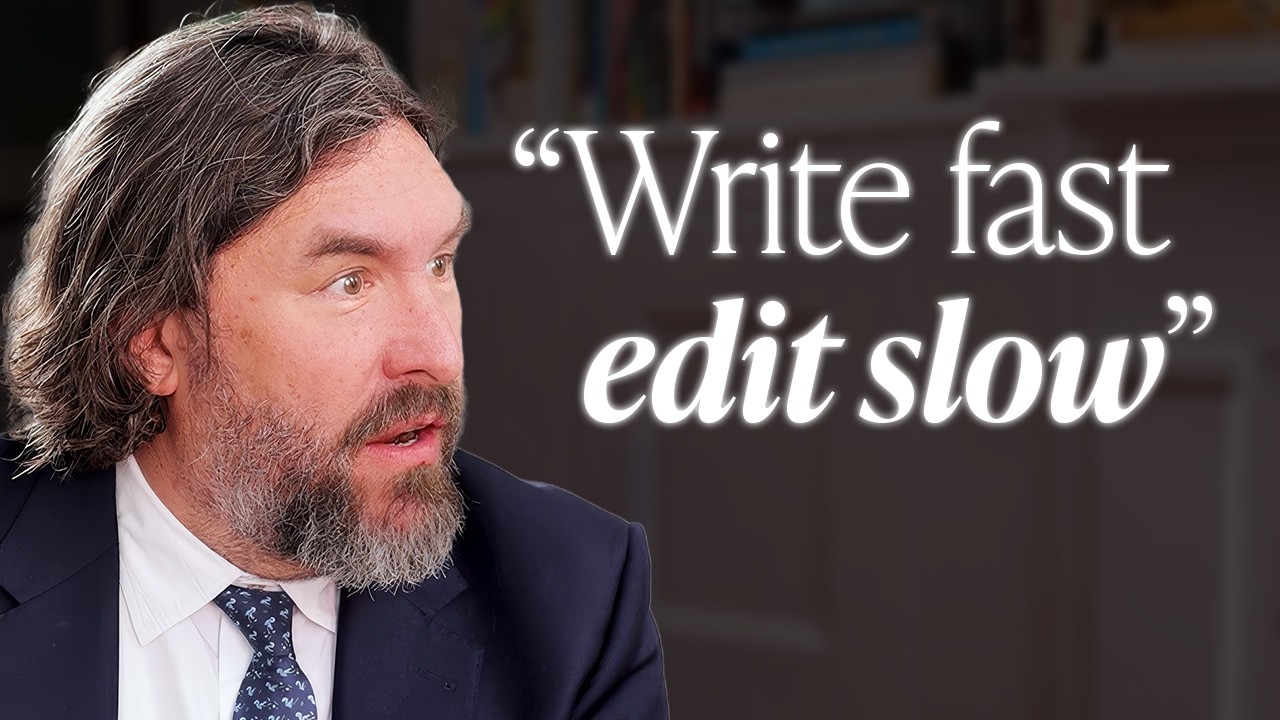
He writes fast and edits slow; the first draft is a race to get it down, and the real work (and joy) is in cutting.
There is no such thing as a good story idea — only obsession
Early in his career, Thompson chased “white whales”: stories no one else could get, driven by external validation. Now he believes a story is worth doing only if he is genuinely obsessed with it.
Writing feels like “doing a really personal thing in a really public way,” and every great profile is partly about the writer working through his own questions.
He no longer believes in rigid rules like “if you’re not outlining, you’re doing it wrong” — the only wrong way is telling someone there’s a right or wrong way.
Outlines and other craft tools are training wheels: you write externally before you can write internally, and you master structure before you can improvise within it.
The core of a profile, per Gary Smith, is identifying the central complication of a person’s life and how they go about solving it daily — almost all of which happens inside.
Interiority turns actions into meaning
Scenes without interiority are two-dimensional origami; the goal is to bring subterranean interior lives to the surface so that exterior actions become freighted with meaning.
In the Michael Jordan at 50 piece, Jordan falling asleep to Westerns means nothing until the reader knows he misses his father and feels closest to him watching Westerns — then the same description carries emotional weight without explanation.
The Tiger Woods profile uses the names of his two boats — Privacy and Solitude — to crystallize the tension between the manufactured extrovert brand and the extreme introvert underneath.
Earl Woods loved his son deeply but applied a marketing playbook designed for an extrovert (Michael Jordan) to an introvert (Tiger), and no one in the room asked what happens when you force that mismatch — the mask eating the face.
Dale Murphy deliberately “killed the avatar” upon retirement, recognizing that the ghost of his former self was the main obstacle to enjoying the next 50 years.
Thompson sees these stories collectively as a kind of prayer for empathy: understanding others thread by thread so that, on your deathbed, you aren’t still lying to yourself.
Reporting is the real work; writing is the fun part later
“All overwritten really means is underreported” — you cannot write your way out of a reporting hole; purple prose signals missing information.
Reporting is problem-solving: figure out what you need to know, who knows it, and how to get them to tell you (or access the archive).
Thompson spent a year gaining access to a closed archive in Biarritz, France, and now has 1,600 pages of French documents to translate page by page — a treasure hunt where each page might hold a bombshell.
A great detail does the work of 50 weak sentences; when stuck, the answer is almost always more reporting, not more writing.
The Jordan code-name detail (Jordan = Yahweh, “and it’s not a compliment”) came from deep reporting, not invention.
Dialogue beats quotes; secondary characters create a fractal portrait
Thompson prefers long runs of dialogue over isolated quotes — dialogue speeds the piece up and lets characters speak for themselves.
No single source owns the truth about a person; ten people from ten parts of a subject’s life will have ten versions, and the writer’s job is to present a fractal image at the intersection of all those impressions.
The truth lives at the intersection of the story a person tells about themselves and the stories others tell about them.
Driving questions propel the writer and the reader
Thompson always has a driving question, but he has learned not to pose it ham-fistedly in the text.
For a current Steve Kerr profile: “What is the work of the rest of his life when basketball is finished? What happens on the first day of the rest of his life?” The meat of the story exists in the undefined period after the piece ends.
A Joe Montana profile was really about struggling with diminishing time eroding his most valuable asset — how people remembered him — though he never stated it explicitly.
He doesn’t care how pieces perform (traffic, metrics); he’s had presumed blockbusters flop and throwaway pieces go viral. He views audience analytics as post hoc ergo propter hoc — a logical fallacy.
He cares about traffic only insofar as his boss (Chris Buckle) cares, out of personal respect, not professional strategy.
A writer has phases; reinvention is essential
Thompson believes writers move through phases, though he can only see his in retrospect.
He identifies a phase from his second Jordan story (“A History of Flight”) through The Barn as “of a piece,” and now feels himself both continuing and searching for something new.
He deliberately took the Caitlin Clark profile after a long break from profiling current athletes because he missed the form and felt he was losing that muscle.
Jay Lovinger warned him about “repetition of effect” — returning to the same obsessions until they become a rut.
He suspects his stories in order would reveal more about his inner life at the time than he’s comfortable with.
Brainstorming meetings kill creativity; real collaboration is informal
Thompson hates structured brainstorming sessions: they’re performative, the goal becomes looking good for the boss rather than making the thing good, and the meeting structure itself is a mask between people and the work.
The best ideas come from iMessage group chats, late-night texts, or a cameraman freezing in Scotland saying, “I love Scotland, where the cows wear coats” — accidental, joyful, collaborative moments.
He would ban chairs from meetings and require tacos for anything over 15 minutes.
Each form demands a different contract with the audience
Writing for TV: Tell, don’t show — the camera shows. The writer provides context the image cannot.
Documentaries: The best writing is no writing at all; every voiceover is a failure to let sound and image carry the story. When writing “skinny tracks” (connective narration), use a light touch to inject subterranean ideas — like putting English on a pool ball.
Magazine stories: Capture a universe — a dispatch from a specific time and place, a letter that feels true right now. It’s rhythmic juggling: pick one thing up and throw it hard at a target.
Books: Create a universe. The Barn works because a map of 1900 railroads revealed the Mississippi Delta was one of the last settled places in the lower 48 — directly under the barn where Emmett Till was killed — suggesting a tectonic misunderstanding of American identity. The book becomes a thought experiment: what if everything we think about ourselves is wrong?
Profiles: What is the central complication of someone’s life and how do they solve it daily? That’s the whole thing — “that’s football, gentlemen.”
Place is not a backdrop; it’s the excavation of self
Thompson is most interested in place because so much of identity is formed by our relationship to home.
The Barn was the book he had been practicing for his whole career — an attempt to understand the Mississippi Delta, a place he both hates and deeply loves.
Humans are forever searching for home: either the home they didn’t have as children or a paradise lost they’re trying to return to (Jason Isbell: “I thought I was running to what I was running from”).
The South externalizes interior human conflict onto the landscape — the “energy vortex” where the subterranean bursts into physical action. Faulkner didn’t invent this world; he saw what was already there (Virginia Woolf: stories exist, some people can see them).
Southern literature often privileges the past (Faulkner, Welty, Morris) over the vibrant present (Jesmyn Ward, Natasha Trethewey, Kiese Laymon), but Faulkner got the essential truth: the South is love and hate, the conflict in every human heart played out on the land.
Endings should open doors, not close them
Thompson always knows the ending before he writes — the Yankee Stadium piece ended on Lou Gehrig’s widow dying alone in the ’80s with no one at her funeral; he built the piece toward that.
He loves elliptical endings that feel hollow, echoey, like the air was sucked from the room — not kickers that hammer the door shut. A story should open a door.
The trick: a satisfying narrative arc that resolves the explicit question (How did Caitlin Clark become Caitlin Clark?) while leaving the deeper, authentic questions unresolved (Will she survive what’s coming?).
The reader gets a vote — if they put it down, it’s the writer’s fault, not theirs. But the reader doesn’t get to demand answers to questions the writer intentionally left open.
Sometimes you lose the ability to see your own story: the Ted Williams family piece went through endless drafts because Thompson could see the ending, then lost it, then couldn’t land it.
When you can see the ending, writing is just following a map.