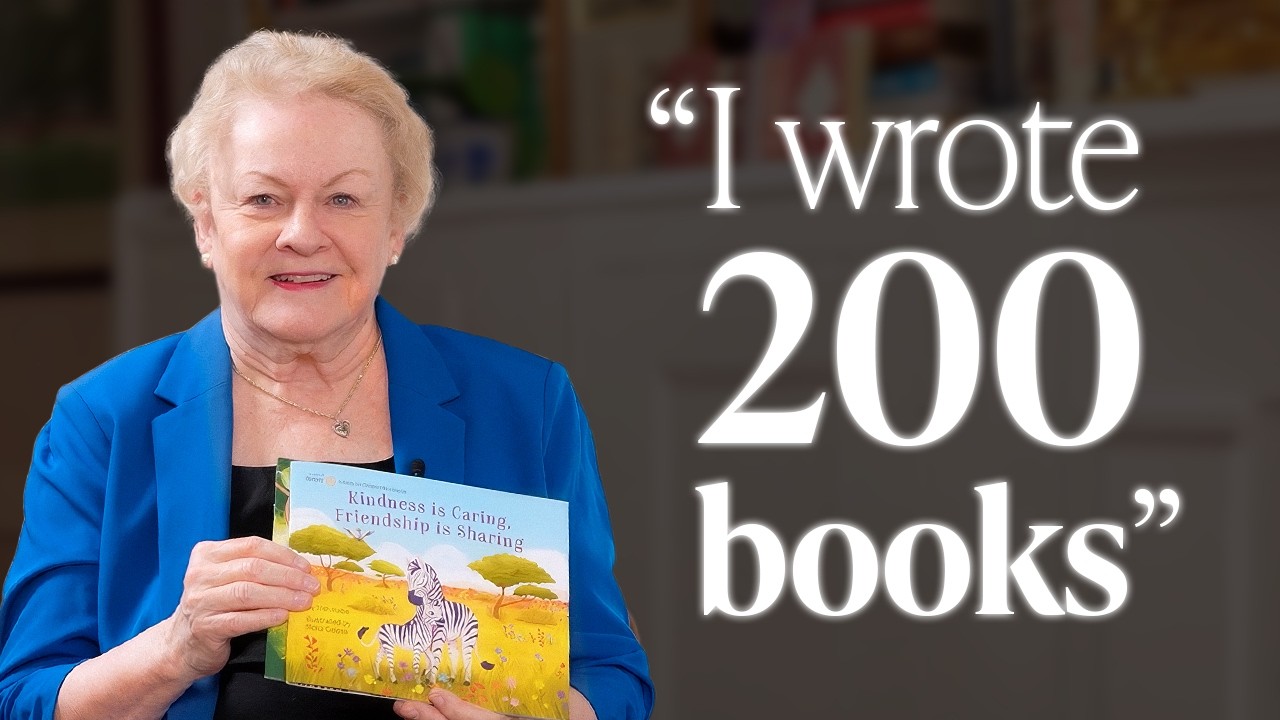
Tish Rabe has written over 200 children’s books across a 40-year career, including for Sesame Street, Disney, and 53 Cat in the Hat Learning Library books after Dr. Seuss’s death; this conversation covers her writing process, structural techniques, rhyme craft, illustration collaboration, and the business of children’s publishing.
Career origins and early breaks
Rabe moved to New York with a vocal performance degree hoping to sing for the Muppets; she landed a music production assistant role on Sesame Street season 3 in 1986.
Her first book, Bert and the Broken Teapot, came from pitching a personal childhood memory (breaking her grandmother’s teapot) to Sesame Street producers who had no books yet.
That first book established a template: emotional stakes (Bert fears David won’t be his friend), resolution through relationship over objects, and a final line — “I love you more than any old teapot” — that became a career-long principle.
Write the ending first
Sesame Street writers taught her to write the punchline/ending first, then back into the story; this ensures every element serves the payoff.
Example: Kindness Is Caring, Friendship Is Sharing — she wrote the final spread (“kindness and caring, friendship and sharing are the best ways to start”) before page one.
Knowing the ending dictates what must happen in the middle (e.g., a lion threat requiring cooperation) and shapes the opening (peaceful African plains, character Ammani gathering flowers).
Story structure: three parts, emotional investment, page-turn suspense
Every book follows beginning–middle–end; the beginning establishes setting and a character kids care about (Ammani gives away flowers → reader is invested before the lion appears).
Page turns are structural tools: the physical turn creates suspense (“are they gonna make it?”) that novels don’t have; she designs spreads (two-page illustrations) for high-impact moments and single pages for simpler beats.
Covers and titles: characters face into the book (pulling the reader forward); titles often rhyme (There’s No Place Like Space, Mystic by the Sea Is the Best Place to Be).
Hooking young readers: character age, target clarity, interactive reading
Two core age bands: 0–4 (few words, slow pacing, bedtime focus) and 4–7 (more lines per spread, older protagonists — kids look up to characters 2–3 years older).
She names characters early (Ammani = “peace” in Swahili) and tests names via Google to avoid collisions; carries notebooks everywhere because “lines on paper are worth a million dreams.”
Recommends interactive questions in books (“What was your favorite part?” not “Was school good?”) and tips for parents (read books you love, tell stories about your childhood).
Editing: handwritten drafts, reading aloud, professional editors
Writes multiple drafts by hand in spiral notebooks before anyone sees them; pacing adjusts by age (one rhyming line per page for toddlers, up to eight lines per spread for older).
Critical editing step: have someone who has never seen the text read it aloud to you — reveals stumbles, misinterpretations, and rhythm failures you’re too close to catch.
Used her own kids as test readers for Dr. Seuss books: “if they stumbled at all, change it.”
Words and images: art notes, illustrator collaboration, sketch review
Words always come first; she types art notes under each spread describing the visual intent (e.g., “Daddy Bear getting on a helicopter”).
Illustrators often improve on her notes (breakfast → packing backpack); authors and illustrators rarely meet — editors mediate to protect each other’s creative space.
Black-and-white sketches arrive first for feedback (move elements, add compass rose) before color; she decides single pages vs. spreads during writing (aquarium = spread, village shop = single page).
Why animals, not human children
Animal characters avoid representation gaps: “where’s the little girl that looks just like me?” — drawing diverse real kids across 24–42 pages is nearly impossible and risks leaving readers out.
Animals also allow universal emotional resonance (military families, bedtime, kindness) without cultural specificity barriers.
Rhyme craft: pure vs. slant, invented words, rhythm as memory aid
Dr. Seuss used pure rhymes (cool/pool); Rabe admits slant rhymes (go/home) when the exact word is non-negotiable (e.g., “home” for deployed parents returning).
When cornered, invent words à la Seuss (Van Vlex rhymes with necks; Gerplets rhymes with pets) — keeps rhythm without sacrificing meaning.
All her books rhyme; she internalized a “million gajillion rhymes” database after 30+ years but used a computer program early on.
Uses public-domain melodies (Twinkle Twinkle, 12 Days of Christmas) as “shell containers” — kids and adults already know the tune, so lyrics stick instantly.
Writing from the child’s POV
Final images center the child’s experience (child in dad’s arms, not dad’s perspective); military book reflects what kids actually feel: waiting for the parent to come home.
Moon as universal connector: deployed parents and kids look at the same moon — a motif she also used in an Elmo lullaby written the week her son left for college.
Teaching through story vs. facts
Cat in the Hat Learning Library: research children’s books on the topic → simplify science → render in accurate rhyme (Mars = “color of rust / covered with dust”).
Pluto demotion forced a two-page spread rewrite: “Mallerie Valerie Emily served up 999 pizzas” (Pluto) → “showed us 999 nickels” (no Pluto); artist only had to swap pizza boxes for nickels.
Story books teach values (friendship > things) rather than facts; Bert and the Broken Teapot drew letters from parents grateful for that message.
Business of children’s books: royalties, formats, distribution, timelessness
Two models: flat fee (work-for-hire) or royalties (Dr. Seuss books pay twice yearly — February and August — with unpredictable amounts).
Price points lower than adult books ($9.99–$12.99); volume compensates; books are timeless (Goodnight Moon 1940s, Cat in the Hat 1950s still sell).
Self-publishing (Tish Rabe Books, 2020) added: choosing illustrators (style must match book — Jill Guile’s softness wrong for Ninja Turtles), reviewing sketches, selecting trim size (7.5×9 vs. 8×8), finding printers, navigating Amazon’s rigorous onboarding.
Distribution is hard; Barnes & Noble placement at kid-eye-level is a major prize; she does some book fairs but school visits consume full days.
IP longevity: a Teenage Mutant Ninja Turtles song she wrote in 1993 appeared in a 2024 movie trailer — Paramount paid and credited her; rights persist for decades.
Biggest business landmine: translation without distribution
Don’t translate (especially rhyming books) unless you have confirmed demand and distribution channels in that language; English-only Amazon is hard enough.
For translations, she’d drop rhyme and keep plain prose (“It was a beautiful day, Ammani and her mother were outside”) — rhythm serves English readers, not a requirement elsewhere.
Creative mindset: belief over preciousness, writer’s block tactics
Not precious about creativity: “I always feel like I’ll come up with something” — rooted in 40 years of experience; a Chamber of Commerce 100th-anniversary book request with a 6-month deadline sparked the Mystic by the Sea concept (four seagulls touring town) in a coffee shop.
Writer’s block is real: she pushes internal deadlines earlier (June deadline → May in her head) for buffer; when stuck, “cannot force it” — do something else, sleep, bath, go somewhere new (the “three B’s”: bed, bath, bus).
Reads every night as a child (mother read Wizard of Oz aloud, no pictures — imagination trained by voice and rhythm); credits that for her career.
Final philosophy
Write inspiring, not sad: “the world’s a tough place” — books should leave kids with hope, joy, and a lasting final impression (the last page before sleep or school).