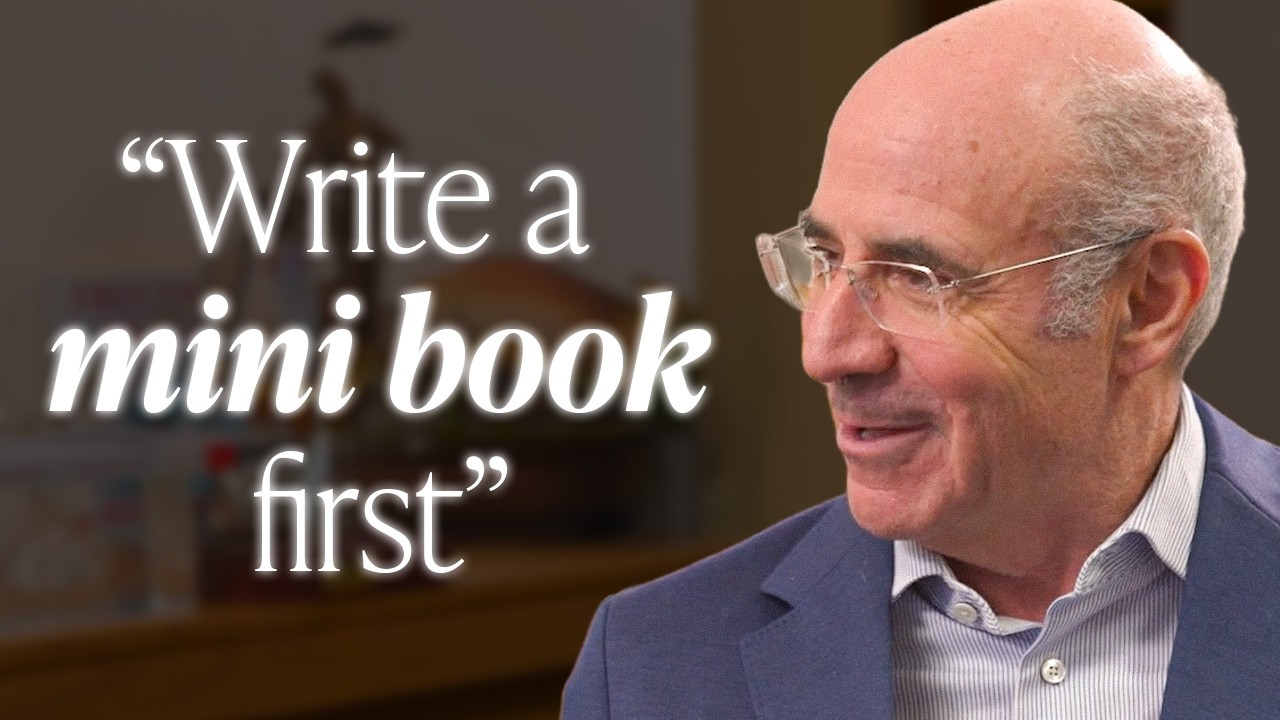
Bill Browder, author of the bestselling memoirs Red Notice and Freezing Order, explains how he crafts page-turning nonfiction by treating every page as a battle for the reader’s attention, using his own life — from hedge-fund manager to Kremlin-targeted justice campaigner — as the raw material.
The core principle: story over prose
Browder insists the writing itself is merely technical; what keeps readers turning pages is the story — specifically, drama, tension, uncertainty, and stakes.
He obsesses over a single question at every sentence: “Why should anyone care about the next sentence?” If he cannot answer it, the sentence goes.
Even a deposition transcript becomes gripping when he isolates the betrayal, the threat to his life, and the reader’s empathy for someone being hunted.
Pacing and chapter architecture
Every chapter must end with an unresolved challenge or question that pulls the reader into the next chapter, like a miniseries cliffhanger.
Within each chapter he creates a mini-arc: a challenge appears, is partially overcome, and leaves a new uncertainty.
He writes a “mini-book” first — roughly 50,000 words of fleshed-out chapter summaries for a 140,000-word final manuscript — so the full dramatic architecture is locked in before he adds color and character.
The third book: raising stakes without rehashing two prior books
The next book centers on Vladimir Kara-Murza, a close ally who helped pass the Magnitsky Act, survived two poisoning attempts, and was sentenced to 25 years in a Siberian penal colony before being released.
The challenge: new readers must become invested in Vladimir and in Browder himself without retreading the first two books.
Solution: weave earlier stories into the narrative only as needed to establish emotional stakes for the current crisis, so the reader feels the weight of each setback.
First-person perspective: advantages and the memory gap
Advantage: the material lives in his head; less external research required.
Disadvantage: at 61, his memory is incomplete. He reconstructs scenes by interviewing other participants, comparing recollections, and stitching them into a coherent narrative.
He cannot interview antagonists (they would sue), so he relies on court transcripts and depositions, which often reveal everything he needs.
Research, recollection, and the “shower effect”
Every detail is verified; the outline is in his head, but the texture comes from research, recollection, and reconstruction.
AI has accelerated background research, but original first-person material still demands legwork.
Recollection is iterative: he revisits episodes repeatedly until sensory details resurface — often while showering, walking, or otherwise not forcing it.
He captures fragments on his phone whenever they arrive; the three-year gestation period lets these pieces accumulate organically.
He sells on the mini-book, which de-risks the publisher and secures an advance and a hard deadline.
The deadline transforms the slog into a accountable sprint; he rewrites heavily after trusted readers (wife, son, agent, 10 diverse friends) flag problems — as happened with Freezing Order, when all three first readers said “this sucks” and he rewrote a third of the book in three months.
Writing books versus articles
An article gives minutes of attention; a good book buys 12 hours of immersive emotional engagement, creating lasting memory and personal connection.
Books are high-risk: most go unread. For a campaigner, spending three years on a book that sells 500 copies is a dangerous opportunity cost.
Safety through visibility
Advisers urged him to stay quiet after Sergei Magnitsky’s murder; he argues publicity raises the cost of assassination because the world would know who ordered it and why.
The books themselves became protective armor: Red Notice inspired an Australian senator to pass a Magnitsky Act during COVID without Browder ever visiting the country.
Ensemble elements: characters, places, and relatable touchpoints
Readers bond with characters through a few vivid, humanizing details — not exhaustive bios — so they root for the good guys and recoil from the bad guys (who sometimes switch sides).
Places become characters: Sheremetyevo Airport’s smell and brass “coffee-can” ceiling fixtures instantly ground anyone who has been there; the Villa d’Este’s pool makes a later crisis viscerally real.
He scatters specific, relatable touchpoints (a hotel, a courtroom, a trading floor) so diverse readers find personal entry points into the narrative.
Bringing a place to life
Describe only the two or three poignant, distinctive sensory details that anyone who has been there will recognize; skip generic description.
Example: Sheremetyevo’s aged 1980s decay conveyed in a single sentence — “built in the 1980s but had really shown its age” — then move on.
Finding truth: talk to people, not screens
As an investor, he discovered massively undervalued preferred shares simply by asking a CFO a basic question no one else had asked; the answer was hiding in plain sight.
In any domain — finance, politics, crime — opacity is an illusion. The truth emerges when you sit down with insiders over coffee and ask naive, persistent questions.
Chapter endings: show, then land the point
He prefers “show, don’t tell” throughout the chapter, then delivers a one- or two-sentence summary at the end that nails the revelation.
Example: “He didn’t realize that Russia had no rule of law. It had a rule of men and those men were crooks.”
Daily routine and environment
Fits writing around family, fitness, and business: currently 2–3 hours a day, three days a week; aims to block out larger uninterrupted stretches.
Writes anywhere — planes, trains, beach, study — without preciousness about setting.
Works closely with his editor at Simon & Schuster, but the manuscript arrives nearly clean after the 10-friend beta read.
Writing trauma: the exciting parts are easy
Harrowing scenes (detention, threats, Magnitsky’s torture) flow naturally because they are inherently dramatic.
The hard chapters are the boring ones (compliance walls at Salomon Brothers, depositions); he must engineer tension — rivals, internal police, personal risk — to make them readable.
The ending as life thesis
Red Notice closes by contrasting the thrill of a 10-bagger stock trade with the incomparably deeper satisfaction of winning a measure of justice for Sergei Magnitsky at the European Parliament.
The final paragraph crystallizes his transformation from financier to justice campaigner and gives the reader the emotional payoff of the entire journey.