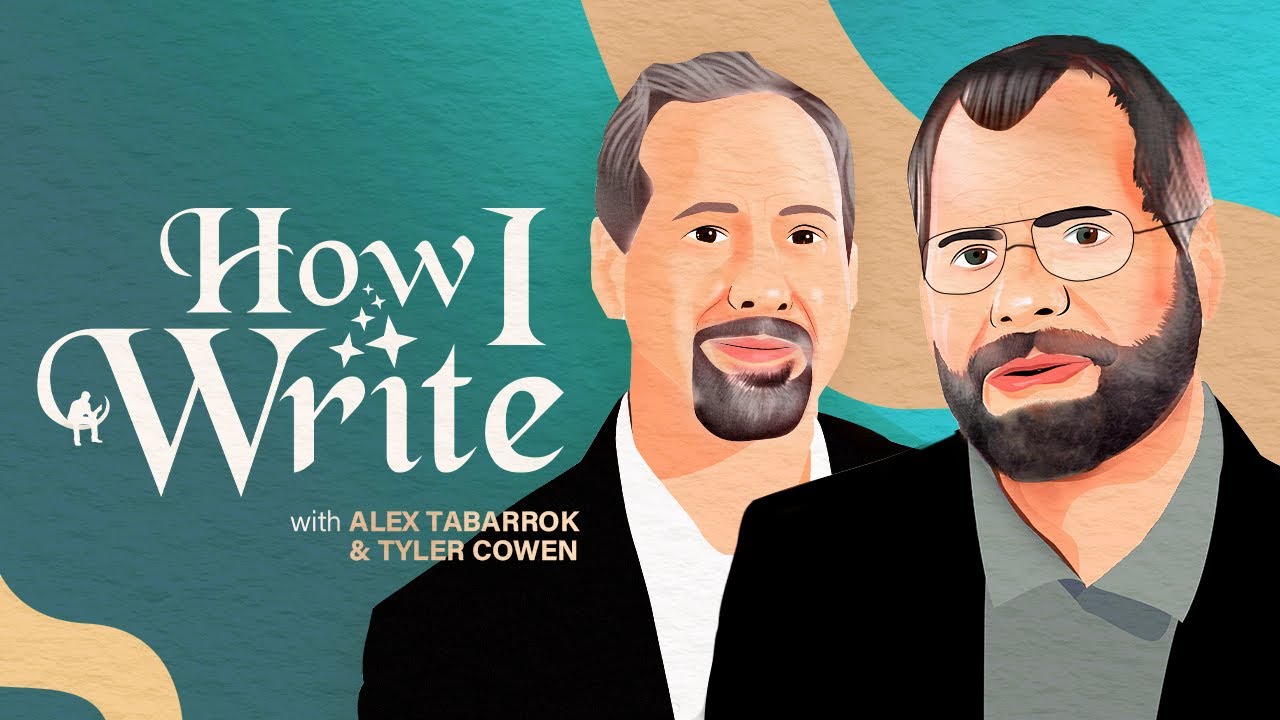
Tyler Cowen and Alex Tabarrok have co-authored Marginal Revolution, the world’s largest economics blog, for 20 years, publishing 4–5 posts daily without missing a day; the blog anchors an integrated product line including a textbook, YouTube channel (Marginal Revolution University), podcast, and columns, all aimed at teaching economics to millions globally.
Genesis and early growth
The blog began in August 2003 after Alex suggested writing a textbook and Tyler countered they should start a blog first; neither knew what a blog was, and they expected perhaps 5,000 readers, mostly academics.
Within weeks they hit 10,000 visitors with no social media, iPhone, or advertising; early posts were practice, but readers appeared immediately.
A 2003 post on Shaquille O’Neal as a plausible greatest basketball player became one of their most-read pieces, teaching them that readers love ranking debates and want chances to “take the writer down a peg.”
Complementary thinking and writing styles
Tyler starts with maximum complexity — qualifiers, edge cases, historical context — then simplifies; Alex starts stark and simple, then adds necessary nuance; they converge at the same point from opposite directions.
“If you’re confused about what the post said, that’s a Tyler post. If you understand exactly what the post said and you’re mad as hell about it, that’s an Alex post.”
Tyler enjoys confusing readers; Alex writes to reduce reading time for high-opportunity-cost readers, treating posts as “dim sum for the mind” — small, crafted bites.
Their textbook (now in multiple editions) is co-written line by line in a single voice, unlike most co-authored texts that split chapters; every picture and caption is chosen by them.
Textbook publishing imposes 40+ referee reports per chapter; the publisher wants “no one hates it,” while the authors want readers to love it — a productive tension.
Integrated product line and intellectual blitzkrieg
They describe MR as an “intellectual blitzkrieg” or integrated product line: blog, MRU videos, textbook, podcast, columns, Twitter — each introduces audiences to the others.
MRU launched early on YouTube with bare-bones iPad recordings; later funding brought professional animation, sound, and Roman Hardgrave as manager.
Goal: reach 25% of U.S. high schools by 2025, but largest impact expected in India, South Asia, Middle East where “MRU guy” recognition is routine.
Auto-generated subtitles (now in 100+ languages via DeepMind) created a dual-learning effect: students learn economics and English simultaneously.
Work habits, speed, and collaboration
Binding constraint: their own time and energy; they don’t want more collaborators because the goal is their own learning, not scale.
Alex prioritizes collaborative work first so the partner can work in parallel; Tyler responds near-instantly — “if I’m going to do it, I might as well do it now because I won’t be less busy later.”
Tyler reads 4–5 books a day; this intake rate is the scarce resource in blogging — without it, writers become repetitive.
They disagree constantly but keep egos detached from outcomes; neither vetoes the other’s posts, and they resolve disputes by focusing on the right answer, not ownership.
Alex has ~2,500 unpublished book pages; Tyler kills ideas freely — wrong, stale, or deliberately held back to avoid pandering.
Idea generation: conversation over solitude
Alex needs dialogue — with a person or a text — to generate ideas; he is “very bad” at solo ideation in the shower or on walks.
Tyler gets ideas in the shower (e.g., the patent-system paper sparked by seeing three patents on a barcode-scanning idea he’d just conceived).
The comment section provides facts from domain experts (terrible for theory, useful for ground truth) and reveals where “the terribleness is at.”
Direct emails are 80% high-quality; cold emails from readers have led to global networks, speaking invitations, and hiring filters (e.g., Emergent Ventures applicants).
India, the internet, and undigested change
India is MR’s #2 market, likely to become #1; Tyler deliberately avoids analytics to stay focused on daily fun, but knows India’s intellectual appetite is massive.
The internet’s power is still undigested by half the world; new norms of discourse and writing are “winning hands down,” and AI will amplify this.
MR acts as a launching pad: it raises the baseline for every other project (Emergent Ventures, Fast Grants, columns) by filtering for readers who tolerate confusion and challenge.
Teaching economics to the world
Core intellectual project (Alex): spread good economic ideas — most of the world hasn’t caught up to Adam Smith; teach principles to as many as possible.
Core project (Tyler): model the life of an infovore — show how to live and think with curiosity, detachment, and analytical independence, unashamedly.
They avoid taking sides fully; “you’re never really fully on anyone’s side” — which makes enemies but attracts readers across political, religious, and national lines.
High-context writing (Tyler) filters for engaged readers; low-context punches (Alex) deliver clarity; together they create a “sitcom” camaraderie readers want to join.
Consistency, craft, and why it lasts
Daily publishing is a rule, not a habit — like a radio station that’s always on; autopublish at random early-morning times maintains the streak without pressure.
Search function is underrated: the archive holds wisdom that becomes diffuse because readers treat blogs like newspapers — read once, forget.
Writing advice from 2004 still holds: be brief, interesting, timely; craft “aphorisms” that stick (e.g., “A price is a signal wrapped up in an incentive”).
After 20 years, it’s still fun, still growing, and keeps them sharp — students stay the same age while they age, forcing renewal.
Both call professorship the greatest job: intellectual freedom, no boss, and the chance to show that curiosity can get you somewhere.