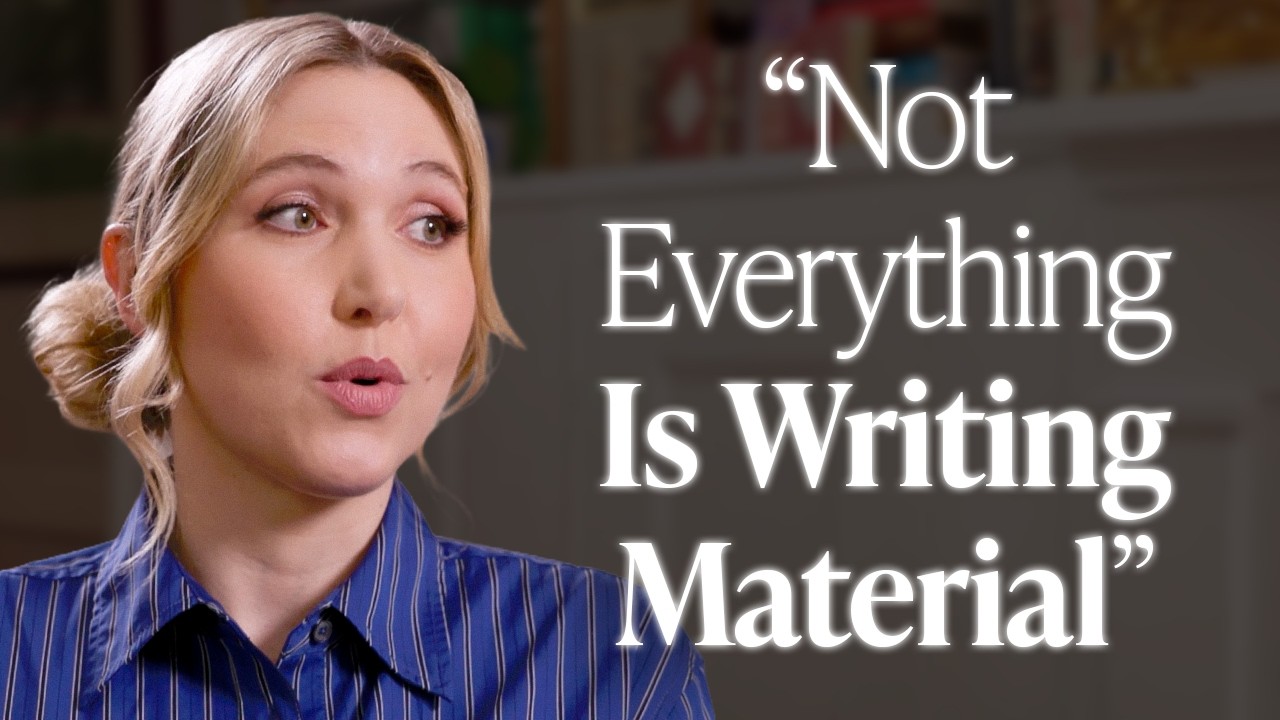
Taylor Tomlinson, a top comedian with multiple Netflix specials and the book Actually, Never Mind, shares her creative process for stand-up and writing, revealing how she develops material, structures hours, balances vulnerability with craft, and navigates the differences between live comedy and book writing.
Joke writing starts with subjects she genuinely wrestles with
She needs a notebook, free time, and a day free of expectations to list topics she could explore for a couple of years — the typical timeline to build a recordable hour.
Fertile ground comes from uncertainty: she writes about having kids because she genuinely goes back and forth on wanting them.
Strong emotions — anger, sense of unfairness, things she thinks are stupid — are the most reliable sources of material, echoing advice from Judy Carter’s Comedy Bible.
She swings between broad and personal across specials
Her specials alternate: first broad, second personal, third broad, fourth personal, fifth broad again.
She always starts specific, then works backward to find where her experience overlaps with the audience’s.
If a personal bit gets laughs, she knows others relate; if it flops, it’s just her — and she takes that to therapy.
A joke evolves from a fleeting observation to a tested bit
Example: on a plane, she texted a dad friend about a loud baby; he asked if it was crying — she said no, it was laughing, and argued that uncontrolled laughter is just as disruptive as crying.
She captured it in a phone note, expanded it in a notebook, then took it to stage unsure if it would work because it’s “unlikable” to complain about a child’s joy.
The laugh it gets is often “I never thought of it like that” rather than “I feel that exact way.”
Likability shapes which jokes she can carry
She has a “round face, nice Midwestern daughter vibe” and can’t pull off an unlikable persona; some comics are “fun to hate” as avatars for dark thoughts, but she isn’t.
Knowing how the audience perceives you when you walk on stage determines which jokes will land.
She’s passed jokes to friends who could deliver them better, and received the same in return.
The first minutes of a special set the contract with the viewer
The first 60 seconds are critical; live-show openers (local references, long applause) get edited out for the special.
In clubs, she does quick crowd work in the first 15 minutes so the audience feels they’re seeing a unique night, not a rehearsed tour stop.
A moment of recognition — “I see you, I know where we are, I’m not on autopilot” — builds immediate comfort.
Crowd work is structured, safe, and optional
She sprinkles it every 15–20 minutes with a specific question tied to the hour’s themes, not random chaos.
She never wants anyone to feel bad, regret speaking, or be encouraged to heckle; if it goes sideways, she deflects or makes it about herself.
For every posted clip, there are 20 forgettable exchanges — she moves on seamlessly because her written transitions are meticulous.
She can’t work like Mitch Hedberg with disconnected one-liners; she needs topical flow to remember the hour and keep the audience oriented.
The core joy is immediate feedback on a private thought
She loves writing something at 4 p.m. and knowing by 8 p.m. if it works — the speed of the write–perform loop.
The feeling mirrors telling a friend a slightly mean observation and having them agree: “Oh my god, I know.”
Writing the book offered a different pleasure: months in a blanket, delayed verdict, but she enjoyed both modes.
Writing the book required a different rhythm and workspace
Stand-up writing happens in public — coffee shops, planes, walking — where she can people-watch and listen to old sets.
Book writing demanded an office, door shut, Wi-Fi off, and earlier hours (9:30 a.m.–4:30 p.m.); generating first drafts fried her by late afternoon, though editing could go later.
Stand-up trains concision (most ideas in fewest words); the book demanded expansion — her editor had to stop her from cutting whole chapters.
Bird by Bird and the perfectionism trap
Anne Lamott’s line — perfectionism makes you think perfection will save you from death, but everyone dies and the imperfect had more fun — is daily life advice for her.
Reading writers admit fear, self-doubt, and the sense that every draft is garbage normalizes the feeling and stops her from abandoning projects.
If Anne Patchett mourns her lack of talent, it’s okay for Taylor to doubt herself and keep going.
She learned to stop insulting the audience through self-deprecation
Early on, she was self-deprecating to an unhealthy degree; women approached her after shows saying, “If you’re ugly/annoying, what am I?”
Attacking herself too hard indirectly attacks the people who relate to her.
Now she balances a self-deprecating joke with a counterweight: “I’m annoying and overbearing… and also I take care of everyone and I’m usually right.”
Therapy material works only when she’s in a healthy place with it
Audiences sense when a comic isn’t over a trauma; jokes about losing her mom young worked inconsistently until she’d done the therapy and could say, “I’m fine — look how successful I am.”
Addressing the room’s tension explicitly (“We’re going to talk about this, and I’m okay”) lets everyone relax and laugh for the next five minutes.
The shift from “melting down on stage” to “in control of the ship” is what makes the material land.
A joke grows by adding scaffolding and tags
The mom-loss chunk grew from 60 seconds to six minutes; the turning point was adding the “I’m fine” framing after initial jokes.
She builds bits by establishing an anchor punchline, then riffing — the lines that stick become tags, and tags can become the whole bit.
Friends’ suggestions (“you could say this”) often arrive as tags that unlock the deeper structure.
Reviewing sets means listening for laugh texture, not just volume
She records audio of every show (voice memos) and listens while walking or on planes — never sounds exactly like she remembered.
She listens for laughs, groans, gasps, silence; distinguishes genuine laughter from “clapter” (applause for agreement) or “woos” (cheering for a point, not a joke).
An hour needs ebb and flow: not every joke murders, and a constant machine-gun pace numbs the audience — like a good album, it needs dynamic range.
The book taught her selective vulnerability
Stand-up trained her to overshare; the book taught her she can be sincere, authentic, and vulnerable without disclosing everything.
She keeps some memories private because they’re too painful, too positive, or simply not for strangers with $20.
Crowd work analogy: you can have a real moment with a crowd and not post it; your soul works the same way.
Early career: the faucet runs dirty before it runs clean
Beginners feel the world is their oyster; experience reveals how much has been done — originality comes from starting ultra-personal (“this happened to me”).
Ed Sheeran’s faucet metaphor: first comes muck (derivative ideas), then clean water — don’t turn off the tap because the water’s dirty.
She consumed comedy heavily early on to learn; later she stopped to avoid comparison spirals (“everyone’s so much better”) that paralyze her on stage.
No book replaces writing and performing
She’s read every writing book; they all say the same thing: you just have to write. If you have nothing to say, go live.
Stand-up adds a second requirement: you must perform. Written jokes aren’t jokes until someone laughs.
Reading about running doesn’t replace steps; reading about comedy doesn’t replace stage time.
Collaboration happens on the road with trusted friends
Sophie Buddle (head monologue writer on her show) and Dustin Nickerson open for her and bounce ideas constantly.
Road weekends turn into all-day writing sessions: breakfast, green room, backstage tagging each other’s bits, writing in each other’s voices.
Deep familiarity lets them say, “This won’t work for me but it’s perfect for you.”
Inspirations: clean comics, Fleabag, and the fourth wall
Raised sheltered, she grew up on Brian Regan and Kathleen Madigan — comics who toured theaters without sitcom hits, a model she wanted.
Fleabag showed grief, trauma, self-sabotage, and hilarity coexisting; the fourth-wall breaks look easy but nobody’s cracked it since.
That blend — making you cry, laugh, cry again — is the art that stays with her longer than “silly for an hour.”
Ann Patchett’s The Getaway Car normalized creative despair
Patchett compares writing to pinning a butterfly: you kill the living idea to fix it on the page, and the result always disappoints.
She mourns her own lack of talent despite being objectively brilliant — reading that makes Taylor feel less crazy and less like a fraud.
If the greats feel this way, self-doubt isn’t a stop signal; it’s part of the job, and you push ahead anyway.