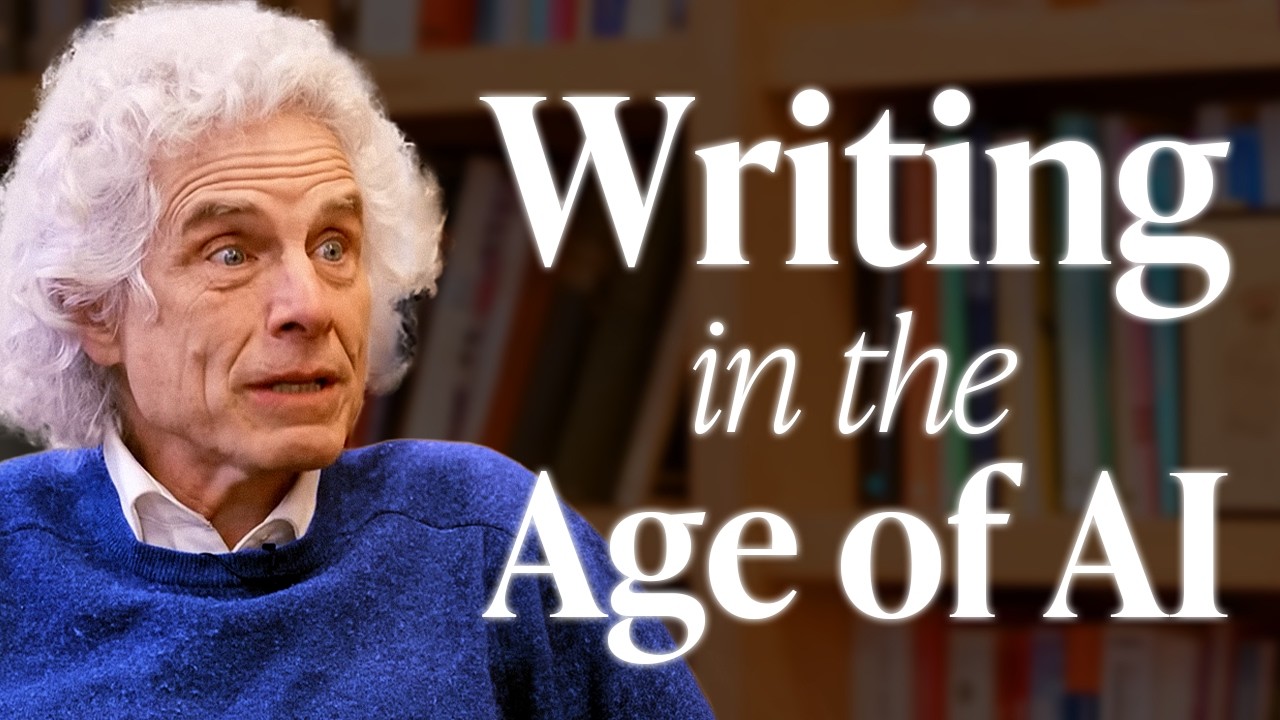
Steven Pinker, Harvard professor of psychology and author of nine books on language, cognition, and writing, explains the principles of clear nonfiction writing and reflects on how AI changes the landscape.
The conversation moves from practical writing rules — curse of knowledge, visual concreteness, brevity, rhythm — to the cognitive science behind why writing is hard, why academics write badly, and what children’s explanations reveal about clarity.
It ends with Pinker’s assessment of LLM output as competent but generic, and how he would revise his own theoretical framework in light of large language models.
The Curse of Knowledge Is the Main Cause of Bad Writing
Bad writing is rarely deliberate obfuscation; it is mostly a failure to imagine what the reader does not know.
Pinker illustrates with a molecular biologist at TED who launched into jargon-heavy details and lost a diverse audience within seconds.
The curse of knowledge — the difficulty of subtracting what you know from your mind — manifests as unexplained acronyms, insider jargon, and abstract nouns (e.g., “the level of the stimulus was proportional to the intensity of the reaction” instead of “kids look longer at a bunny than a truck”).
Even brilliant experts fall prey because the curse is invisible to the sufferer: what seems obvious to you may be opaque to everyone else.
Escaping the Curse Requires Real Readers, Not Just Empathy
Pinker tries to simulate a naive reader but acknowledges the simulation is unreliable; the solution is showing drafts to actual people outside his subfield.
His mother — intelligent but not a cognitive psychologist — served as an ideal test reader; commercial editors and colleagues in other disciplines play the same role.
Even academics in adjacent fields often fail to understand each other because lab groups develop private jargon that becomes unintelligible a few doors down the hall.
Good Writing Is Visual: Help Readers Form Mental Images
Understanding is not a string of words; it is sensory, motoric, and visual. Language is a vehicle for conveying those nonverbal ideas.
Replace abstractions (“stimulus,” “framework,” “paradigm”) with concrete referents (“bunny rabbit,” “the hawk’s talons sinking into flesh”).
Older prose feels more vivid because writers before modern academic specialization had to reach for shared visual metaphors rather than ready-made technical terms.
Abstractions are efficient inside a specialty but become barriers when the audience lacks that shared knowledge base.
Writing Is Harder Than Speaking Because Context and Feedback Are Missing
In conversation, participants share common ground, situational context, and real-time feedback (furrowed brows, requests for clarification).
Writing wrenches the author from all of that: the reader may be in another country, a different century, or reading after the author’s death.
No prosodic cues, no body language, no opportunity to repair misunderstandings on the fly — the text must carry the entire burden.
Generalizations and Examples Need Each Other
Generalizations without examples are vague; examples without generalizations are pointless.
Pinker demonstrates: “familiar phrases don’t always mean the sum of their parts” becomes clear only after examples like “bathroom,” “breakfast,” “Christmas,” “adultery vs. infantry.”
The trade-off is context (examples) versus compression (generalizations); good writing swings between them.
Beauty in Prose Comes from Sound, Rhythm, and Freshness
Pinker reads aloud (or subvocalizes) to test flow; if he stumbles, the reader will too.
Metrical rhythm matters: disrupted beats interfere with reading even silently.
He avoids excessive sibilants, uses subtle alliteration for pleasure and momentum, and values euphony — not ornamentation, but the “music of the language” that makes sentences roll past easily.
Humor shares the same requirements: brevity, freshness, and precise timing; strained or overused jokes produce groans, not laughter.
Brevity Improves Both Clarity and Aesthetics
“Brevity is the soul of wit” (Shakespeare) and “omit needless words” (Strunk & White) are self-demonstrating principles.
Compressing to a strict word limit (e.g., 800 words for a newspaper) often improves prose by forcing concrete language, cutting clichés, and reducing the reader’s cognitive load.
Every syllable costs processing effort; shorter paths to the same meaning are both kinder and more beautiful.
Academic Writing Is Uniquely Bad Despite High Intelligence
The waste is enormous: taxpayer-funded research locked in turgid prose, reviewers re-reading paragraphs five times, misunderstandings that could be avoided.
Linguists and psycholinguists are especially culpable — they study what makes sentences hard to process, then ignore their own findings.
The problem is not malice but the curse of knowledge amplified by professional incentives that reward signaling to insiders over communicating to outsiders.
Children’s Explanations Model Clarity and Freshness
Kids say “clouds are water vapor,” “smoke is fire vapor” — poetic because they lack clichés and abstract vocabulary.
They cannot think inside the box because they don’t know the box exists; they reach for visible, shared images.
Historical figures (Darwin, Edison, Rockefeller, Holmes) wrote beautifully partly because they were educated on classics, lacked modern abstractions, and had to forge new metaphors for new ideas.
Informalization Eroded Elevated Prose Over the Last Century
Cultural shifts — democratization, romantic valuation of authenticity/spontaneity, collapse of formal address and dress — made crafted language seem pompous.
The conversational vernacular displaced the well-crafted style; we now feel awkward writing with the care that was once ordinary.
LLM Output Is Competent but Bland: A Pastiche of Billions of Examples
LLMs produce grammatically sound, well-structured, jargon-free prose — better than most academic/bureaucratic writing.
But it is generic, anodyne, and recognizable: a “mashup” of existing text, fine-tuned via reinforcement learning into a five-paragraph-essay template.
Pinker speculates that averaging many mediocre sentences may yield a “composite face” effect — clearer but not beautiful — because the worst convolutions are smoothed out.
LLMs Would Change How Pinker Theorizes Language Acquisition
His earlier work (Chomskyan linguistics, computational cognitive science) emphasized innate rules, logic, and structured algorithms.
LLMs show that massive statistical pattern extraction from unstructured input can generate sophisticated language — a challenge to the “poverty of the stimulus” argument.
He would now give more weight to the power of large-scale pattern learning, though he notes human children learn from situated interaction and far less data, so the mind is not simply an LLM.