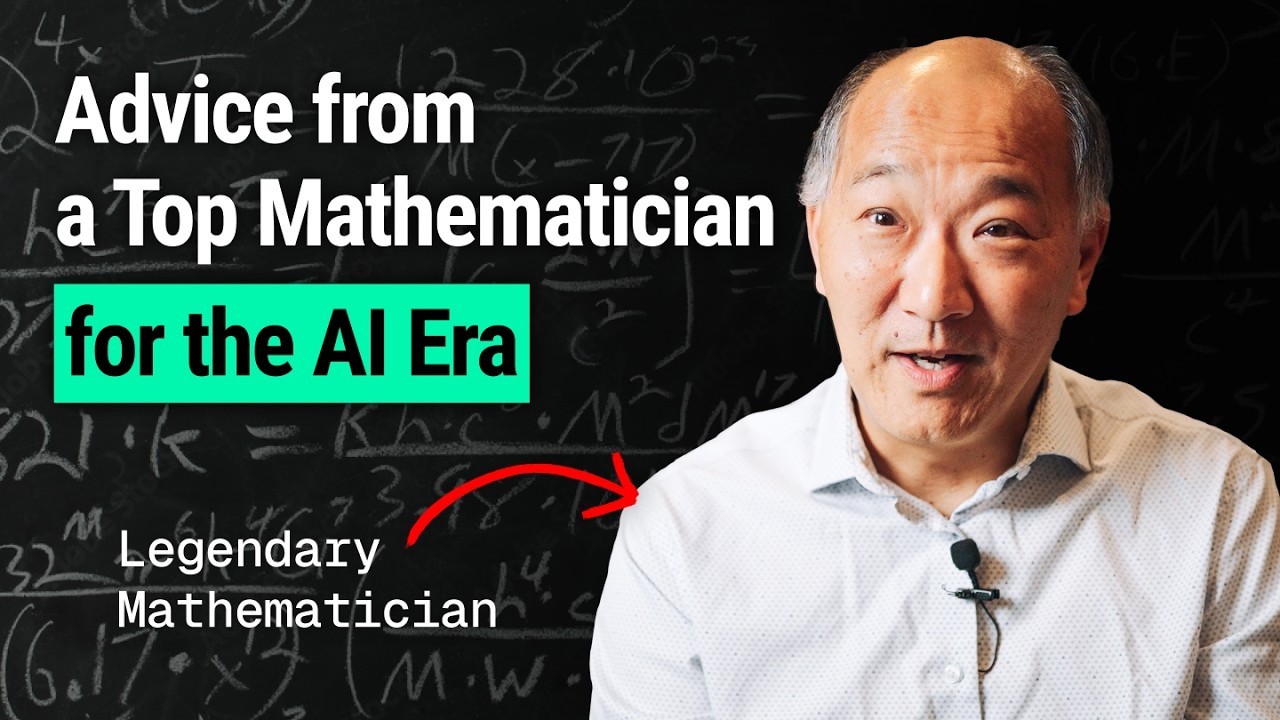
Ken Ono, a mathematician and founding mathematician at Axiom Math, describes how encountering frontier AI models triggered a personal crisis and led him to redefine intelligence, education, and talent discovery in an era where knowledge has become cheap but human judgment, curiosity, and deep reasoning remain scarce.
The Crisis: AI as Extraordinary Librarian
One year ago, Ono was a “happy-go-lucky” professor at the University of Virginia; then he joined the Frontier Math program at Epoch AI, where mathematicians created difficult problems to test large language models.
For the first time, he struggled to assemble questions that ChatGPT would get wrong, and he was devastated to realize these models know more facts than any human.
He initially asked, “How am I going to stay ahead of AI?” but concluded that is the wrong question — competing with AI on knowledge is like Usain Bolt racing a motorcycle.
Large language models function as the most extraordinary librarian ever seen: they have ingested virtually everything written, posted, or published, and new information reaches them within hours.
Knowledge is now cheap for those with internet and model access, but using and verifying that knowledge has become more expensive.
A librarian should not be your neurosurgeon or air traffic controller — human judgment remains essential where stakes are high.
Intelligence is not fact regurgitation but the ability to reason, make proper inferences, create new concepts, generate ideas, and string concepts together deeply — speed does not matter.
Deep intelligence includes designing systems from scratch (industry, software, new science) and recognizing transferable patterns across disciplines to propel another field forward — this is genius, not mere luck.
The committed expert who plugs away daily in a niche field, learning something new each day, embodies a hard-nosed genius society needs to recognize.
Schools at any level rarely teach or reward these forms of intelligence; they prioritize perfection and speed in ordinary test-taking.
The Ramanujan Story: Discovering Talent the System Misses
Ono’s father, a Japanese mathematician post-WWII, found hope in Srinivasa Ramanujan — a two-time college dropout, autodidact, and mystic who attributed formulas to visions from his goddess.
Ramanujan left three notebooks of formulas; his widow Janaki Ammal wrote to Ono’s father in 1984 thanking him for a gift toward a promised statue, moving Ono’s stoic father to tears.
That letter gave teenage Ono hope: his parents’ hero was not a perfect Ivy League student but a flawed, passionate dropout — permission to be himself.
Ono later dropped out of high school, resisting parental pressure, but a PBS documentary on Ramanujan reignited his purpose; he went on to do PhD work on Galois representations tied to Ramanujan’s mathematics, which later proved central to the proof of Fermat’s Last Theorem.
Ono asks: where would we be had Ramanujan not been discovered? There must be other “Ramanujans” walking the earth, often without privilege.
He ran the Spirit of Ramanujan program to find undiscovered talent; his former student Karina Hong was an early recipient — he wonders where she would be without that fellowship.
The potential for creative productivity resides in everyone; students need bravery to act on curiosity and a system that embraces it.
Education When Knowledge Is Free: Wonder, Debt, and Human Judgment
Top students worldwide are stressed by middle school, chasing checkboxes (test scores, “right” schools) rather than wonder — Ono calls this “messed up” but acknowledges the system’s gatekeeping power.
Education should start with inspiring curiosity about the world and other cultures; children playing with blocks are doing science, learning gravity through wonder.
Ono wants students to say a class is wonderful because the subject is beautiful, but he knows they are really worried about grades and graduate-school GPAs — an opportunity lost.
AI as a tireless, non-judgmental librarian can accelerate book-learning at a fraction of university cost ($80,000/year in the US), but it cannot provide human access: how the right questions are derived, what the next questions in a field might be.
That is why colleges and professors still matter — but tutoring and precision learning can shift to AI.
Kindergarten wonder — “I know all the prime numbers” — should be bottled and maintained; the best scientists and doctors still view the world as wondrous and practice from benevolence, not publication metrics.
Valuing perfection and speed in test-taking does not train the next Einstein, who wondered aloud in a lab.
Crushing student debt ($150K–$350K in the US) traps people in careers they hate — “purgatory” where life becomes paying bills; identity must be owned by the individual, not creditors.