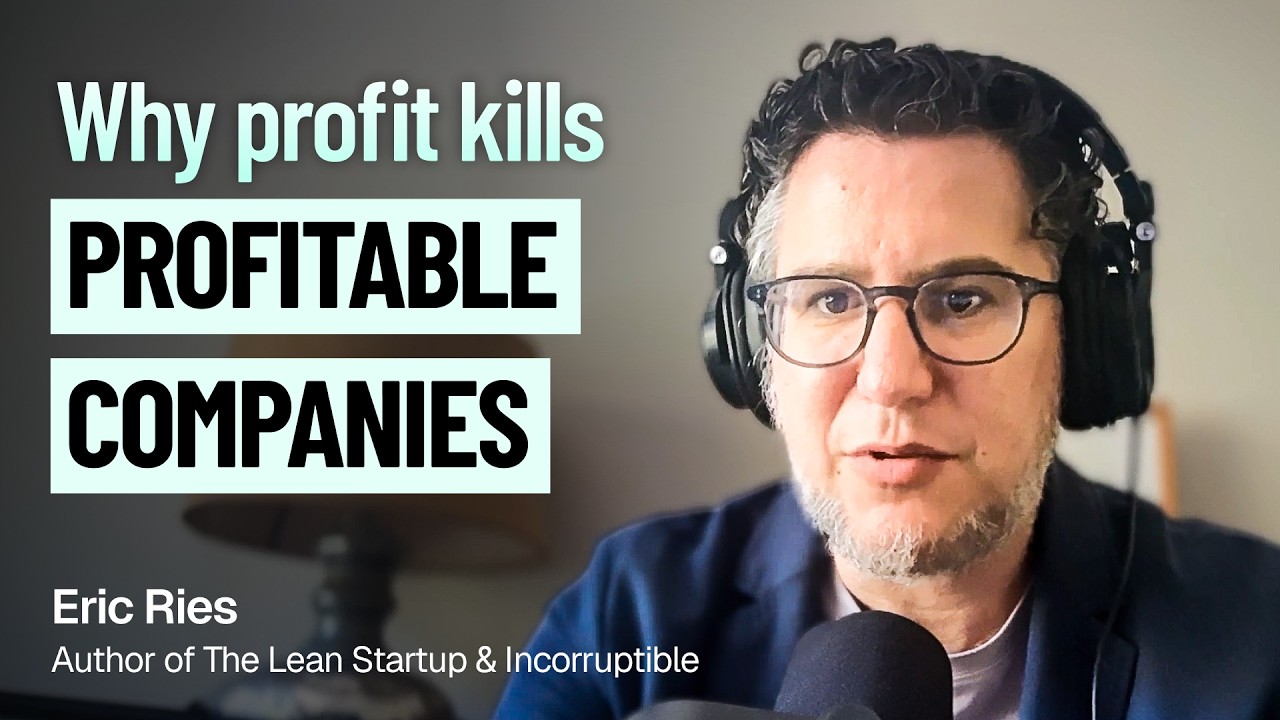
Eric Ries, author of The Lean Startup, explores why financially successful companies are often destroyed by the very investors who should benefit from their long-term value creation, and presents a blueprint for building “mission-controlled companies” that resist short-term financial pressure through governance structures, ethos, and integrity.
The Core Problem: Financial Gravity Destroys Value in the Name of Profit
A pervasive force Ries calls “financial gravity” pulls companies toward short-term cost-cutting and extraction, rewarding executives and investors for moves that destroy brand, quality, and long-term value while never holding them accountable for the consequences.
This is not inevitable or inherent to capitalism; it is a design choice embedded in modern governance norms, particularly shareholder primacy, which treats companies as vehicles for shareholder enrichment rather than purposeful institutions.
The result: companies with strong missions and loyal customers — food brands, retailers, healthcare firms — are routinely acquired and degraded by private equity or strategic buyers who extract near-term returns at the expense of durable value.
The FedMart and Costco Story: What Governance Can Prevent or Enable
Saul Price built FedMart on a fiduciary ethos: he posted competitors’ lower prices in his own stores, paid above-market wages, and prioritized customer trust over margin — and the company thrived for 20 years.
After taking the company public, investors pressured him to cut wages and raise prices; when he refused, the board fired him in 1975 by changing the locks on his office door.
Under conventional retail practices, FedMart was liquidated within seven years — a clear case of value destruction masquerading as profit-seeking.
Price rebounded by founding Price Club, which later merged with a protégé’s company to become Costco, now a $400 billion enterprise that still operates on Price’s original principles.
The difference was not culture or strategy alone: Costco was built with a “governance fortress” — structural provisions that prevent outside meddling and protect the mission from investor pressure.
Governance Fortresses and Mission Guardians: The Structural Defense
Most founders never read their governing documents; they unknowingly adopt default charters that enshrine shareholder primacy, legally obligating the board to sell to the highest bidder regardless of mission alignment.
Ries identifies “mission guardians” — structural entities or provisions that hold the company accountable to its purpose, including the power to appoint or remove directors — as the common feature of companies that defy financial gravity.
These companies are routinely rated as having “bad governance” by proxy advisors and ratings agencies, yet since 2008, “bad governance” companies have outperformed “good governance” ones.
The Vectura case illustrates the danger: a UK inhaler-therapy company was acquired by Philip Morris International (a cigarette maker) because the board felt legally compelled to accept the higher bid (165p vs. 155p), destroying a lung-health mission in three years.
Mission guardian structures are not new: Zeiss (1887), Patagonia, and Anthropic all use a two-entity model where an independent trust appoints directors to the for-profit board, insulating the mission from capital pressure.
Academic research shows companies with this structure live five times longer on average than conventionally governed peers.
The Two Dimensions of Incorruptibility: Ethos and Integrity
Ethos is a company’s character: the consistency with which it does the right thing, aligns profit with purpose, and embeds mission into every employee’s judgment — even when no manager is watching.
Requires a business model where money is made only by achieving the mission (a virtuous cycle of performance).
Requires culture built through relentless repetition: hiring, training, rewarding, and modeling the mission daily — “harder is easier” (Steve Jobs insisting on beautiful cable routing inside a sealed computer case).
Example: H-E-B store manager telling customers to take groceries for free during a power outage — not a rogue act, but a trained response rooted in seeing the customer as the person served.
Integrity is structural: the ability to make and keep promises that survive leadership changes, rooted in legal charter changes (e.g., public benefit corporation status) that reject shareholder primacy and enshrine mission guardians.
Corporate promises cannot rely on individual good intentions; they must be embedded in governance architecture.
The public benefit corporation form legally permits directors to consider stakeholders beyond shareholders, and mission guardians enforce accountability.
Historical Context: Shareholder Primacy Is a Recent Aberration
For centuries, corporate charters required a stated public purpose approved by legislatures; the idea that companies exist solely to enrich shareholders would have been considered a crime in 19th-century America.
The shift began in 1899 (New Jersey incorporation law) and solidified in the 1980s with the rise of shareholder primacy as academic and legal orthodoxy.
Reformers in multiple countries are now restoring the option for companies to declare a public purpose in their charters — a return to historical norm, not a radical innovation.
Ries frames the goal as “constitutional governance”: checks and balances, separation of powers, and mission-controlled architecture for institutional longevity.
Case Study: Anthropic’s Mission-Controlled Structure
Anthropic’s founders consulted Ries shortly after leaving OpenAI; they adopted a public benefit corporation charter with an AI safety mission and a Long-Term Benefit Trust (LTBT) — an independent trustee body that appoints a portion of the board.
This structure has already been tested under intense pressure (including from powerful external actors) and has held, enabling the company to defy demands that would compromise its safety mission.
The structure mirrors Patagonia’s and Zeiss’s: a for-profit entity governed in part by a mission guardian that cannot be captured by investors.
Rethinking The Lean Startup in the Age of AI
Fifteen years after The Lean Startup, founders ask if AI-accelerated building and measuring means faster entrepreneurship — but learning remains bottlenecked by human cognition (“wetware”).
AI agents can gather information, but validated learning requires the founder to understand the research, not just possess a report.
Ries now uses AI as an editorial and research partner: decomposing large projects into human-scale subtasks, brainstorming together, and retaining final judgment — “teach me how to make a product” rather than “make me a product.”
The build-measure-learn loop still turns at the speed of human insight; tools that accelerate validated learning (not just output) are the ones that matter.
Founders should be cautious about outsourcing learning and may be better served by familiar methods until AI tools genuinely close the comprehension gap.
Practical Advice for Founders: Quarterly Integrity Reviews
Building an incorruptible company is a training regimen, not a one-time act — like fitness, it requires consistent practice over time.
Ries recommends a quarterly (or bimonthly) review with co-founders, board, and executives asking:
Is our ethos intact? Survey employees: do they know the mission and values?
Are governance protections adequate for current threats? Are cracks forming?
What new threats are on the horizon? Look for “micro-fractures” — tiny inconsistencies that signal structural stress before collapse.
Seek outside partners who can help pressure-test these questions; the goal is to avoid becoming a case study in the “graveyard of good intentions.”
Ultimately, the public — as consumers, employees, investors, citizens — generates the financial gravity; learning to wield that power for mission-aligned outcomes is the highest-leverage intervention.