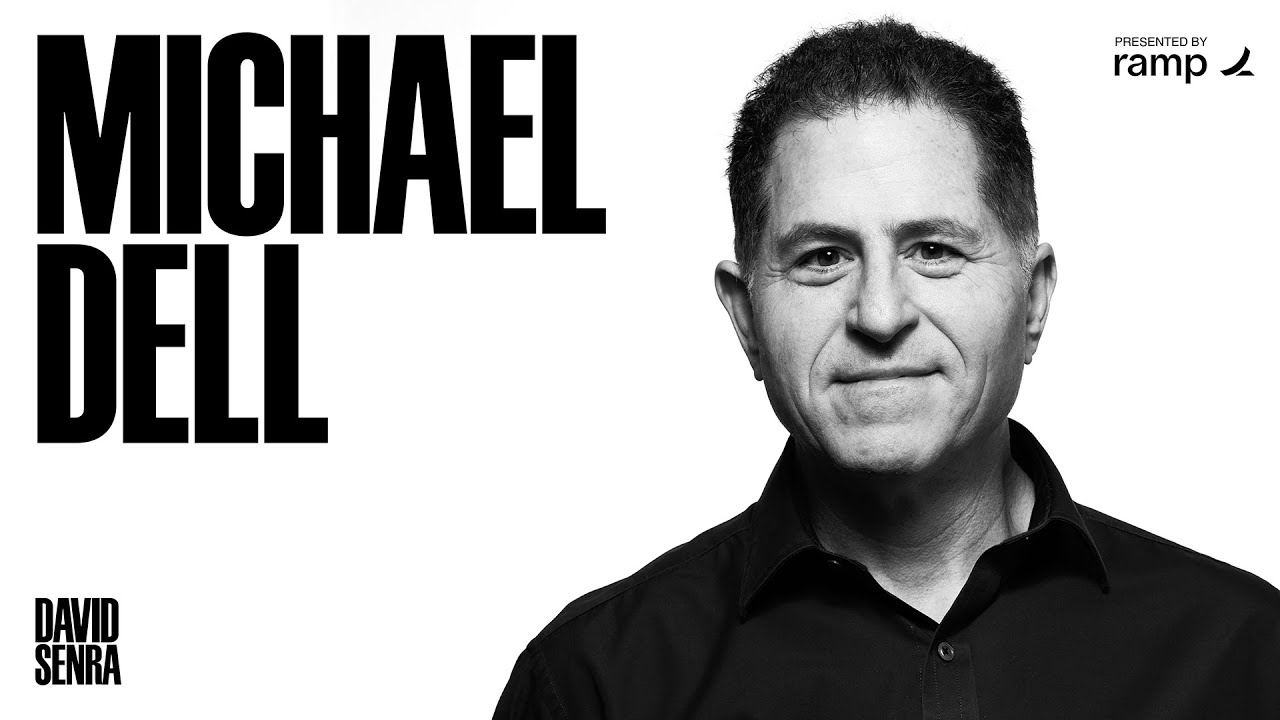
Michael Dell, founder and CEO of Dell Technologies, reflects on 41 years building the company — from a dorm-room startup to a global enterprise — driven by a lifelong obsession with understanding how things work, solving puzzles, and continuously reinventing the business across multiple technology waves.
Early Obsession and the Roots of Curiosity
At age 11 or 12, Dell rode the bus to downtown Houston, discovered the stock exchange tickers, and became fascinated with financial markets — an interest nurtured by parents who discussed markets at home.
He saved up for an Apple II at age 12, brought it home, and immediately took it apart to understand its components and logic — frustrating his parents but satisfying a compulsive need to “peel the onion” of any technology.
When the IBM PC launched, he took it apart before turning it on, realized none of the chips, drives, or power supplies were made by IBM, and began pricing each component at distributor rates — discovering IBM’s massive markup and realizing he could assemble the same machine for far less.
This early cost analysis mirrored Elon Musk’s later “first principles” approach to rockets: break a product into its constituent parts, price the raw materials, and question the incumbent’s pricing power.
Dell read biographies of entrepreneurs like Sam Walton, Fred Smith, and Charles Schwab in the 1970s, absorbing their stories in Houston’s boom-town atmosphere — he never imagined doing anything other than starting a business.
The Dorm Room Startup and Parental Confrontation
At 19, Dell told his father he wanted to compete with IBM — a mix of naivete (not knowing why it wouldn’t work) and confidence (believing he could figure it out), with a persistent undercurrent of fear that kept him from arrogance.
His parents, expecting a pre-med path, confronted him tearfully; he “caved” and stopped working on computers for 10 days, but the compulsion returned — he realized this was not a hobby but a calling.
He dropped out of UT Austin with $1,000, slept in the office, and worked “all of them” hours — total, all-consuming immersion driven by curiosity and the puzzle of building a business.
The Negative Cash Conversion Cycle: A Structural Advantage
With no capital, Dell stumbled into a revolutionary model: collect payment from customers before paying suppliers, while keeping inventory near zero — generating cash as the company grew rather than consuming it.
Competitors like Compaq had 90-day supply chains (distributors, dealers, warehouses); Dell compressed this to five days by selling direct — dated chips inside competitor machines proved the inventory age gap.
Three compounding advantages emerged: lower component costs (prices fell predictably over 90 days), fresher technology (latest chips, not 90-day-old inventory), and a real-time customer feedback loop that informed product decisions.
Competitors dismissed or misunderstood the model — Compaq’s CEO called Dell a “mail-order company” or “garage operation” — and their inability to see the threat became Dell’s multiplier.
Supply Chain Mastery and the “Dad Terminal”
Dell’s first Asia trip in 1985 (Japan, Hong Kong, Taiwan, South Korea) began a decades-deep dive into supply chain mechanics — he views it as a critical puzzle where mistakes were made, lessons learned, and advantages stacked.
His son Zach calls him “Dad Terminal” (like a Bloomberg Terminal): a subscription to 41 years of supply chain, operations, and strategic pattern recognition — Zach queries him on problems and gets “advanced answers” from lived experience.
Dell emphasizes: if they hadn’t mastered supply chain, the company wouldn’t exist — it’s foundational, not peripheral.
Learning from History: Carnegie, Walton, and the Cost Obsession
Andrew Carnegie’s autobiography taught Dell: invest in new technology even if it only neutralizes competitors — the savings compound, and the alternative is obsolescence. Carnegie ripped out old machines the moment better ones appeared; rivals who didn’t went bankrupt.
Ken Griffin recommended “Hardball” — its core lesson: examine costs in detail or risk hidden profit leaks; drive costs down faster than competitors and use savings to upset their strategies.
Dell’s operating costs were 18% of revenue vs. Compaq’s 36% — a structural advantage that let Dell win on price, speed, and freshness while competitors bled margin.
Sam Zemurray (the “Banana King”) started at 19 with no money, bought “ripes” (bananas about to spoil) for near-zero, used railroads to sell them at every stop — a small creative wedge that scaled into an empire. Dell sees the same pattern: necessity forces creativity, which stacks into advantage.
The Mail-Order Stigma and the Internet Pivot
For years, press labeled Dell a “mail-order company” as a pejorative — even after 30,000 patents and global scale. Dell ignored the label and kept executing; the internet eventually made the stigma obsolete.
Dell launched one of the first commercial websites (dell.com on every page of his 1998 book), experimented with CD-ROM catalogs before the web, and sold a $50,000 server online — shocking observers who couldn’t imagine large purchases without a salesperson.
The direct model, once a stigma, became rocket fuel when the web made it infinitely scalable — Dell had already built the plumbing; the internet just removed the friction.
Navigating Six to Seven Technology Waves
Dell has reinvented the company through roughly six to seven major shifts: microprocessor PCs, client-server, internet/e-commerce, mobile, cloud, and now AI — each wave arriving faster than the last because each builds on the prior infrastructure (5B connected devices now vs. early web’s niche audience).
Timeframes shrink: the internet took a decade to hit e-commerce escape velocity; AI adoption moves 5–10x faster because the distribution layer already exists.
Dell’s mental model: hold the possibility that any wild idea might succeed; don’t dismiss based on current paradigms. Experts are often wrong — 99 of 100 top AI researchers five years ago would have bet against LLM progress.
Henry Ford’s warning: “If I want to sabotage my competition, I fill their ranks with experts” — experts know too much to question assumptions.
The AI Inflection: “Become the Competitor That Will Kill You”
When ChatGPT launched (Nov 2022), Dell plotted the LLM improvement curve: agents, multi-agent systems, reasoning over massive data — and realized every core business process (support, sales, software dev, supply chain) would be dramatically transformed.
He told the company: “Five years from now, a new competitor will exist in every business we’re in — faster, more efficient, more capable. They’ll put us out of business unless we become that company.”
Example: “Next Best Action” in support — ingests telemetry, warranty data, call logs, knowledge bases, Jira tickets (millions of documents no human could synthesize) to guide agents to the optimal resolution in fewest steps. Result: faster resolution, happier customers, summarized calls, empowered agents.
Same pattern applied to coding assistants, sales tools, supply chain optimization — and Dell sells the compute, storage, and networking that powers it all for customers.
The technology isn’t the hard part; the hard part is organizing people, motivating change, and overcoming institutional inertia — “if you don’t have a crisis, make one.”
Influences, Storytelling, and Institutional Memory
Dell wrote his book during COVID to capture the story for employees — as companies scale, oral tradition breaks; a book (or internal podcast like Spotify’s “A Product Story”) preserves context, decisions, constraints, and culture for new hires.
Public storytelling also drives business: humans buy stories. James Dyson attached a 200-word origin story to every vacuum; sales rose because customers connected to the person and the “why.”
Dell studies entrepreneurs across eras — Carnegie, Ford, Walton, Jobs, Gates, Schwab, Smith — not to copy but to understand patterns of struggle, creativity, and reinvention.
He learns from failures too: Adam Osborne pre-announced Osborne 2 before shipping, killing demand for Osborne 1 (the “Osborne Effect”) — a cautionary tale about timing and messaging.
Self-Sabotage, Fear, and the Entrepreneurial Mindset
Most founders Dell has known weren’t killed by competitors — they sabotaged themselves: overexpansion, design errors, failure to read the landscape, or the classic trio (per Munger): “ladies, liquor, and leverage.”
Dell’s antidote: deep understanding + rapid iteration. Make mistakes small, fix them fast, experiment toward the answer — no playbook exists for new models.
Fear of failure remains his primary motivator — not paralyzing, but sharpening. “Pain is the best teacher.” He runs incremental experiments, never betting the company on a single decision.
Naivete + confidence + fear = the entrepreneurial sweet spot: naive enough to start, confident enough to persist, fearful enough to stay rigorous.
Energy Management and the Infinite Game
Daniel Ek (Spotify) taught Dell: “I’m not obsessed about time. I’m obsessed about energy management. If you have time but no energy, you accomplish nothing.”
Dell’s energy comes from the work itself — it’s an infinite game, a puzzle that never ends. He doesn’t work for money or status; he works because the curiosity is bottomless.
Lee Walker (hired at 21, Dell was 21, Walker 45) brought capital relationships, operational discipline, and scaling expertise — filling the gaps Dell didn’t care about (finance, HR, legal) so Dell could focus on product and customers.
Relationships run the world: Walker’s banker connections unlocked receivables financing against blue-chip POs (Texaco, etc.) when Dell had $200K in the bank on $60M revenue.
Final Reflection: The Founder as Guardian of the Soul
Sidney Harman: “The founder is the guardian of the company’s soul” — the creation cannot be separated from the creator.
Dell built a business natural to him: deep curiosity, cost obsession, direct customer intimacy, supply chain as competitive weapon, reinvention as survival.
To outsiders, the 41-year sprint looks superhuman; to Dell, it’s just “wake up every day and go do the thing” — the abnormality is invisible from the inside.